Texas Homeowner Builds a Chicken Shed Entirely on Her Own Property — Then the Neighbor Gives Her 36 Hours to Move It Twenty Feet So She Can “Regain Her View”
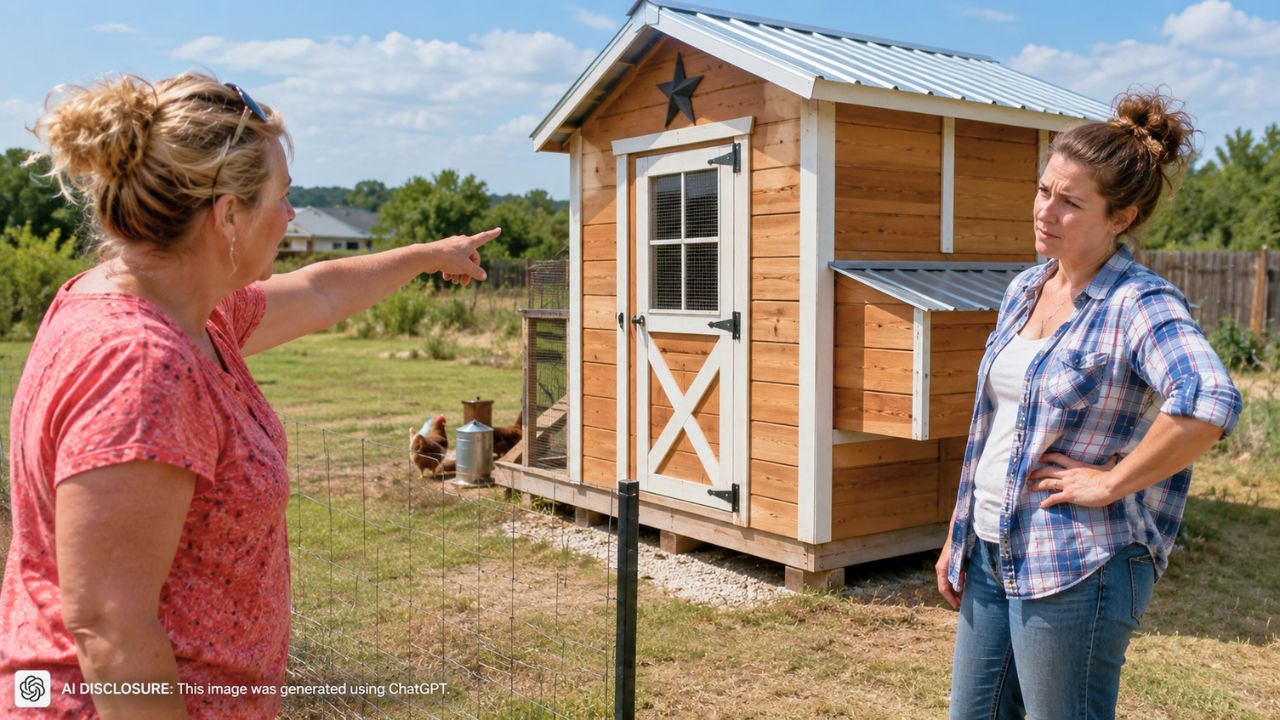
Photo credit: AI-generated image created using ChatGPT. Illustrative only.
The shed was supposed to be the easy part. A Texas couple found a 7x7x8 structure being given away with one catch—“if you can move it you can have it”—and they did the hard work the budget-friendly way: hauling the disassembled pieces home, storing them in the garage, and spending a few days putting it back together on their own land.
Then a neighbor showed up furious, demanding changes on a deadline that sounded more like a hostage note than a normal fence-line conversation. In the source post, the homeowner describes the neighbor “screaming” and insisting the shed be moved—quickly—so she could get her view back.
A free shed turns into a heavy, real-world problem
The building wasn’t some tiny box you drag around the yard. The homeowner estimated it at around 1,200 pounds, built from plywood and 2x4s, and already assembled in place. Moving it “even a few feet” would take several people and the right tools—none of which they could line up within the neighbor’s timeline.
And it wasn’t just the weight. This wasn’t a case where the shed was sitting on a pallet ready to slide. It was set up, positioned, and mentally “done,” the kind of weekend project you want to stop thinking about once the last panel goes on.
The reason for the shed was simple: chickens on a budget. It was meant to be a coop setup, a step toward a small homestead life in a subdivision with half-acre lots.
The neighbor’s list came with a countdown
According to the homeowner, the neighbor demanded multiple changes within 36 hours, or she would contact local government entities to force removal.
Her requirements weren’t subtle. First, she said the shed had to be at least five feet away from her fence. Second, she insisted it be moved about 20 feet farther down the fence line so she could “regain the view she had before.”
Then came the roof complaint. The neighbor wanted the roof “angled” so it wouldn’t pour water onto her fence or send runoff into her yard—along with an oddly specific concern that water in her yard would make her dogs messy.
It’s the kind of escalation homeowners recognize instantly: a project you thought was contained to your own property suddenly becomes a neighbor’s full-blown emergency.
Rules, deed restrictions, and selective enforcement anxiety
The neighbor didn’t just complain—she cited laws. She told them local rules required structures to be at least five feet from the property line and claimed it was illegal to raise chickens where they lived. That’s when the homeowner went digging after the fact and found deed restrictions (CCR) created in 1997 that included a clear line: “No animals or fowl shall be raised, bred or kept on any Lot other than common household pets.”
But the neighborhood reality didn’t match the paper. The homeowner said they knew of “at least a dozen houses” in their subdivision that already had chickens, plus other violations that had been ignored for years. That history made the demand feel less like a community standard and more like one neighbor deciding she’d had enough—of this particular shed, in this particular spot.
To make it even messier, the homeowner believed the complaining neighbor had violations of her own: chain link fences (apparently not allowed), a broken car in the driveway for over a year, property line maintenance issues, and even a shed within five feet of the homeowner’s property line.
That’s where these fights get personal fast. Once both sides start counting violations, it stops being about a shed and turns into a cold war of who can get whom in trouble first.
Permits, setbacks, and the fear of a knock on the door
The homeowner admitted they didn’t get a building permit and said they’d never heard of needing one for a chicken coop. That’s a common assumption—small backyard structures often feel “temporary” until a neighbor forces the question.
They also weren’t sure whether the five-foot rule was real for their area, noting they lived in the Georgetown Extra-Territorial Jurisdiction (ETJ). In places like that, the layers can stack up: county rules, city influence, and subdivision deed restrictions all swirling together. Homeowners don’t always realize what applies until someone threatens to call it in.
The practical fear wasn’t just fines or an argument. It was logistics. If an inspector decided the shed had to go, would they have days? Weeks? Would they be required to dismantle it and start over, after already investing sweat and time?
The homeowner’s questions showed how quickly “a neighbor is mad” turns into “what’s the process if code enforcement gets involved?” They asked whether they’d get any grace period—something like 30 days—to remove or relocate the structure if it came to that.
What other homeowners focused on: proof, boundaries, and paperwork
The post itself reads like the moment where frustration turns into documentation. The homeowner had already started comparing restrictions and pointing out inconsistencies, including what they saw as the neighbor’s own rule-breaking.
When people read stories like this, the most practical instinct is usually the same: stop arguing in the yard and start getting facts you can stand on. That typically means confirming property lines, measuring the real distance to fences, and figuring out what rules apply in an ETJ versus what’s merely written in old deed language.
The homeowner also mentioned a neighbor behind them brought up the idea of getting a “variance” to have chickens—an exemption of some kind. Even that detail shows how fast backyard animals can shift from a lifestyle choice to a permissions problem, where one person’s coop becomes another person’s leverage.
And underneath it all sits the unspoken worry: once a complaint is made, you might not be dealing with the neighbor anymore. You’re dealing with a system that moves on its own schedule.
A shed can be moved, but the neighbor line doesn’t
What makes this kind of property dispute so exhausting is that there’s no clean reset. Even if the homeowner drags the shed 20 feet and reshapes the roofline, the relationship across the fence is still changed. The next rain becomes a runoff investigation. The next chicken noise becomes an “illegal animals” accusation.
For the homeowner, the shed wasn’t just lumber and screws. It was their low-cost path to raising chickens like many others nearby. For the neighbor, it was a blocked view and a new object close enough to feel like an intrusion.
And for anyone watching from their own backyard, it’s a familiar lesson: the hardest part of building on your property isn’t always the build. Sometimes it’s the moment someone else decides your project is their problem—on a 36-hour deadline.
Like Fix It Homestead’s content? Be sure to follow us.