Homeowners Learn Both Their Garages Sit on the Neighbor’s Lot Where No Survey Pins Were Set — Then the Court Denies Ownership but Lets Them Stay
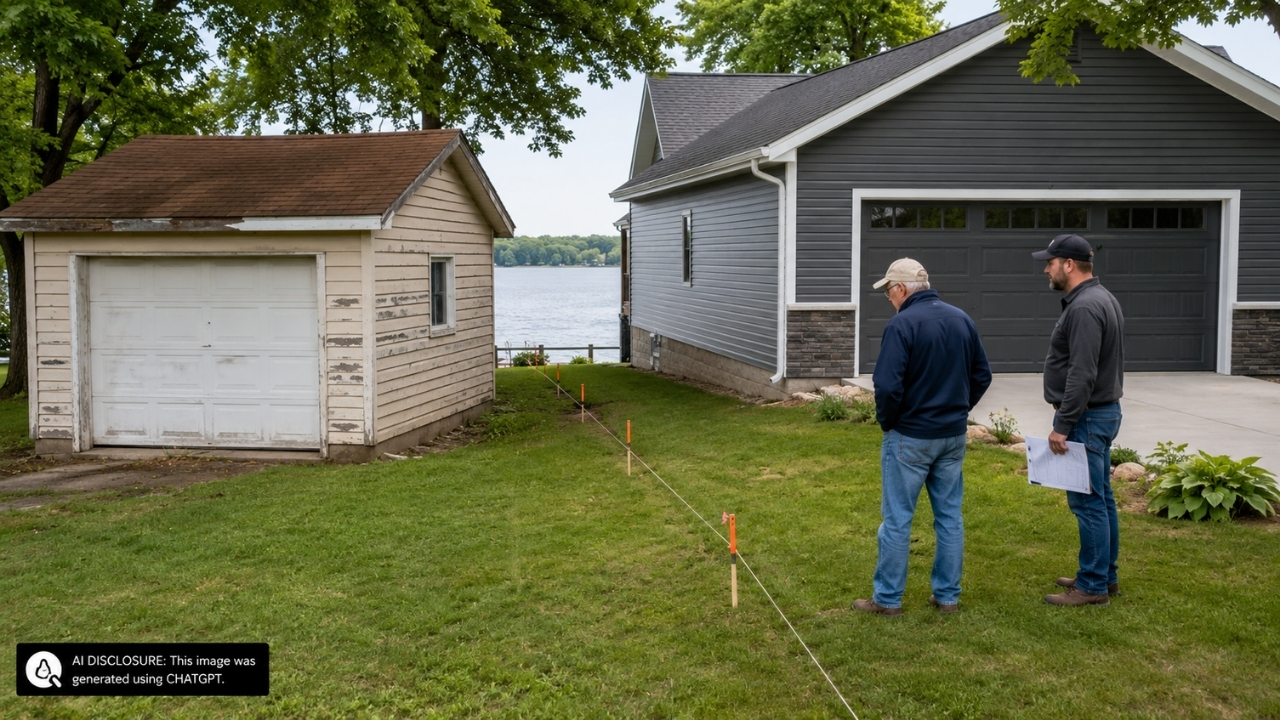
Photo credit: AI-generated image created using ChatGPT. Illustrative only.
It starts the way a lot of property-line problems start: two neighboring lake lots that “feel” obvious on the ground, until someone finally pays for a survey and the map says otherwise. On Pickerel Lake in South Dakota, that surprise turned into a full-blown neighbor fight when homeowners learned that two garages didn’t just sit close to the line—they actually crossed it.
The court fight that followed, laid out in the source post, ended with a split decision that feels familiar to anyone who’s ever tried to untangle decades of DIY improvements and “we’ve always done it this way” assumptions. The homeowners who wanted the land didn’t get it. But the garages that were already over the line? Those got to stay.
A 1920s plat, no pins, and decades of “close enough”
The Ramona Beach subdivision dates back to 1925, with lakefront lots platted at 50 feet wide. The problem was that no survey pins were originally set, so the boundary everyone pictured wasn’t anchored by anything you could point at and say, “That’s the corner.”
By the late 1940s, the ground truth had started drifting from the paper truth. A prior owner on what later became Andrew and Jennifer Hemmah’s property built a driveway and a large rock retaining wall. Around the same time, a cabin on what later became Thomas and Marsha Luzier’s property was converted into a small garage.
That small garage, built in 1948, turned out to extend across the legal boundary. And it wouldn’t be the last time the line got treated more like a suggestion than a limit.
Two garages, two eras, same problem
The second encroachment arrived in 1997, when the Luziers’ predecessors built a much larger garage farther back on the lot. That one also crossed over onto the neighbors’ land.
This is where these disputes get expensive, because a garage isn’t a flowerbed you can move on a Saturday. It’s concrete, framing, rooflines, electrical, maybe a slab. It’s also where people store cars, tools, freezers, and all the stuff you don’t want exposed to a South Dakota winter.
The Luziers bought their property in 2005, living with these structures as part of the normal layout. In 2015, the Hemmahs bought the adjoining lots—but first they commissioned a 2014 survey. That survey flagged both garage encroachments: the older small garage crossed onto one lot, and the newer big garage crossed onto another.
According to the court record, the Hemmahs didn’t tell the Luziers about that survey. For a while, it didn’t matter. The families were friendly, their kids and grandkids spent time together, and the boundary stayed mostly theoretical.
The fight didn’t start over the old garages—it started over the next one
Things broke down in 2024, when the Hemmahs sought a variance to build another garage near the Luziers’ large garage. Suddenly, the “future plans” problem landed on top of the “existing encroachment” problem.
The proposed construction included demolishing a retaining wall extending from the Luzier garage. Once the Luziers learned what was being planned and got a copy of the older survey, they went to court.
At that point, the dispute expanded fast. Instead of only fighting to protect the footprint of the existing garages, the Luziers claimed they owned a much larger strip of the Hemmahs’ land through adverse possession. Their proposed boundary wasn’t a straight surveyed line—it followed what they described as a “use of land line,” tying together buried earth anchors, retaining walls, an old driveway rock wall, an oak tree area, and then down toward the lake.
The Hemmahs pushed back and counterclaimed for trespass and to quiet title. While the case was pending, the judge essentially hit pause on the property: a temporary string fence had to come down, the Luziers could mow a narrow strip near the surveyed line, and neither side could do construction or other work that would change the disputed area.
The court wasn’t buying an “imaginary” boundary for the whole strip
After a two-day trial, the judge rejected the Luziers’ attempt to take ownership of the larger strip. The South Dakota Supreme Court agreed: the recorded deeds and plats still controlled, because the Luziers didn’t prove their competing claim by clear and convincing evidence.
One of the biggest issues was the lack of a recognizable boundary. Under South Dakota law, adverse possession generally needs disputed land to be substantially enclosed or regularly cultivated or improved. Here, the proposed “use” line was more like a connect-the-dots of features—some buried, some partial, some not continuous.
A driveway rock wall covered a portion, but there wasn’t a fence line, a clean tree line, or a continuous physical marker that told any reasonable person, “This is where one yard ends and the other begins.” The court also noted that Thomas Luzier acknowledged there was no physical line between the lots showing the boundary he claimed.
The Luziers also argued they and prior owners had mowed, maintained, and landscaped enough of the strip to earn it. But witnesses disagreed about who did what over the years, and with the high burden of proof, uncertainty sank the claim.
But the garages themselves had been there long enough to earn a “stay put” right
Where the Luziers lost the bigger land grab, they won something narrower—and very practical. The small garage had openly crossed the line since 1948. The large garage had openly crossed since 1997. That’s far beyond South Dakota’s 20-year prescriptive period.
The court treated those long-standing footprints differently than the larger yard area. Even though the Luziers didn’t get ownership of the neighbors’ land, they did get prescriptive easements for the pieces of land physically occupied by the garages. In plain homeowner terms: they don’t own that slice of the yard, but they have a legal right for those existing structures to remain where they are.
The easements weren’t unlimited. They cover the garage footprints plus only the immediately adjacent area reasonably necessary to maintain and operate them. The court also refused to grant a broader buffer around the large garage based on an imprecise estimate of where underground earth anchors might extend. And when the Luziers later asked for an additional five-foot easement to improve access toward the lake, the court said they waited too long to raise it, so the issue was waived.
So the line on paper stays the line. The Hemmahs keep record ownership of the disputed strip. But the garages stay, locked in place by time, not by a deed.
Homeowners’ takeaway: the “friendly neighbor” phase can end overnight
Reading between the lines, this is the kind of dispute that sits dormant until someone wants to build, sell, or tear something out. The neighbors were friendly for years, and the layout worked—until a new garage plan put retaining walls, access, and property rights under a spotlight.
It’s also a reminder of how a missing piece of information can turn into a bigger blowup later. The Hemmahs had a survey showing the encroachments before they bought, and the Luziers didn’t learn about it until construction plans surfaced. Once that happens, every mowed strip and landscaping choice starts getting treated like evidence.
The ending is awkward in the way real life is awkward. The Hemmahs still own the ground under parts of two garages they don’t control, and the Luziers have legal rights to keep structures sitting on someone else’s land—but only within tight limits. Nobody got the clean fix. They just got a ruling that freezes decades of “close enough” into a permanent, live-with-it arrangement.
Like Fix It Homestead’s content? Be sure to follow us.