New Minnesota Landowner’s Survey Confirms the Neighbor’s Garage Extends Onto Her Property — Then She Learns the State’s Fifteen-Year Adverse Possession Law Puts the Land at Risk
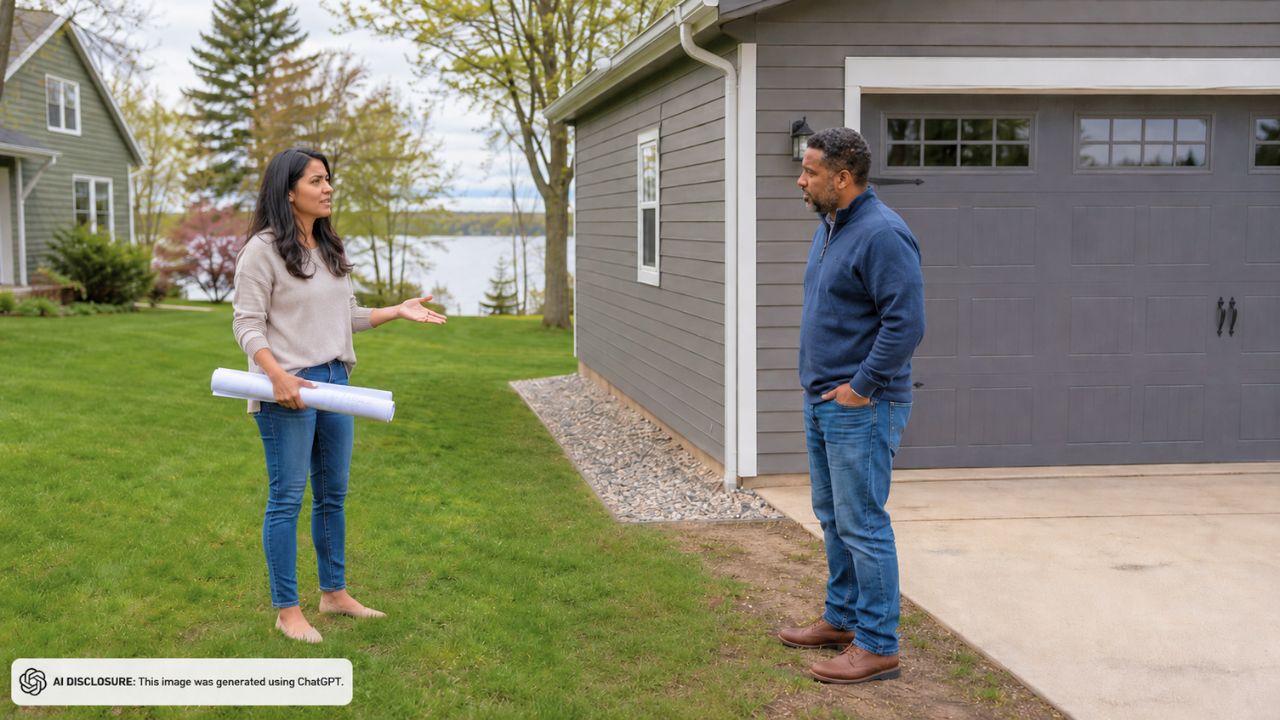
Photo credit: AI-generated image created using ChatGPT. Illustrative only.
Buying land is supposed to feel like a clean slate. For one new Minnesota landowner, it started that way—until an official survey turned up an awkward surprise: the neighbor’s garage wasn’t fully on the neighbor’s side of the line.
In the original post, the new owner explained that the garage extends a few feet onto her property, and the neighbor also uses about another 10 feet of her land to store a trailer. None of it “bothers” her in the day-to-day sense, she said. What bothers her is the clock she can’t un-hear ticking: Minnesota’s 15-year adverse possession law.
The survey made it real, even if the garage looked “normal”
Property lines are invisible until they aren’t. Fences drift. Sheds “just fit better” where someone placed them years ago. Garages are big, expensive, and usually assumed to be permanent—so most people don’t walk around them imagining a boundary dispute.
But this wasn’t a hunch or a vague feeling. The homeowner said she has an official survey showing the encroachment. Once you have that in black and white, it’s hard to go back to the comfortable idea that it’s all fine because everyone gets along.
And the garage isn’t the only thing crossing over. The neighbor’s use of additional space—about 10 feet for storing a trailer—adds a second layer: not just a structure over the line, but ongoing use of the land like it’s theirs.
It wasn’t about being bothered—it was about losing ground later
The homeowner’s tone was almost painfully relatable: she’s not looking to pick a fight. She basically said, “This doesn’t bother me, but I don’t want it claimed later.” That’s a very homeowner kind of fear—being easygoing today and punished for it years from now.
Adverse possession laws are the stuff of neighbor folklore until you’re staring at a survey that says part of your yard is effectively being treated as someone else’s. The homeowner knew Minnesota has a 15-year threshold and didn’t want to wake up years down the line and find out her friendliness accidentally helped someone else’s claim.
That’s the emotional trap with encroachments: if you act immediately, you feel like the bad guy. If you wait, you risk losing leverage—or at least making the mess harder to unwind.
The balancing act: protect the line without lighting a fuse
Her initial plan was simple and human. Before bringing it up, she wanted to build a good relationship with the neighbor “for obvious reasons.” Anyone who’s lived next to someone for more than a season understands those reasons without them being spelled out.
A garage that crosses a property line isn’t like a loud party you can complain about once and move on. It’s a permanent object tied to day-to-day peace: snow removal patterns, where cars pull in, where water runs, how someone stores their stuff, and how close people feel they can stand to each other without it being weird.
The homeowner asked if there was a way to “cement” her ownership without coming off like a jerk. That one word—cement—hits hard here, because the object at the center of the issue is literally a cement-and-framing kind of problem. Once something is built, everyone starts treating it like it’s always been that way and always will be.
What people pushed: paperwork first, feelings second
Even with limited details shared, the reaction pattern was predictable: people urged her to treat it like a documentation and legal-risk issue, not a personality test. When adverse possession is on the table, the advice almost always turns to written agreements and formal steps, because casual conversations don’t hold up well when memories change.
Commenters typically zero in on the same practical question the homeowner was already circling: how do you give permission—or deny it—in a way that can’t later be twisted into “they never objected”? The idea is to make it clear that the land is not being taken “hostilely” or by default, even if the day-to-day use continues.
There’s also an unspoken reality behind a lot of the practical reactions: once you alert a neighbor that a portion of their garage sits on your land, you can’t un-ring that bell. Some neighbors react reasonably. Others hear only “I might make you move your garage,” even if you never say those words.
Why a few feet can turn into a major homeownership problem
This kind of encroachment doesn’t stay theoretical for long. It can show up when you try to put up a fence, add a driveway, plant trees, install a shed, or even bring in heavy equipment. Suddenly that strip of land isn’t just “not a big deal,” it’s the exact place you need to access.
It also has a way of popping up at the worst times—when you refinance, sell, or apply for permits. Surveys and title work don’t care that everybody’s been friendly. They care what’s on paper, what’s been used, and what might turn into a claim.
And garages aren’t small fixes. If it ever came to moving, modifying, or formally addressing the structure, you’re not talking about a weekend project. You’re talking about big costs, contractors, and possibly a timeline that drags on through seasons. Even if no one wants a fight, the logistics alone can create one.
She brought in a lawyer—because this isn’t a handshake problem
After reading responses, the homeowner posted an update: she consulted a lawyer to review options. That’s often where these stories land when the stakes include a long-term property-rights risk and a permanent structure.
A lawyer doesn’t automatically mean escalation. Sometimes it’s the opposite: a way to find the cleanest, least-inflammatory path to protect ownership while keeping the neighbor relationship intact. But it does signal that the homeowner understands something important—this is bigger than “being nice.”
For now, the garage is still there, the trailer is still being stored, and the homeowner is trying to do what a lot of people struggle to do: handle a boundary problem early enough to prevent future loss, but carefully enough to keep today’s peace. In rural and suburban life alike, that’s often the hardest line to walk—especially when the line is literally drawn in the wrong place.
Like Fix It Homestead’s content? Be sure to follow us.