Landowner Asks His Brother to Move the Gate Blocking the Deeded Right-of-Way — Then a Judge Calls the Lock a ‘Minimal Inconvenience’ and Dismisses
Photo credit: AI-generated image created using ChatGPT. Illustrative only
The driveway was supposed to be the one thing nobody in the family had to fight about. A right-of-way had been written into the deeds years earlier so the parcels could function like normal rural property—get in, get out, haul supplies, call for help if you need it.
Then somebody put a locked gate across that road on somebody else’s land. And when the brothers couldn’t get it resolved like a family issue, it turned into a court fight that climbed all the way to the Mississippi Court of Appeals. The full back-and-forth is laid out in the court’s opinion, and it reads like the kind of “shared driveway” drama every rural homeowner dreads.
A right-of-way meant nobody would be landlocked
The property started with Joseph Failla in Pearl River County, Mississippi. Over time, he divided it among his sons, including David, Andrew, and Anthony. To avoid the classic problem—somebody gets a back parcel and suddenly can’t legally reach it—Joseph created an express, nonexclusive right-of-way easement across the family land.
Later, the easement language got even clearer. The clarification said descendants who owned adjoining property had “unlimited use and access” to the right-of-way in perpetuity. In plain-life terms, the road was supposed to stay a road, not a bargaining chip.
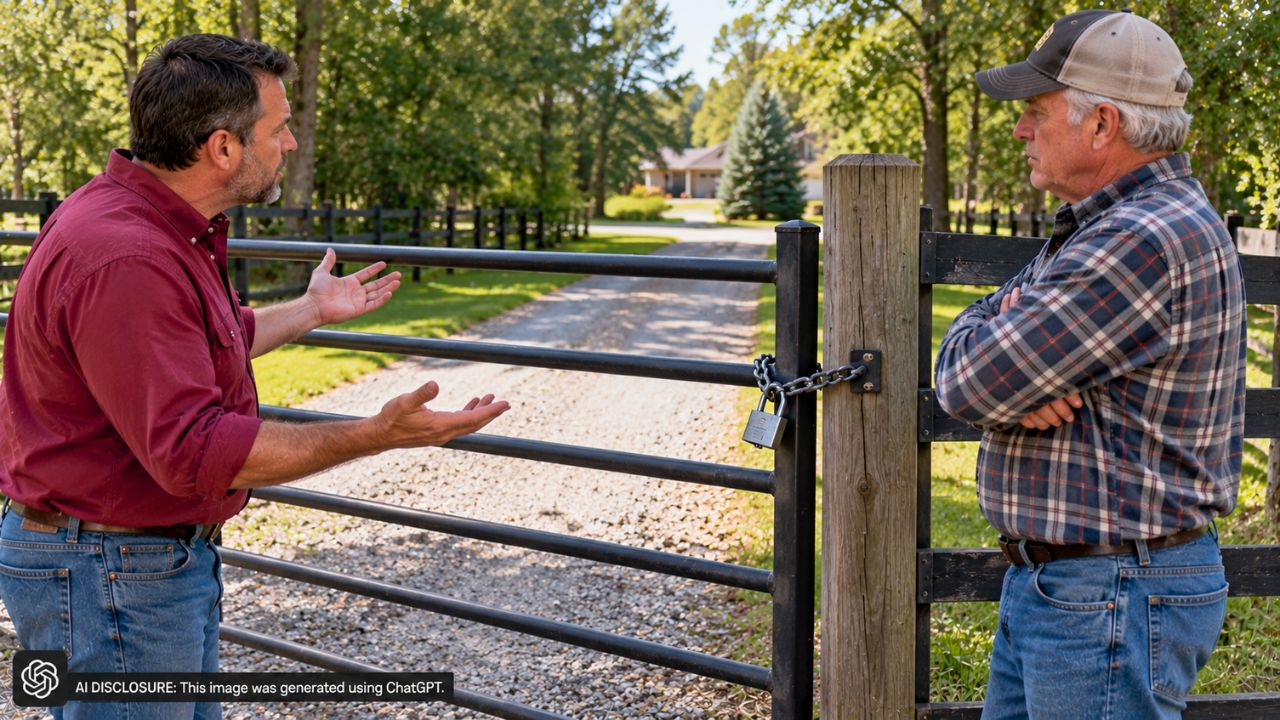
That’s why the next part stung: around 2016, David put a gate across the right-of-way on land owned by Andrew and Anthony. Not on his own fence line. Not on the edge of his own yard. Across the easement route running over his brothers’ property.
The gate turned “access” into permission
Andrew asked David to remove the gate. David refused. If you’ve ever been in a rural access dispute, you know what happens next: people stop talking, then they start moving things.
Anthony eventually removed the gate himself. David put it back. Years passed with the same argument resetting again and again—gate goes up, gate comes down, feelings get worse.
Andrew and Anthony testified that they did not have keys to the gate. Anthony said there were times he had to take the gate off its hinges just to get into his own property. That’s not “I had to slow down and hop out,” that’s “I had to physically dismantle a barrier to reach my land.”
David’s version looked different. He testified that their father had originally asked him to install a gate near Highway 43 when the road was constructed in the 1990s, and that family members had been given keys. He also said he moved the gate farther from the highway because his daughter had trouble with passing motorists honking while she stopped to unlock it, and later moved it again to leave room for vehicles to turn around.
In other words, David framed the gate like a long-standing, practical feature. Andrew and Anthony experienced it like a lock on their freedom to use property they owned.
Security fears were real—but so was the obstruction
This wasn’t a cartoon villain story where somebody just wanted to be difficult. David and Cindy testified to genuine safety concerns. David described an incident involving his daughter and sexual predators that made him anxious about who could access the property.
Cindy testified that without the gate she didn’t feel safe caring for her 84-year-old mother and a two-year-old granddaughter when David was away. She described strangers entering the property, people using the driveway as a bathroom, and multiple vehicle-related issues involving outsiders.
Anybody who has lived off a highway or down a tempting “looks like a public road” lane recognizes that dread. Once random traffic starts treating your driveway like a cut-through, it doesn’t just feel intrusive—it can become dangerous.
But the facts on the ground kept escalating past a simple locked gate. By 2023, Andrew posted another demand letter at the gate. Anthony removed the gate again and took it to his house.
David responded by parking his car across the easement, which forced Andrew to call the sheriff. The next day, David put a chain across the right-of-way instead. At that point, this wasn’t just about a gate existing—it was about active, physical blockage of a deeded access route.
A judge called the lock a small hassle—until the appeal court stepped in
The trial judge sided with David and Cindy. The chancellor concluded that a locked gate was only a “minimal inconvenience” as long as every easement holder received a key or passcode. Under that view, the gate could stay.
Andrew and Anthony appealed, and the Mississippi Court of Appeals reversed. The appellate court focused on the deed language creating the easement, calling it unambiguous: it granted a nonexclusive perpetual right-of-way, later clarified as “unlimited use and access” in perpetuity.
The appeals court’s core point was blunt: the easement gave a right to pass for access—entering and exiting the properties—not a right to control the road. Security, privacy, and peace of mind might be understandable motivations, but they weren’t written into the easement as reasons to put a locked barrier across land owned by someone else.
The court also emphasized the basic boundary that many families forget: having an easement doesn’t mean you own the ground underneath it. David and Cindy were dominant estate holders in the sense that they held rights to use the easement, but that didn’t give them the right to impose conditions that significantly burdened Andrew and Anthony’s property and their ability to use the road.
And the “minimal inconvenience” idea didn’t survive the real-world testimony—no keys, forced gate removal from hinges, a car parked across the route, then a chain across it. The appeals court said the trial court’s “minimal inconvenience” finding was manifest error.
The fix wasn’t “work it out”—it was an injunction
Sometimes appellate courts send a case back with vague guidance. This one didn’t. The Court of Appeals reversed and remanded with instructions to grant Andrew’s requested prohibitive injunction.
That matters in homeowner terms because an injunction is the court saying: stop doing this, not just “we disagree.” The order on remand is meant to prohibit David and Cindy from placing the gate or similar obstruction across the easement in violation of the brothers’ rights.
There was also a sanctions angle. A temporary order had previously prohibited reinstalling the gate, and Andrew accused David and Cindy of violating that by putting a chain across the easement. The appeals court didn’t impose sanctions itself, but it sent the issue back for further proceedings on possible sanctions.
The result: Andrew and Anthony won the appeal, but the family still had to return to the trial court to put the appellate ruling into an enforceable, on-the-ground outcome.
The reactions you hear in fights like this are always the same
Homeowners tend to split into two camps when they hear a story like this. One side says, “If it’s your land, you should be able to secure it,” especially when there are credible safety fears and unwanted outsiders. The other side says, “A right-of-way is not a favor,” because an access easement is often the difference between usable property and stranded acreage.
Practically, people also home in on documentation—who has keys, who changed locks, what the deed actually says, and what got blocked when. In this case, the detail that Andrew and Anthony said they didn’t have keys (and sometimes had to take the gate off its hinges) is the kind of fact that turns a theoretical argument into a livability problem.
And then there’s the escalation everyone recognizes: when a gate becomes a chain, and a chain becomes a car parked across the road, you’re no longer talking about “neighborhood security.” You’re talking about control.
In the end, the appeals court treated the easement like what it was meant to be from the beginning: a clean, perpetual promise that family parcels would remain reachable. Whatever security measures David and Cindy felt they needed, the court said they couldn’t solve that problem by locking a barrier across their brothers’ deeded route.
Like Fix It Homestead’s content? Be sure to follow us.
- Man Says He Found Out the Fence He Paid For Wasn’t Actually on His Property
- Woman Says Her Neighbor Started Taking Mulch From Her Delivery Pile Before She Could Even Spread It
- I made Joanna Gaines’s Friendsgiving casserole and here is what I would keep
- What Caliber Works Best for Groundhogs, Armadillos, and Other Digging Pests?