Homeowner Asks a Court to Make the Neighbors Lock the Gate on Her Own Land — Then the Judge Bars Her From Locking It
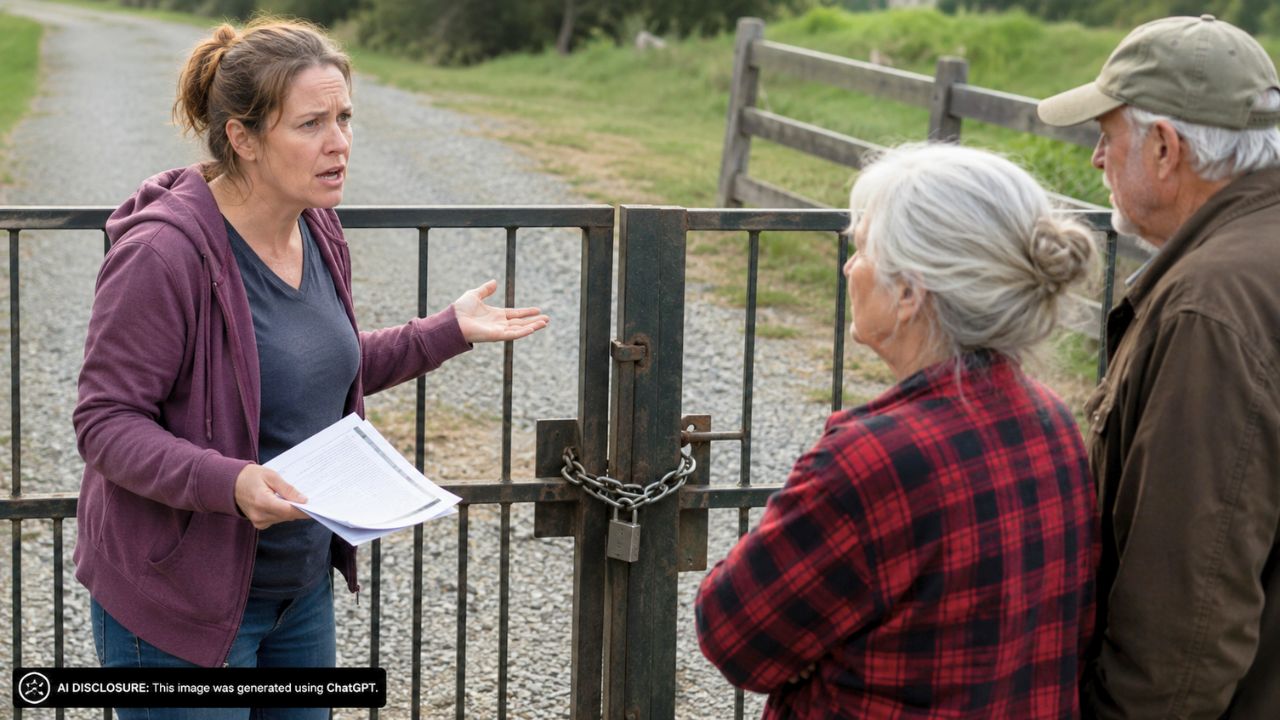
Photo credit: AI-generated image created using ChatGPT. Illustrative only
If you’ve ever bought rural property and thought, “I’m going to tighten things up around here,” this one will feel painfully familiar. A New York landowner looked at a gate on a woods road crossing her land and decided it needed to be shut and locked—every time, no exceptions.
What happened next turned into a full-on right-of-way fight, and the courts ended up telling her she couldn’t do what she wanted with the gate—even though the gate sat on her property. The details come out in the discussion of Baldo v. McDonald from New York’s Appellate Division, Fourth Department.
A gate on a woods road sounds simple until it isn’t
Angela Baldo owned land in a rural area with a woods road running through it. That road wasn’t just her driveway or a private trail, though—it was burdened by a right-of-way, meaning neighboring owners had legal access across her land to reach their own properties.
There was already a gate across that road. The everyday expectation Baldo had—“close it behind you, lock it, keep people out”—sounds like basic country-living security. But the gate wasn’t just a boundary marker. It was sitting in the middle of someone else’s access route, and that’s where the trouble started.
The part that tripped her up: she didn’t put the gate there
Baldo’s case wasn’t built around a gate she installed to protect her home, animals, or equipment. Evidence showed the gate had been built back in the late 1980s by a predecessor of one of the easement holders. Keys were distributed to others who were entitled to use the road.
In other words, the “gate culture” already existed long before Baldo bought the property. And it wasn’t just about hardware—it was about habit. Over the years, the people using that road developed a pattern of how the gate worked in real life, not how someone might wish it worked on paper.
That pattern mattered: sometimes the gate was left open or unlocked to let guests through. And when it was locked, people regularly went around it with smaller vehicles like ATVs and snowmobiles.
New owner, new rules—and neighbors who didn’t agree
After Baldo bought the land, she tried to impose tighter rules. She went to court asking for an order that would require the neighboring easement holders to close and lock the gate at all times.
She also wanted to stop them from going around the gate—whether on foot or with ATVs and snowmobiles. And she sought nominal trespass damages tied to claims that John McDonald bypassed the gate.
From a homeowner’s perspective, you can see the worry: a gate that’s left open becomes an invitation. An unlocked gate turns into “everyone has access.” And once people start driving around it, you’re not just talking about access—you’re talking about ruts, churned-up soil, widened paths, and that feeling that your land is becoming a thoroughfare.
The neighbors saw it differently. McDonald counterclaimed and asked the court to stop Baldo from interfering with his right to pass.
The judge didn’t just say “no”—the court put limits on her
The trial court sided with the easement holders and essentially told Baldo she couldn’t do what she was asking. The ruling didn’t merely deny her request to force everyone else to lock up; it also barred her from locking the gate or requiring that everyone close and lock it.
Just like that, a landowner who wanted a locked gate for peace of mind ended up under an order not to interfere with the neighbors’ use of the right-of-way.
Baldo appealed, but the Appellate Division unanimously affirmed the ruling. The higher court agreed: she couldn’t unilaterally change the terms of access in a way that made the easement more burdensome than it had been for decades.
Decades of “how it was used” beat one owner’s idea of security
The core rule the court relied on is one a lot of rural homeowners learn too late. Even if it’s your land, if it’s burdened by an easement, you can’t make changes that impair the easement holder’s right of passage—or that significantly increase their burden, frustrate the easement’s purpose, or substantially reduce its usefulness.
Here, the deeds gave the neighboring owners the right to use the woods road to access and leave their properties. The deeds didn’t spell out every operational detail, like the exact width of the easement or whether users were restricted to the precise traveled surface of the roadway.
That “missing detail” is where long-term behavior filled the gap. For years, the easement holders had used the road in a way that included sometimes leaving the gate open or unlocked for guests. And when locked, they routinely bypassed it with smaller vehicles—ATVs and snowmobiles—rather than treating the lock as a hard stop.
Baldo’s proposed rule would have forced a new routine: stop, get out, unlock, drive through, close, and relock every single time. The court found she hadn’t shown the neighbors exceeded their rights by bypassing the gate on foot or with small vehicles, especially given the way the right-of-way had been used for decades.
Baldo also argued a security justification for keeping it locked. But the court found she hadn’t demonstrated an actual security need requiring the gate to stay closed and locked at all times. On the other side, the neighbors showed that constant locking would make access more burdensome and would depart from the “convenience to which [they had] been accustomed.”
The reactions were predictable: “Easement means you can’t play bouncer”
If you spend any time around property disputes, you can almost hear the chorus that tends to follow cases like this. People latch onto the same practical points: an easement isn’t theoretical, it’s lived. If the lane has been used a certain way for decades—especially with a gate installed by the easement side and keys shared around—courts are going to treat that history like the operating manual.
Homeowner-minded readers also tend to focus on what you can control without triggering a legal boomerang. The biggest theme is documentation over confrontation: understand what your deed actually says, learn what the easement has historically allowed, and don’t assume “it’s on my land” equals “I can enforce it my way.”
And in rural settings, the ATV/snowmobile detail hits a nerve because it’s not just about access. It can be noise, headlights at odd hours, track marks, and a path that slowly gets wider as people keep skirting the same obstacle.
The bottom line from the appellate court was blunt: Baldo could have a gate on her land, but she couldn’t use it to materially interfere with the neighbors’ established right of passage. So the gate stays, the right-of-way stays, and the day-to-day reality is still shaped by what the area has treated as normal for decades—even if the current owner wishes the lock could finally mean “locked.”
Like Fix It Homestead’s content? Be sure to follow us.
- Man Says He Found Out the Fence He Paid For Wasn’t Actually on His Property
- Woman Says Her Neighbor Started Taking Mulch From Her Delivery Pile Before She Could Even Spread It
- I made Joanna Gaines’s Friendsgiving casserole and here is what I would keep
- What Caliber Works Best for Groundhogs, Armadillos, and Other Digging Pests?