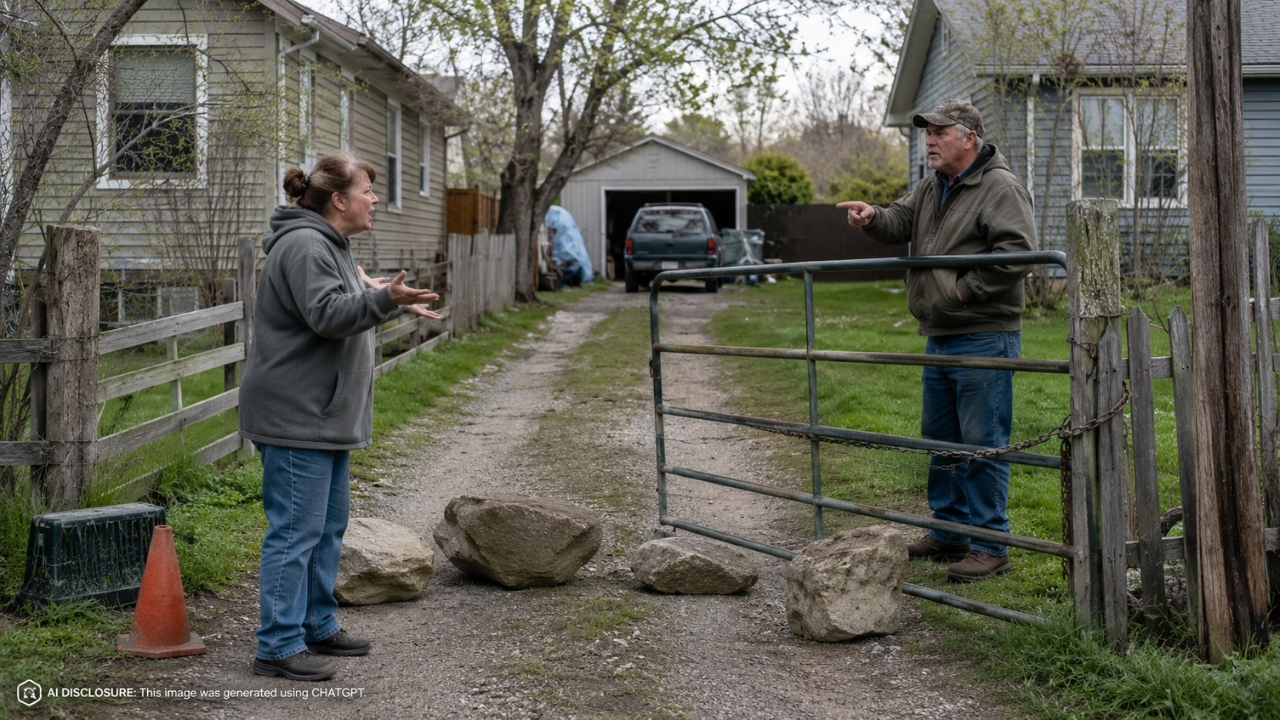
Homeowners Drive and Park Past Their 1954 Driveway Easement for Decades With Permission — Then the Neighbor Revokes It and Blocks the Access With Stones
Photo credit: AI-generated image created using ChatGPT. Illustrative only
The driveway was already there. It started on the Stones’ property, then dipped onto the neighbor’s land just enough to make the route work. For decades, that wasn’t a problem—because the neighbor and prior owners had allowed a little extra room to drive and even park beyond the strict lines of an old easement.
Then the permission got pulled, the “extra” became trespass in the neighbor’s eyes, and the access started getting physically blocked with objects and stones. The back-and-forth eventually landed in court, and the latest twist—over a gate—ended with an appeals court telling the trial court it had to take its own earlier “don’t block access” order seriously. The full decision is laid out in the source post.
A 1954 driveway easement that never stayed neatly on paper
This all traces back to a 1954 “driveway” easement granted to the Stones’ predecessor-in-interest across the northern portion of what is now Melissa Humphress’s property. The purpose was practical: it permitted access to the rear of the Stones’ land by cutting across the neighbor’s side.
But the lived reality didn’t match the legal description perfectly. The appellate opinion notes that for many years, the Stones and their predecessors were allowed to drive across portions of the neighbor’s land outside the easement and park in ways that encroached onto the neighbor’s property.
That kind of arrangement is common in older rural and edge-of-town properties—everybody “knows” where people drive, nobody pulls out a plat map, and the routine becomes the rule until it suddenly isn’t.
When “we’ve always done it” turned into “you can’t do that”
In 2021, Humphress revoked the authorization to park or travel on her land beyond what the easement expressly granted. In the court’s wording, the prior extra use was treated as a “license” (permission) rather than a permanent right—meaning it could be revoked.
From a homeowner’s point of view, that’s the moment when daily life turns into logistics. It’s one thing to be told “don’t park there.” It’s another when the driveway is tight, the turning radius is unforgiving, or you’re trying to get to a garage in the back corner of the lot.
It also didn’t stay theoretical. The opinion says Humphress attempted to block access to the easement using stones or other objects, setting the stage for the court to step in and define what, exactly, each side could do.
The court drew the lines: drive to the garage, walk the trash, but no parking
Both sides asked the Hancock County Common Pleas Court for declaratory relief—basically, to spell out the rights and responsibilities tied to the easement. The trial court determined the easement authorized the Stones to travel to and from a garage structure on the southwest corner of their property using a driveway that crossed onto Humphress’s land.
The easement also permitted walking across it to pull trash receptacles. But the court found the easement language did not allow parking within the easement or parking anywhere in Humphress’s yard.
Here’s the part that mattered later: the trial court also found Humphress had been placing large objects in the easement—“planters, troughs, metal tubs, tables, stands”—and called it “retaliatory.” The court ordered the items removed and explicitly held that Humphress “shall not block access to the easement in any way.”
The declaratory judgment was filed September 22, 2023, and neither side appealed it. That made those rulings the “law of the case,” meaning the trial court’s own words were supposed to govern what happened next.
The first contempt fight: trailers and obstructions, then a fee award
Less than a month after that ruling, the Stones filed a contempt motion. They argued the obstructions hadn’t been removed despite the “shall not block access” order.
At a January 4, 2024 hearing, evidence was presented that Humphress was still blocking the easement—this time including parking a pull-behind trailer in the easement and placing other obstructions. The trial court ordered her to remove “all obstructions” by January 16, 2024, to purge the contempt.
By April 18, 2024, the parties agreed the obstructions had been removed. The trial court didn’t impose jail or a fine, but it did order Humphress to pay $250 in attorney’s fees plus costs. Again, no appeal followed.
In neighbor disputes, that kind of ruling often works like a temporary ceasefire. The judge draws a boundary, everyone behaves for a bit, and then one new “solution” restarts the war.
The gate goes up, and the question becomes: is “annoying” the same as “blocked”?
On May 23, 2024, the Stones filed a second contempt motion. This time, it wasn’t stones or planters—it was a gate erected across the easement.
At a July 2024 hearing, Humphress didn’t appear (though her lawyer did), and the court continued the matter. In the meantime, the judge ordered the gate to remain open at all times until the court could decide whether it obstructed the easement.
At the October 10, 2024 hearing, Michael Stone testified that the gate obstructed use because he had to get out, remove an unlocked chain, and open it. He described it as an inconvenience even though the gate had a wheel intended to make it easier to move. He also acknowledged Humphress had horses and was working to enclose her property.
Humphress testified she put up the gate as part of fencing-in efforts. She said horses had escaped before, including one that was hit by a vehicle and killed. She also said she chose a gate rather than a fence specifically so the Stones could open and close it to reach their garage, though she acknowledged there were gaps in fencing around the garage area.
A new trial judge (the prior one retired) denied the second contempt motion on February 24, 2025. The judge reasoned that while the gate was “annoying,” it didn’t prevent the intended use of the easement, especially since it wasn’t locked. The judge also cited an old Ohio case, Gibbons v. Ebding (1904), for the idea that gates may be allowed so long as they don’t “unreasonably interfere” with the easement.
The appeals court wasn’t buying it: the old order said “in any way”
The Third District Court of Appeals reversed. And the core reason wasn’t complicated: the earlier, unappealed order said Humphress “shall not block access to the easement in any way.”
In the appeals court’s view, a gate across the easement blocks access “in some way,” because the Stones must exit their vehicle, remove the chain, and move the gate. The court also pointed to the trial court’s prior contempt ruling ordering the removal of “all obstructions,” and leaned on Black’s Law Dictionary definitions—an obstruction is something that impedes or hinders, and “hinder” includes slowing or making something difficult.
The court also noted that Gibbons itself requires considering circumstances showing whether the way was intended to be “open.” Here, the trial court’s own prior language made “open” pretty explicit. The case was reversed and remanded for further proceedings consistent with the appellate opinion.
One extra procedural detail added weight: Humphress didn’t file an appellate brief on time, and the court invoked the rule allowing it to accept the Stones’ statement of facts and issues as correct if their argument reasonably supported reversal.
What people tend to focus on in driveway-easement fights
When homeowners read a story like this, the reactions usually split into two camps: “a gate is normal in the country” versus “you can’t touch someone’s access.” The appellate court’s answer here was less about country norms and more about the exact words already entered as a final order.
Practically, these disputes often turn on documentation and repeatability. Photos of where vehicles actually travel, measurements, a clear map of the easement bounds, and a timeline of each obstruction can matter more than anyone’s memory of “how it’s always been.” And once a court order is in place, the wording becomes the ballgame—especially phrases like “shall not block access…in any way.”
The unresolved tension is easy to picture: one neighbor trying to keep animals contained and protect their property use, the other trying to reach a garage without stopping in the middle of the drive to wrestle a gate. On remand, the trial court will have to deal with that reality under the shadow of its own earlier orders, and the next “fix” either side tries could end up right back in front of a judge.
Like Fix It Homestead’s content? Be sure to follow us.