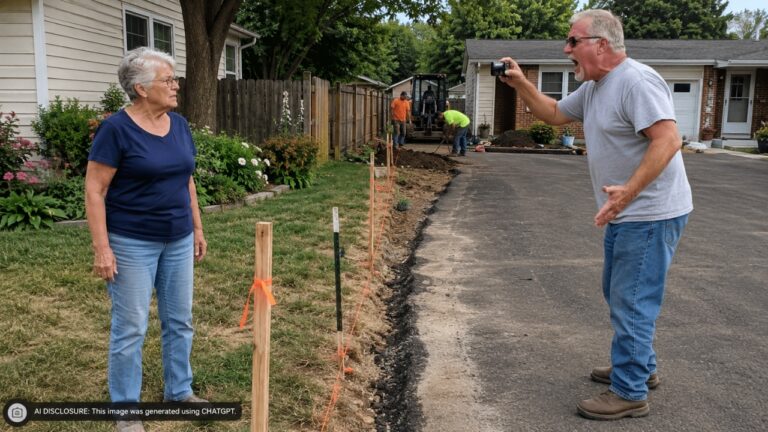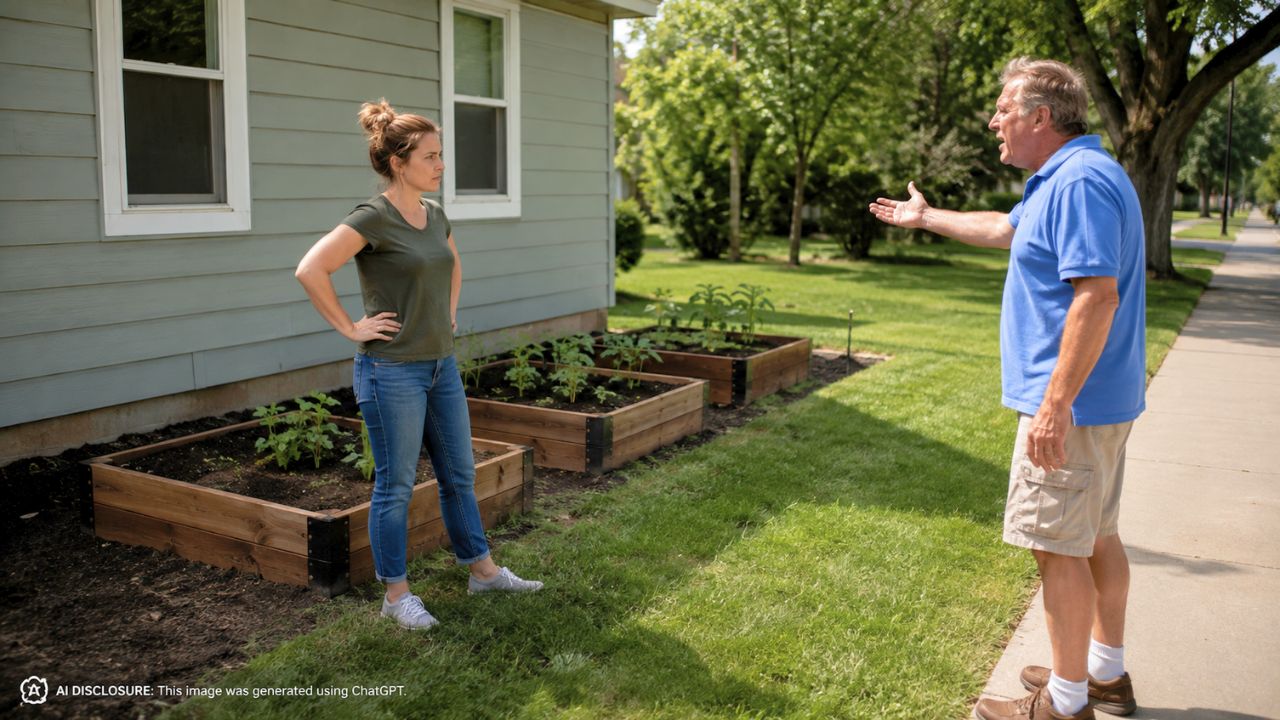
First-Time Homeowner Sets Up Garden Beds Four Feet Inside the Property Line — Then the Neighbor Claims Ownership Up to the Sidewalk, Overlapping Her House by a Few Feet
Photo credit: AI-generated image created using ChatGPT. Illustrative only.
Moving into a first home is supposed to come with paint samples and weekend projects, not a turf war measured in feet. But that’s where one new homeowner in Pennsylvania found herself after trying to do something harmless: build a few elevated garden beds along the side yard.
In the original post, she describes buying a small ranch on a narrow 30-by-150-foot city lot. There’s no fence between the three neighboring yards, and for the first year she mowed where the seller told her the boundary was: to the middle of the sidewalk that separates her home from the neighbor to the right.
The garden beds went in… and the neighbor moved the line
This spring, she decided to improve the yard with elevated planters. She didn’t even push them to the edge—she set the beds an additional four feet in from where she believed the property ended, basically giving a cushion just to avoid exactly this kind of argument.
That’s when the neighbor stepped in and told her those beds were on “his property,” because he claims his lot runs all the way to the sidewalk. Not only that, he reportedly claimed ownership far enough that it would overlap her house by a few feet—an assertion that doesn’t pass the gut-check test for anyone who’s ever seen a row of city lots laid out in real life.
And then came the part that makes these disputes feel real: he started mowing up to his claimed line. Once someone is acting like the boundary has already shifted, it’s harder to treat it like a simple misunderstanding.
Two neighbors, two stories, and a map that “isn’t to be trusted”
The homeowner didn’t only have one person’s word to go on. A neighbor on the other side told her the properties on the block extend to the right of the houses, never to the left—basically suggesting the neighbor to the right is trying to pull everyone’s yards in his direction.
She also checked GIS mapping, which appeared to confirm the boundary—but she knew enough to hesitate, noting that GIS maps aren’t definitive for property lines. That’s the maddening middle ground homeowners get stuck in: you can see a line on a map, but you also know it might not hold up when it counts.
The neighbor, meanwhile, wanted the planters moved. For the homeowner, it wasn’t just about garden beds anymore. Four feet on a 30-foot-wide lot is not a sliver. She calculated it as more than 10% of her property—space she bought, pays taxes on, and expected to use.
Why four feet turns into a real-money problem fast
In a long, thin yard with no fence, “we’ve always just mowed it this way” becomes the default rulebook. The trouble is that mowing patterns don’t always match deeds, and when a new improvement goes in—planters, a shed, a patio—that’s often when a neighbor suddenly decides the invisible line is somewhere else.
The homeowner’s immediate obstacle was cost. A survey was quoted at $1,100, and she didn’t want to spend that much “over him.” That number hits especially hard for first-time buyers, who are already juggling repairs, tools, and the steady drip of unexpected expenses that come with year one.
But there’s also a quieter risk baked into letting the neighbor’s claim stand unchallenged. If one side begins using land openly and consistently, it can turn into a long-term mess—at the very least a permanent source of friction, and at worst a dispute that makes selling or refinancing harder because everyone’s memories are louder than the paperwork.
The moment it stops being neighborly
The homeowner made it clear she didn’t want to be “the neighborhood jerk.” That’s the tightrope: push back too hard and you’re the newcomer who arrived and started fights; do nothing and you’re the person who got steamrolled out of part of the yard.
This is also where property-line disagreements get personal fast. A planter box isn’t just lumber and soil. It’s a statement that you plan to live there, put down roots, and use your space. For a difficult neighbor, that can feel like a threat—even when it’s four feet inside what you believe is your own lot.
And when the neighbor’s claim is so broad it allegedly overlaps the house footprint, it sends a message: this isn’t a minor correction, it’s a power move. You don’t “accidentally” claim a few feet of someone’s house unless you’re either deeply mistaken or trying to see what you can get away with.
Most people focused on paperwork, not arguing in the yard
The homeowner’s question was simple: what’s the next step? In disputes like this, the practical crowd tends to land on the same advice, even when everyone hates it—get the boundary documented.
Not because a survey is fun or fair, but because it’s the one thing that can end the “he said, she said” loop. A neighbor can insist a sidewalk is the line, or that the whole block runs one direction, or that the yards were “always” used a certain way. A deed description and a real survey don’t care about any of that.
There’s also a tactical angle that comes up in these conversations: avoid escalating in person. When someone is already mowing as if they’ve won, a shouting match in the grass usually just creates new problems—especially if police get called, tempers flare, or one side starts retaliating with petty complaints.
Documentation is the boring answer, but it’s the answer that holds. Photos of where the beds were placed, notes about what the seller told her, copies of any property paperwork from closing—those are the kinds of “small” details that suddenly matter when a boundary becomes contested.
The tension: paying to prove what you already own
The most frustrating part of her story is how common it is: the person trying to quietly use their yard ends up being the one who has to spend money just to keep it. The neighbor makes a claim; the homeowner pays to disprove it.
And yet, the alternative can be worse. Moving the garden beds might buy temporary peace, but it also trains the neighbor that a complaint gets results. Leaving them could lead to more aggressive pushback. Without a clear line—literally—every future project becomes another flashpoint.
For now, she’s stuck in that early-homeownership limbo where you’re still learning the property, still learning the neighborhood, and suddenly realizing that the biggest surprises aren’t always behind the walls. Sometimes they’re right there in the open, measured from the sidewalk in.
Four feet doesn’t sound like much until it’s your four feet, on a lot that’s only thirty feet wide, with a neighbor actively trying to take it. The planters were supposed to grow vegetables. Instead, they grew a property dispute that won’t be solved by mowing patterns or memory—only by proof.
Like Fix It Homestead’s content? Be sure to follow us.