Florida Homeowner Learns After Closing That a Neighbor’s Utility Trailer Has Sat on the Property for Years Under an Informal Deal — Then the County Threatens Fines as the Unresponsive Neighbor Ignores the Deadline to Move It
Photo credit: AI-generated image created using ChatGPT. Illustrative only.
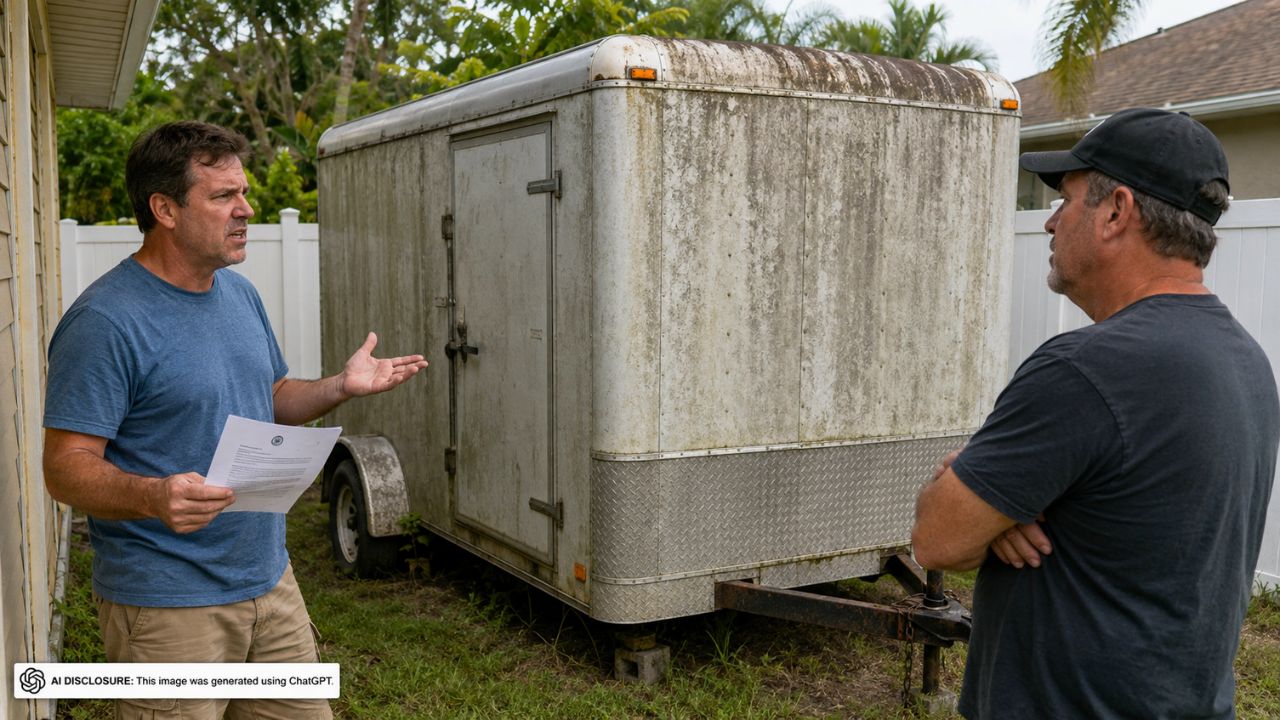
Two months into a new Florida home, one of those “small quirks” of the property started to feel a lot less small. An enclosed utility trailer sat on the homeowner’s land like it belonged there—because, in a way, it had for years.
Only after closing did the new owner learn the backstory: the previous owner had a handshake-style arrangement with a neighbor. The neighbor could store his trailer on the property, and in exchange he’d cut the grass. The new homeowner didn’t love the surprise, but initially let it slide—until a county notice landed on the door and put a deadline on the whole thing. The homeowner shared the dilemma in the original post, asking what could be done when the neighbor wouldn’t respond and the county was talking fines and court.
The first sign was easy to brush off
At first, the trailer was just… there. It wasn’t blocking a driveway, and it didn’t feel like an emergency. The homeowner had just moved in, was still settling, and figured that if the neighbor was cutting the grass, maybe it was a weird but workable trade.
It also sounded like a legacy arrangement—something the previous owner tolerated long enough that it became “normal.” But the key detail was also the one that made it fragile: there was no written agreement, and the new owner wasn’t informed until after closing.
That matters because informal deals don’t transfer cleanly when properties change hands. A new owner inherits the land, but not necessarily the obligations they never agreed to—especially when the “deal” is basically, “I’ll let you keep your stuff here.”
Then the county notice turned it into a clock
The homeowner’s posture shifted the moment code enforcement got involved. A note from the county said the trailer had to be moved because of local rules about where it was placed on the property. If it didn’t move, the homeowner—not the neighbor—would be fined and forced into court.
That’s the brutal part of these property-line headaches: the government communicates with the person on the tax bill. It doesn’t matter whose trailer it is when it’s sitting in violation on your parcel. The homeowner suddenly wasn’t managing a neighborly favor anymore. They were managing a compliance problem with a deadline.
And the timeline wasn’t generous. The homeowner wrote that the trailer needed to be moved “by tomorrow.” With that kind of window, even a cooperative neighbor might struggle. With an unresponsive one, it becomes panic-inducing.
A handshake deal meets an unresponsive neighbor
The homeowner tried the straightforward approach: talk to the neighbor, ask him to relocate it, see if he had another place to store it. But the trailer hadn’t moved once since the homeowner moved in, and the neighbor still hadn’t “got back” to them.
There’s a specific kind of frustration in that silence. It turns a simple request into a standoff without anyone ever agreeing to have a standoff. The homeowner isn’t trying to start a feud—they’re trying not to get fined—but every day the trailer sits there makes it look like they’re choosing to ignore the county.
Adding to the discomfort, the homeowner noted the trailer had “no plate or sign of registration.” Whether that’s normal for that trailer type or not, it read to the homeowner like another reason this could get messy fast if the neighbor decided to fight instead of move it.
The towing question is where it gets tense
Once the county is threatening fines, homeowners start thinking in practical, immediate terms: if it’s on my property and the owner won’t move it, can I have it towed?
That’s exactly where the homeowner’s mind went. They asked if towing it could expose them to legal trouble if the neighbor called law enforcement. It’s a fair fear—because towing someone else’s property can quickly turn into accusations of theft, damage, or wrongful removal, even when the trailer is sitting on land it doesn’t belong on.
But leaving it where it is also has consequences. The county isn’t asking the neighbor to appear in court. The homeowner is the one facing fines tied to their address, their parcel, their responsibility to comply. In a matter of days, an “easy to ignore” storage favor became a risk with paperwork attached.
This is also where people realize how little control they sometimes have after closing. You can own the land outright and still feel stuck when another person’s property is physically planted on it.
What people latched onto: proof, paperwork, and a clean timeline
Even without a full comment thread included in the source material, the homeowner’s questions point to the practical themes that usually come up when this kind of dispute hits: documenting what’s on your property, showing you acted quickly, and making sure any removal is handled in a way that doesn’t boomerang back onto you.
The most valuable “currency” in a dispute like this is a timeline you can prove. When did you move in? When were you told about the agreement? When did the county notify you? When did you contact the neighbor? What did you say, and what did they do—especially if they did nothing? Those details can matter when you’re trying to show you didn’t invite the violation and you aren’t ignoring enforcement.
It’s also the kind of scenario where homeowners start thinking about the boring tools that suddenly become essential: written notices (even if the original deal was verbal), photos showing where the trailer sits, and copies of whatever the county left at the door. Not because anyone wants to build a case against a neighbor, but because nobody wants to stand in front of an official and sound like they simply hoped the problem would go away.
A new home, an old problem, and a deadline nobody asked for
The homeowner bought a house and expected the usual to-do list—unpacking, fixing little things, learning the quirks of the yard. Instead, they inherited a neighbor’s storage habit and got introduced to local placement rules the hard way.
There’s no dramatic twist in the details provided. No shouting match, no fence-line war—just a trailer that won’t move, a neighbor who won’t respond, and a county warning that doesn’t care about the backstory.
That’s what makes it relatable. So many property problems start as “not a big deal” until an outside force—code enforcement, a complaint, a sale, a storm—turns them into an urgent, expensive headache. And once the clock starts, the hardest part isn’t knowing what’s fair. It’s getting someone else to act before you’re the one paying for their inaction.
Like Fix It Homestead’s content? Be sure to follow us.