Homeowners Find the Developer Next Door Planning to Excavate Beside Their Wall and Move Their Sewer Line — Then They Demand a Structural Engineer First
Photo credit: AI-generated image created using ChatGPT. Illustrative only
It started the way a lot of property-line problems start: a project next door that looked big, loud, and close. In Saratoga Springs, two neighboring property owners found themselves tied together by old construction choices—buildings built tight to the line, shared assumptions about where water should go, and a sewer setup that couldn’t just be “worked around” once a new development plan showed up.
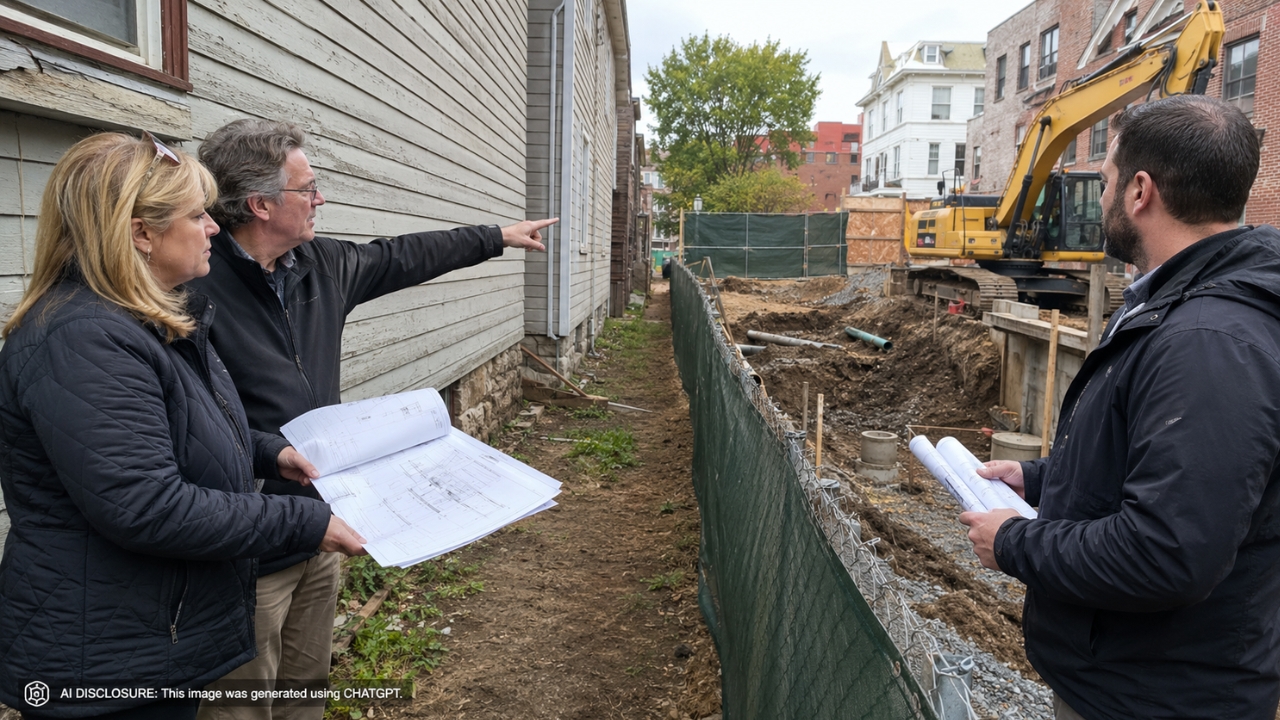
In the court record from the source post, the developer (Places in Saratoga, LLC) wanted access to the neighbors’ side for excavation and to relocate drainage and a sewer line that served the neighbors’ building. The neighbors (the Izzos) weren’t automatically refusing—but they wanted a structural engineer involved first, and they wanted protections in place before anything started happening inches from their wall.
A century-old layout, and then the barn came down
The adjoining parcels sat in a tight setup that had been in place for generations. For more than 100 years, the developer’s parcel had a wooden barn about 10 feet from the north wall of the neighbors’ two-story building. A single-story connector structure actually ran from the barn’s south wall to the north wall of the neighbors’ building, creating a long-standing “everything is right here” footprint.
Then in 2018, the developer demolished those older structures to build a new three-story building. That’s when the real anxiety kicked in for the neighbors: excavation near an existing wall, a new taller building changing wind and snow patterns, and the possibility that once the new construction went up, their north wall might become inaccessible for repairs.
“We’ll talk, but get an engineer”: the deal that set the rules
Before the developer started, it went to court under New York’s RPAPL 881 process seeking a license to enter adjoining properties to do the work—excavation and relocation of a drainage line and a sewer line servicing the neighbors’ building. The neighbors answered with a very homeowner-brained response: fine, but only with safeguards.
The parties settled in November 2018 with a stipulation that reads like the kind of agreement people sign when they’re trying to prevent the worst-case scenario. Before the neighbors would abandon the sewer easement, the developer had to hire a structural engineer to inspect the neighbors’ north wall “to determine and opine” what measures were needed to protect it during construction.
After the engineer’s report, the stipulation required the parties to “enter into discussions” about the protective measures and who would handle what. And it wasn’t vague about drainage: it said the protective measures would “necessarily include” a rainwater catchment system to receive runoff from the neighbors’ roof and the developer’s new building—paid for by the developer.
The engineer’s report didn’t calm anyone down
The developer’s engineer came back with recommendations that were not small. The report recommended structural repairs to the neighbors’ north wall before construction began. It also warned about potential water infiltration between the two buildings and flagged a specific detail that would make any homeowner’s stomach drop: the construction plans called for removing a preexisting roof gutter on the neighbors’ north wall even though roof drainage flowed toward the developer’s new building from that direction.
So now drainage wasn’t just a nuisance; it was a design problem. The report said an alternate way of removing roof water would be necessary. And then came the snow issue—another one of those problems you don’t think about until a taller structure appears next door. The engineer warned that the height of the new building could increase drifted snow buildup on the neighbors’ roof, meaning the roof might need strengthening or some other method of snow removal.
Negotiations started over the rainwater catchment system, but the neighbors’ architect proposed a different solution than the developer’s plan. The developer’s system was never installed. Even so, the neighbors executed a termination of easement agreement abandoning the sewer easement, and the developer eventually began construction.
A gutter on the north side of the neighbors’ roof was removed around the start of construction. In tight urban builds, little details like that are the difference between “fine for decades” and “mystery water in the wall.”
From “protect our wall” to “your roof is damaging my new building”
By late 2019, the neighbors went back to court trying to compel the developer to pay for roof improvements to prevent collapse from increased snow loads. They pointed directly to the structural engineering report and argued the developer was building without addressing the snow concern, which they believed violated the stipulation. The trial court denied that motion in January 2020.
Then the tables turned. The developer later sued, claiming water runoff from the neighbors’ roof infiltrated the developer’s new building and caused damage. The developer brought multiple claims—nuisance, trespass, negligence, and more—and asked for money damages plus an injunction to stop the neighbors from letting roof runoff reach the developer’s property.
The neighbors defended themselves in a way that will sound familiar to anyone who has ever been accused of “causing” a leak: they disputed the source. They submitted an expert affidavit from a licensed engineer who said any water that got into the developer’s building came from other sources and stemmed from the developer’s own actions. They also raised an affirmative defense claiming a prescriptive easement to discharge water onto the developer’s property.
The trial court denied the developer’s first motion for summary judgment on nuisance and trespass because factual questions remained about where the water was coming from. After more discovery, the developer tried again with a second motion. The trial court refused to revisit nuisance/trespass summary judgment and also found factual disputes on negligence and on the prescriptive easement defense.
The good-faith fight: negotiations, demands, and a possible impasse
Where the appellate decision gets especially “neighbor dispute real,” though, is the argument over negotiations. The developer claimed the neighbors weren’t negotiating in good faith under the 2018 stipulation because they wouldn’t agree to the developer’s proposed rainwater catchment system—unless the developer also paid for substantial roof repairs to address increased snow load.
The stipulation clearly required good-faith discussions about the catchment system, but it didn’t force acceptance of any one design. The record showed the neighbors didn’t just stonewall; they worked with an architect, proposed an alternative, and continued discussions. At the same time, there was evidence supporting the developer’s claim that the neighbors’ objection was at least partly tied to pressure on the developer to reconstruct or improve the roof for snow concerns.
The twist: the stipulation was “silent” about any obligation on the developer to address snow load on the neighbors’ roof. So the appellate court said summary judgment dismissing the developer’s claim for breach of the implied covenant of good faith and fair dealing was premature because there were factual questions about whether the neighbors were conditioning agreement on demands outside the stipulation.
The homeowner reactions: document everything, because water never stays simple
If you’ve ever watched two property owners argue about drainage, you know how it goes in real life: everyone becomes an amateur hydrologist, and every downspout turns into a courtroom exhibit. The court record reads like the practical fears people always have in these builds—“Will my wall crack?” “Who’s paying if the roof fails?” “If your gutter is gone, where is the water going now?”
The most relatable part is how the dispute kept changing shape. It began with access, excavation, and moving a sewer line. It shifted into wall protection and drainage design. Then snow load entered the picture. And finally, it landed where so many neighbor fights land: alleged hidden water infiltration, experts blaming the other side, and both parties insisting they’re the ones trying to be reasonable.
By the time it reaches this stage, it’s rarely just about fixing a gutter. It’s about control, timing, who gets stuck with the risk, and whether the “fix” you agree to today becomes the admission that sinks you tomorrow.
In dense builds, the most expensive part is often the gap between “we’ll work it out” and “the water is already inside.” And once construction starts and the original conditions are gone—old gutters removed, sight lines blocked, walls harder to access—everyone’s options get narrower fast.
Like Fix It Homestead’s content? Be sure to follow us.