Neighbor Asks Permission to Cut One Tree Near Her Mother’s Thirty-Year Garden — Then Cuts Down Seven and Claims the Entire Yard Is Actually His Property
Photo credit: AI-generated image created using ChatGPT. Illustrative only.
It started with what sounded like a reasonable request: a neighbor worried a tree might come down in a storm and asked permission to cut it. The homeowner said yes. Then she came home and found not one tree missing, but several—and a brand-new claim that the land her family has treated as “the yard” for decades might not even be hers.
In the original post, an adult child described what happened to their mother, who bought her house more than 30 years ago and spent those decades building a garden that’s become the centerpiece of her home life. What’s now at risk isn’t just a few trees in a buffer strip, but the peace that comes from knowing where your property ends.
A thirty-year yard, and a garden built around it
The homeowner, 56, has lived on the property since the early 1990s. Over time she poured herself into the landscaping—planning seasons ahead, tending flowers, and shaping the yard into something personal. The post describes it as her “one true love,” the kind of place you don’t just mow, but nurture.
Between her home and the neighboring property was a narrow sliver of woods that provided privacy. It wasn’t just aesthetic. That kind of natural divider acts like a living fence: blocking sightlines, buffering noise, and making both yards feel separate even without a formal barrier.
That wooded strip also became the front line in what would turn into a boundary fight—because once trees are gone, the land stops feeling like “protected space” and starts feeling like open, usable yard.
The first sign was easy to brush off: a shed and missing trees
A few years ago, a new neighbor moved in next door. The homeowner’s first major change came when the neighbor built a large shed roughly 10 to 15 feet from her garden/yard area. The shed construction required cutting down trees, leaving what the family described as an eyesore.
Still, the homeowner didn’t pursue it. She may have assumed it was within his rights, or simply decided it wasn’t worth a prolonged feud. A lot of people do that with neighbors—choose quiet over conflict, especially when the damage feels contained.
But in property-line disputes, early changes matter. Once a neighbor starts building close to a line, clearing brush, or reshaping the edge of a lot, the “normal” look of the boundary can shift fast.
One tree became seven—and then came the claim
The next request sounded specific: the neighbor wanted to remove a tree in the wooded sliver because he feared it could fall on his house during a storm. The homeowner agreed to the one tree.
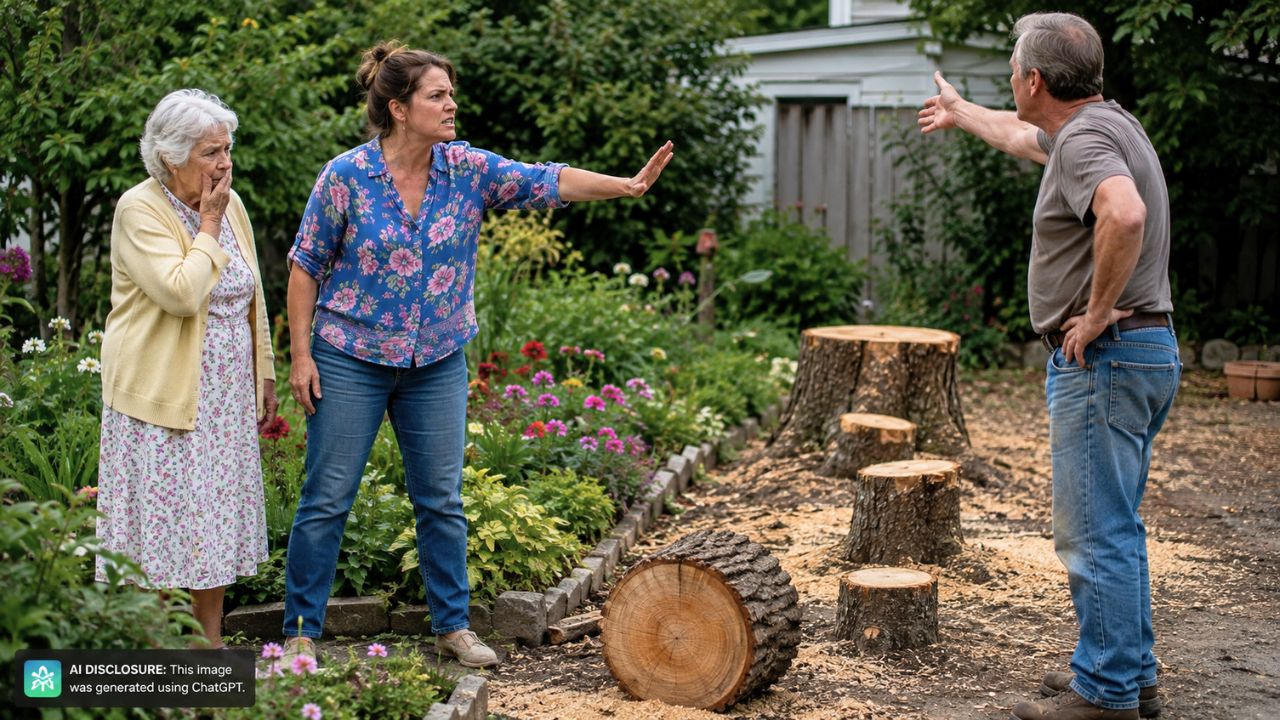
When she returned home, she found several trees—around seven—had been taken down. The shock wasn’t just the extra cutting. It was the feeling that permission had been treated like a blank check.
She went over to talk to him. That’s when the conversation jumped from “trees” to “ownership.” According to the post, the neighbor told her that his property line actually cuts through her whole yard.
That’s the kind of statement that makes your stomach drop, because it threatens everything tied to the land: gardens, fences, sheds, additions, future sales, even the ability to insure or improve what you think you own.
Paperwork, surveys, and the fear that the map is wrong
The homeowner didn’t respond with a guess or a handshake history. She came back the next day with a land survey from 2007. That survey was done when she built an addition onto her house—exactly the kind of project that typically involves confirming boundaries.
The neighbor dismissed it, saying the survey was wrong. He claimed that when he bought his house, his property line was shown cutting through her yard, but he didn’t provide proof in the moment described.
Trying to get clarity, the homeowner hired a surveyor. And that’s when things got even more destabilizing: she was told her 2007 survey may be wrong.
For anyone who’s never dealt with survey disputes, that phrase hits hard. People treat surveys like absolute truth. But a boundary can get messy when old markers are missing, records conflict, or different surveyors interpret the same legal description differently—especially on older properties where “the line” was historically understood by trees, stones, or long-gone fences.
Now the homeowner is heartbroken and struggling to understand how a yard she’s had for three decades—one that stayed consistent through two previous neighbors—could suddenly be in question because a new neighbor arrived with a different story.
What people focused on: proof, documentation, and stopping the bleeding
The post wasn’t just a vent; it was a request for direction. The family is already thinking about paying for a lawyer, but they’re afraid of spending money only to find out there’s “no chance” of keeping the garden area they’ve always treated as hers.
When homeowners end up in this kind of standoff, the practical instincts tend to come down to two things: (1) prove where the boundary actually is, and (2) stop further changes while it’s being figured out. Because every new tree cut, every cleared patch of woods, every structure placed “near the line” makes the dispute harder to unwind.
Even without getting into legal specifics, the immediate home-and-land reality is clear: the wooded buffer that once protected her garden is being erased piece by piece. With the trees gone, the neighbor can see into her space, access becomes easier, and the psychological line that used to be obvious starts to dissolve.
The family’s worry is that the neighbor is “slowly planning to clear out the woods and take on her garden.” That’s the nightmare scenario for anyone who gardens seriously—because a garden isn’t just land, it’s years of soil work, plantings, and layout choices that can’t be picked up and moved without loss.
A yard line isn’t just a line—once it shifts, everything shifts with it
This isn’t only about trees. If the boundary truly cuts through the yard the way the neighbor claims, the implications stack up quickly: where the homeowner can plant, whether she can keep structures or beds where they are, and what happens when the property is sold or refinanced.
And if the neighbor is wrong, the tree cutting becomes more than “overstepping.” It becomes the removal of mature trees from land that may belong to someone else—trees that provided privacy and value and can’t be replaced overnight.
What makes the story feel so tense is that it’s not resolved at the emotional level. The homeowner lived with an understood boundary for 30 years, knew a prior owner for 20 years, and had two different neighbors before this without the yard being questioned. Then a new neighbor shows up, builds close, clears trees, asks for one removal, takes seven, and follows it with a claim that redraws the entire map.
For now, the garden is still there—but the sense of security around it isn’t. And once a neighbor starts treating your side like it’s his, every sunny afternoon in the yard can start to feel like you’re waiting for the next chainsaw.
Like Fix It Homestead’s content? Be sure to follow us.