New Arkansas Landowner Discovers Several Neighbors Have Spent Years Mowing and Planting Trees Onto the Back of the Lot — Then Learns the State’s Seven-Year Adverse Possession Law Could Let Them Keep It
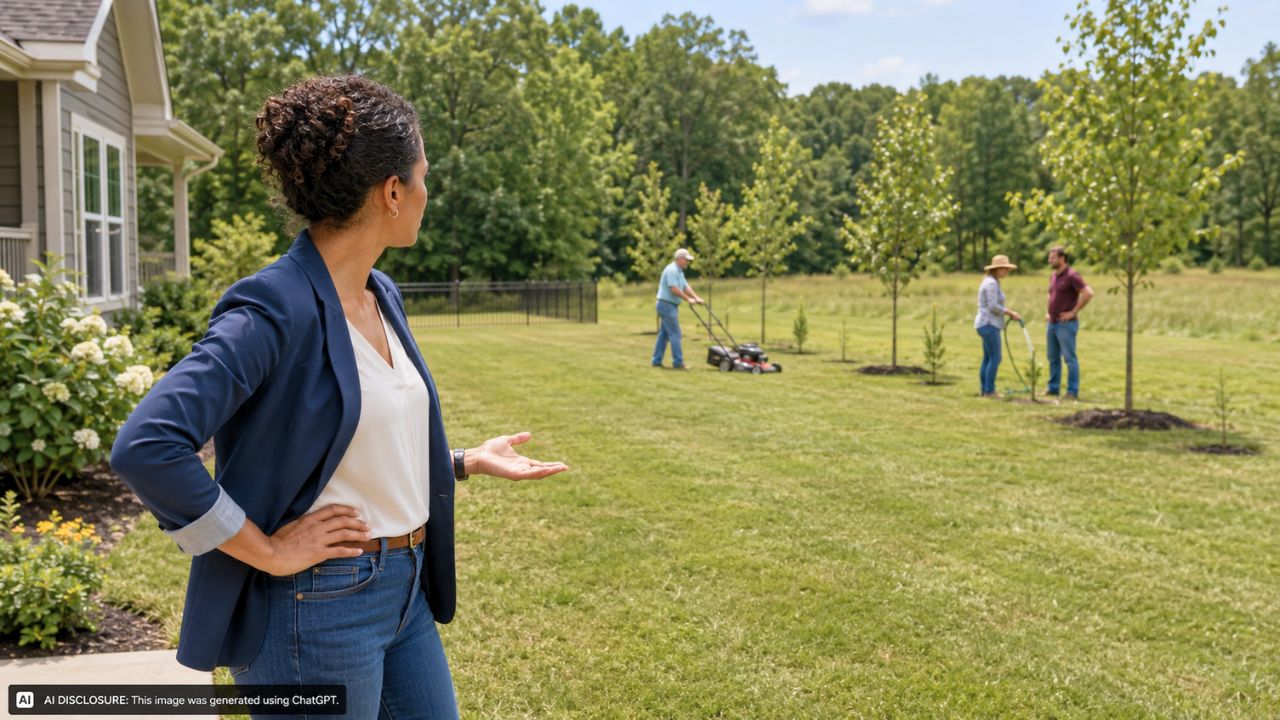
Photo credit: AI-generated image created using ChatGPT. Illustrative only.
Buying an empty lot in a built-out subdivision sounds like the simple part of homeownership: you pay, you get the deed, you keep it mowed, and you decide what happens next. But for one new Arkansas landowner, the “empty” space came with a surprise—several neighboring backyards had quietly expanded into it over the years, complete with regular mowing and even trees planted on ground that wasn’t theirs.
In the original post, the buyer explained that the lot sits behind multiple homes in an established subdivision. The houses have been there anywhere from five to twenty years, and during that time, homeowners behind the lot appear to have treated pieces of it like extensions of their yards. Now the new owner is maintaining the portion they purchased—but the moment they read about Arkansas’s seven-year adverse possession rule, the unease set in.
The backyard “extensions” were already built into the neighborhood routine
This wasn’t a case of one neighbor tossing a lawn chair across a fence line. The new owner described a pattern: over time, multiple homeowners made their backyards “bigger” by mowing land that didn’t belong to them and planting trees on it. In a subdivision, that kind of slow creep can start innocently—someone mows a little beyond their line because it’s easier than leaving a strip of tall grass.
Then it becomes normal. The grass looks continuous. Kids play there. Maybe a sapling goes in because it “feels” like part of the yard. A few seasons later, nobody remembers the original boundary without pulling up the plat map.
For the person who just bought the lot, the unnerving part is that this isn’t a brand-new encroachment they can correct early. It sounds like a long-standing neighborhood habit, repeated across several properties, in a place where the “real” lines may not match what everyone has visually accepted.
New owner, old habits—and a boundary that doesn’t show itself
Once the lot changed hands, the new owner started maintaining it. That’s a practical move, but it also highlights the problem: whose routine wins when routines conflict?
If neighbors have spent years mowing and landscaping back there, they may not immediately stop just because someone new owns the lot. Some people will keep mowing out of habit. Others will do it because they assume it’s still “basically theirs.” And a few will take it personally the minute the new owner shows up with a mower, a string trimmer, or a plan.
The owner’s post carried that specific kind of disbelief only property lines can create: they “literally just paid” for what was plotted in the original subdivision. They assumed the recorded lines would be the end of the story. But adverse possession, even as a concept, makes it feel like the ground can shift under paperwork.
The phrase that changes everything: “seven years”
What flipped this from minor annoyance to real anxiety was Arkansas’s adverse possession timeline, which the owner summarized as the ability to gain possession if someone maintains the property for seven years. Whether or not that’s a complete description of the law, the fear is easy to understand: if a neighbor has treated part of your lot like their yard for long enough, can they actually end up with it?
This is where a lot of homeowners get blindsided. They think of property ownership as a hard, fixed thing—deeds, surveys, county records. But the adverse possession idea injects a different kind of reality: use, time, and behavior can matter, too. And in subdivisions where people have been casually mowing beyond their boundary for a decade, the timeline question becomes impossible to ignore.
It also turns every “nice” improvement into a potential land claim. Mowing is one thing, but trees are long-term. Trees feel permanent. If someone planted them, watered them, mulched them, and pointed to them for years as “my yard,” that’s the kind of detail that makes a new owner wonder how much of the lot is already socially spoken for.
Proof on paper vs. proof on the ground
The owner’s core question was simple: should they be concerned, or will the subdivision’s original plotted lines control?
On the ground, though, boundaries don’t announce themselves. A lot can sit behind several homes and be treated like a shared buffer, a no-man’s-land, or a bonus yard—especially if there was never a fence. Without a visible marker, people default to convenience. They mow where the mower already goes. They plant where the sun looks right. And after enough seasons, the neighborhood develops an “everybody knows” version of the property lines.
The new owner is now stuck balancing two kinds of proof. There’s the recorded plat and the purchase paperwork—the official version. Then there’s the lived-in version: years of maintenance by others that may have created expectations. Even if those expectations aren’t legally decisive, they’re socially powerful, and social power is often what drives the first round of conflict.
That’s the part that can get expensive fast, even before any formal legal claim. People argue. People call the city or the county. People demand you stop “touching their trees.” People start moving lawn ornaments as boundary markers. And everyone suddenly becomes an amateur surveyor.
How commenters typically react when a yard has “crept” for years
The post itself didn’t include a running comment thread in the provided material, but homeowners in similar disputes usually focus on the same practical pressure points: documentation, clear boundaries, and avoiding vague handshake agreements that create more confusion later.
When multiple neighbors have been mowing into a lot for years, the general instinct is to establish what you own in a way that is visible and defensible—because mowing patterns and planted trees create a story, and in property fights, whoever has the cleaner story often has the upper hand socially.
People also tend to warn against letting “maintenance” continue unchecked once you’re aware of it. Not because every mower pass equals a land grab, but because time and routine are the entire engine of the worry here. The new owner already started maintaining the lot, which signals ownership in a very everyday, understandable way. But if neighbors keep treating sections like theirs, that mixed signal can stretch on—and stretching on is exactly what the owner is afraid of.
A quiet lot can turn into a neighborhood flashpoint
What makes this kind of property drama so tense is that it doesn’t start with a single dramatic act. It starts with grass. Then it becomes trees. Then it becomes assumptions built up over five, ten, fifteen years—until one day someone buys the lot and expects it to behave like a normal purchase.
The owner isn’t trying to take something away; they believe they’re simply stepping into the lines they paid for. But to the neighbors, those lines may feel like a technicality that arrived late to a yard they’ve been using for years. That mismatch—paper certainty versus lived routine—is the spark.
For now, the lot owner is doing the most basic thing a landowner can do: maintaining their property. The unresolved tension is whether the neighbors will accept that as the new normal, or whether the past seven (or more) years of “backyard expansion” will turn a simple mow job into a fight over where the subdivision ends and someone’s yard begins.
Like Fix It Homestead’s content? Be sure to follow us.