New Homeowner Finds the Neighbor’s Aging Timber Retaining Wall Was Built Three Feet Into the Property — Then the Neighbor Says Disturbing It Would Cause a Hillside Collapse and Refuses to Allow Survey Markers Anywhere Near It
Photo credit: AI-generated image created using ChatGPT. Illustrative only.
The wall didn’t fail in a dramatic, movie-scene way. It just gave up—one section slumping and spilling out like a tired shelf finally snapping under weight it was never designed to carry. For one new homeowner on a hillside lot, that collapse turned a quiet boundary line into a high-stakes standoff with the neighbor uphill.
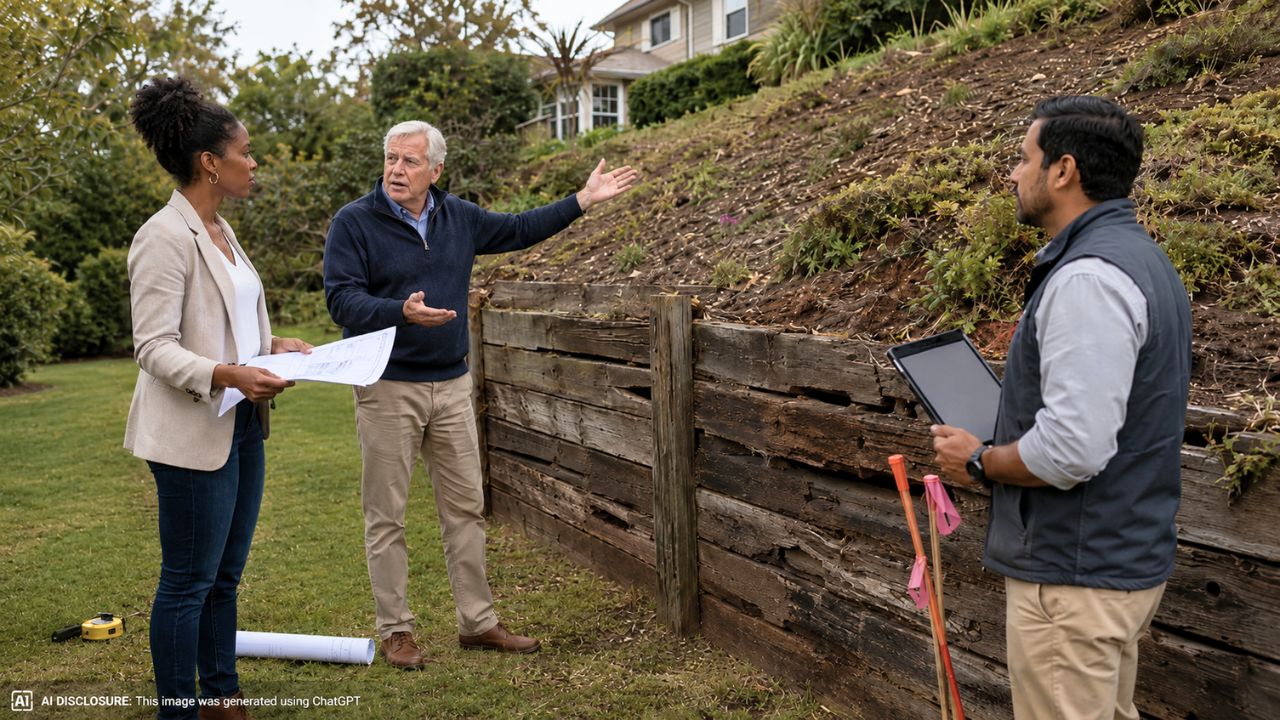
In the source post, the homeowner explains that the houses sit parallel, but the neighbor’s home is higher on the slope. The retaining wall between them looks like it exists mainly to hold back the uphill yard. When it started falling apart, the downhill owner wasn’t just looking at an eyesore—there was now a real chance of debris sliding onto their property, and a bigger risk that continued erosion could destabilize the hillside itself.
The first warning came from a tree that never should’ve been there
This wasn’t a brand-new problem, just a problem that finally reached its breaking point. A couple of years earlier, the previous homeowner planted a large tree near the wall. Over time, the roots pushed the timber structure out of alignment.
The current homeowner did what a lot of people try first: they said something, early, before it became a crisis. The neighbor—new to the property herself—did respond by cutting the tree down. But by then, the root system had already done the kind of slow structural damage you don’t really “undo” with a chainsaw.
Then the weather did what weather does. With increased rainfall, the wall that had been stressed and shifted for years finally failed a few months ago.
Once the wall fell, the slope became the problem
A retaining wall isn’t like a fence where a missing panel is mostly cosmetic. Here, the downhill homeowner is staring at a gravity problem. If the remaining wall continues to deteriorate, more dirt, timber, and whatever’s sitting behind it could tumble down onto their lot.
At the same time, the person uphill has their own nightmare scenario: erosion chewing away at the support under their elevated yard, potentially threatening the structural integrity of the house above. That’s what makes retaining-wall disputes so tense. Both sides can feel like they’re the one “at risk,” even when the wall clearly serves one property more than the other.
And in this case, the failure didn’t happen in a private backyard bubble. Both homes face a busy street, there’s no homeowners association acting as referee, and local code enforcement got involved. That added a ticking clock: debris has to be cleared on a timeline.
The property-line argument turned the cleanup into a standoff
Instead of rallying around a repair plan, the neighbors got stuck on the question that stops everything: whose wall is it, and whose land is it on?
The uphill neighbor resisted taking action because she believed the retaining wall was on the downhill homeowner’s property. The homeowner looked at the stakes in the ground and admitted that, at a quick glance, those markers might support the neighbor’s claim.
But the homeowner also suspected the stakes don’t tell the whole story anymore. Erosion can move soil, shift structures, and make an old boundary look “obvious” when it’s actually been creeping for years. If the wall has slowly been pushed forward, it could be sitting where it never originally belonged—especially after roots shoved it out of line.
That’s the maddening part: if you’re the downhill owner, it can feel like you’re being asked to pay for something that doesn’t benefit you, possibly built to protect the neighbor’s higher lot. Yet if the wall truly sits on your property, you can end up holding the liability bag anyway.
When code enforcement is watching, “wait and see” gets expensive fast
With code enforcement involved, the homeowner isn’t just dealing with neighbor tension. They’re dealing with deadlines. Clearing debris and addressing a dangerous condition becomes less optional when the city or county is paying attention.
That outside pressure changes the tone. It’s no longer two neighbors casually debating responsibility. It’s one neighbor wanting to pause until ownership is proven, and another neighbor looking at a schedule they didn’t choose—and a mess that keeps getting worse each time it rains.
Even if both people privately agree the slope needs to be stabilized, nobody wants to be the first one to authorize work that might be interpreted as accepting ownership. In homeowner disputes, that fear—“if I touch it, I own it”—can freeze people in place.
Meanwhile, the practical risk grows. Timber walls don’t typically fail once and stop. They fail in stages: one section collapses, the next section starts bowing, and the pressure line shifts. Add water, and you’re not just managing dirt. You’re managing a moving hillside.
People fixated on proof: stakes, surveys, and documenting the damage
The details in the post show the homeowner already looking for physical clues: the old stakes, the current location of the wall, and the way erosion may have altered everything since the wall was built. That’s usually where these disputes go next—because “I think it’s yours” doesn’t hold up when repairs cost real money.
In similar neighborhood blowups, the most practical voices tend to push for documentation before confrontation escalates: photos of the collapse, rain patterns, the direction of soil movement, and any history showing why the wall was there in the first place. When a wall is holding back an uphill yard, the “benefit” question isn’t academic—it can drive who pays and who has to act first.
There’s also the reality that an old timber retaining wall can be both a boundary-adjacent structure and a safety issue. That’s why people often urge getting a proper survey and keeping everything in writing, especially when code enforcement is already tracking timelines.
The hardest part is that fixing it can make the dispute worse
Repairing or rebuilding a retaining wall isn’t like swapping a few boards. Depending on height and load, it can mean excavation, engineered drainage, and a rebuild that changes the footprint of the area. And that’s where neighbor disputes get thorny: any digging near a contested line can look like a land grab to the other side.
The homeowner’s frustration comes through in a simple point: they don’t believe the wall benefits them. It’s the uphill yard that needs holding back, and it’s their property that’s sending material downhill when things fail. Yet the neighbor’s reluctance hinges on location—if it’s on the downhill lot, she’s treating it as “not my problem,” even though the uphill property may be the reason the wall exists.
So the homeowner is stuck between two bad options: do nothing and risk more collapse (with code enforcement watching), or push forward with cleanup and repairs that could inflame the ownership fight. When you add in the suspicion that erosion has shifted the wall over time, you get a dispute that feels impossible to solve with a handshake.
For now, the hillside remains the real antagonist. Rain doesn’t care whose lot line is correct, and gravity doesn’t pause for neighbor negotiations. The longer the wall sits partially collapsed, the more the earth behind it treats the gap like an invitation—and the harder it becomes for two homeowners to find a fix that doesn’t also feel like a surrender.