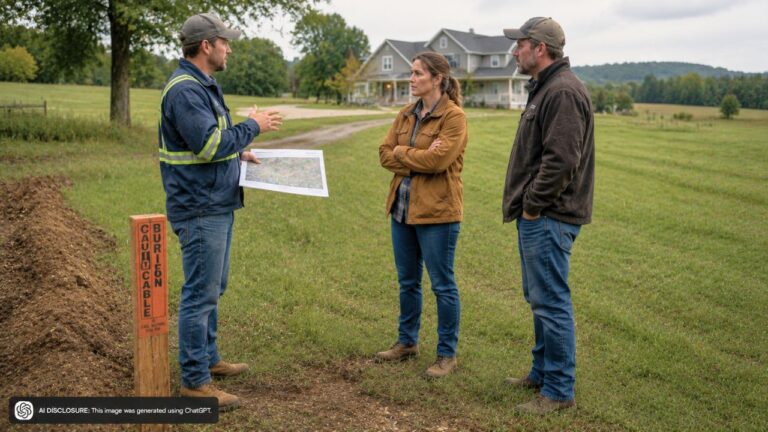
New Landowner Finds the Neighbor’s Septic System Was Built Onto the Property — Then the County Says the Installation Was Never Permitted and Must Be Relocated
Photo credit: AI-generated image created using ChatGPT. Illustrative only
Out in Stevens County, Washington, a fence line that was never meant to be “the line” has turned into a potential five-figure headache. One homeowner says they’re now realizing a neighbor’s septic system may have been placed well past where everyone casually assumed the boundary sat—possibly right onto their land.
The details came from the original post, where the homeowner laid out a familiar rural chain reaction: a practical fence goes up for the dogs, new neighbors arrive years later, and suddenly that old “good enough” marker becomes the reference point for major construction.
The fence was for the dogs, not the deed
The homeowner bought their house about six years ago, back when they had no neighbors next door. They put up a fence to keep their dogs away from the road, placing it where it was easiest to build by hand because the ground farther out was too rocky.
That choice made sense at the time. Plenty of people do it—especially on rural properties where the terrain dictates what you can realistically do on a weekend with posts, wire, and a post-hole digger.
The catch is that the fence was never intended to mark the property line. The homeowner says their father-in-law, who lives on the property, even warned the eventual neighbors: the fence is just a barrier for the dogs, not the boundary.
New neighbors, fast decisions, and a septic too close for comfort
A few years after the fence went in, new owners bought the neighboring five-acre parcel. Then came the kind of installation that can’t be casually undone: a septic system built “really close” to that fence line.
The homeowner describes their father-in-law “throwing a fit” when the septic went in, but eventually letting it go. In rural life, people pick their battles. And without a clear survey in hand, “close to the fence” is still just a feeling, not proof.
That uneasy truce held—until someone else pointed out what might be the real problem.
The moment the real property line came back into the picture
The homeowner says a neighbor on the other side of the property recently pointed out that the actual line may be about 46 feet past the fence. That’s not a “couple of feet” dispute. That’s a strip of land wide enough to change where you can build, where you can run utilities, and whether a major system is trespassing.
If that 46-foot figure is accurate, the homeowner believes the neighboring septic tank could be halfway onto their property—or possibly completely on it.
At that point, it stops being a backyard argument and becomes a documentation problem. Septic systems aren’t like a shed you can drag with a tractor. If a tank and drain field are encroaching, the fix is expensive, disruptive, and not optional if the county gets involved.
The homeowner’s first instinct was to hire a surveyor and then contact a real estate attorney depending on what the survey shows. They also planned to keep quiet about the septic question until they had the measurement nailed down.
Then the creek and the pigs turned it into a water issue
As if a septic placement dispute wasn’t enough, there’s a second conflict running alongside it: pigs.
The homeowner says the neighbors built a pig pen right next to a creek. Now, people down the way reportedly have contaminated water. The homeowner notes that they do too “technically,” but they draw drinking water from a well instead of directly from the creek.
Even so, the implications are hard to ignore. A creek is never just one household’s concern. It runs through properties, past livestock areas, and into someone else’s intake, garden irrigation, or kids’ summer swimming spot.
The homeowner had heard there may be a rule requiring some distance—“at least 200ft from the creek”—and wanted to know where to report it if the neighbors refuse to move the pen. They were hoping to start with a civil conversation, but didn’t want to walk over empty-handed. Their plan was to do “a little leg work” first: schedule the survey, then bring up the contaminated water and the appointment.
The comments leaned heavily on proof, paper trails, and not tipping your hand
While the post itself is focused on what to do next, the practical theme that typically comes up in disputes like this is the same one the homeowner is already circling: get hard proof before you confront anyone.
In other words, a survey first. Photos and dates. Copies of whatever property documents you have. If the fence is in the wrong place and everyone has been using it as a reference anyway, you don’t want the first “official” step to be a heated conversation at the edge of the yard. You want it to be a licensed professional placing markers and producing a drawing that’s defensible.
From there, the next layer is permitting and county records. The homeowner’s headline worry—being told by the county that a septic was never permitted and must be relocated—is exactly why people push for a records check. If the installation wasn’t properly permitted, the neighbor’s leverage can shrink quickly. If it was permitted but placed wrong, that’s still a problem, but it may play out differently depending on what was approved and what was actually built.
And on the livestock side, commenters in similar rural disputes tend to point people toward local health or environmental authorities, because contamination claims get taken more seriously when they’re documented with tests, locations, and an identifiable source. “My water seems off” is one thing. “Here are multiple households reporting contamination downstream of a pen on the creek bank” is another.
The hardest part is that every “next step” changes the neighbor relationship
This is the part homeowners rarely say out loud, but you can feel it in the way the post is written: once you hire a surveyor and start making calls, you’re no longer in a neighborly disagreement. You’re creating a record.
That’s often necessary. It’s also irreversible. If the septic truly crosses onto the homeowner’s land, they’re stuck protecting their property rights and their future resale value. A septic encroachment can complicate everything—financing, title questions, future building plans, and the ability to sell without disclosing an ongoing dispute.
At the same time, the creek and pig pen issue raises the temperature. Water contamination doesn’t stay politely on one parcel, and it tends to bring outside scrutiny fast once official reports start stacking up.
For now, the homeowner’s plan is to stay methodical: confirm the line with a survey, then decide whether a real estate attorney needs to get involved. In rural living, fences are easy. It’s what people build next to them—septic systems, pens, and anything tied to water—that can turn a quiet stretch of land into a long, expensive standoff.