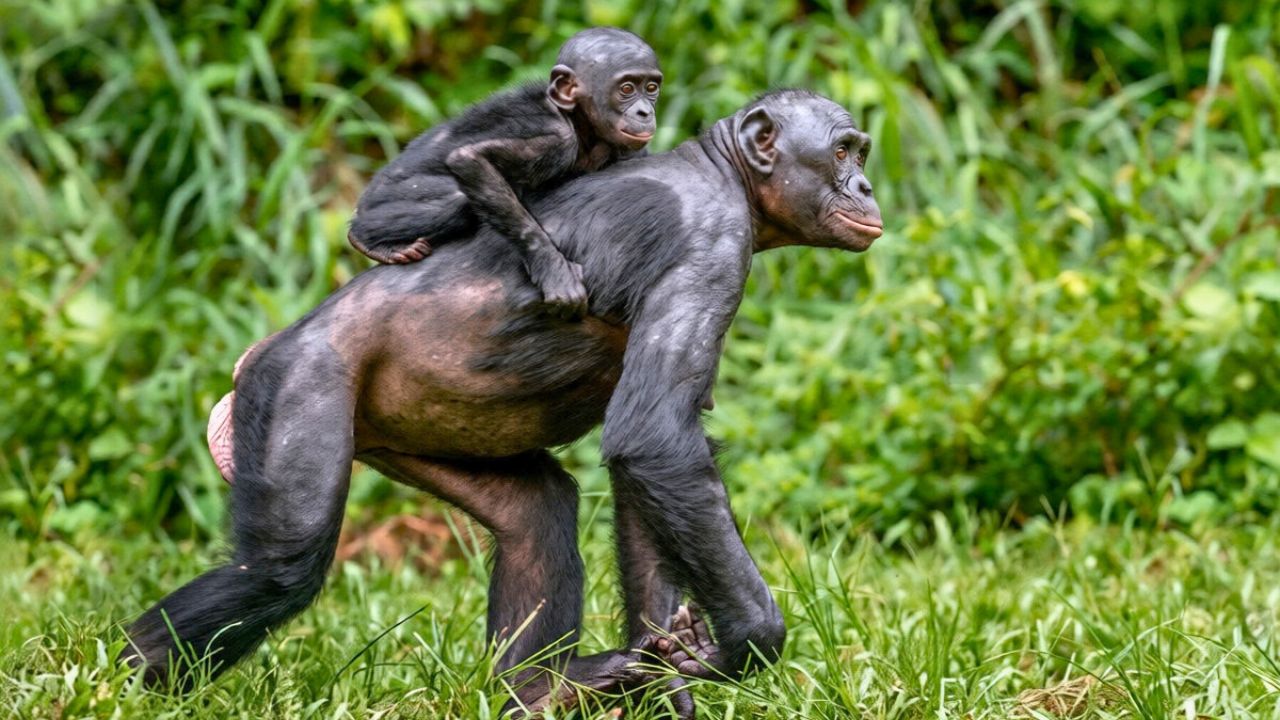
New research challenges the idea that bonobos are the “peaceful” primates
Photo credit: Sergey Uryadnikov/Shutterstock.com
For decades, bonobos have been cast as the gentle foil to violent chimpanzees, the “hippy apes” that supposedly settled conflicts with sex instead of fights. New research now paints a more volatile picture of these endangered great apes and challenges the tidy story that they are the peaceful primates of the Congo rainforest.
Rather than a species defined by harmony, scientists now describe a society where male bonobos fight frequently, bite and chase rivals, and jockey hard for status and mating opportunities, even as females still play an outsized role in keeping the peace.
From hippie myth to hard numbers
Bonobos, or Pan paniscus, live only in the Central African rainforest of the DRC and have long been portrayed as a mirror of humanity’s better angels. Popular accounts leaned on their frequent sexual behavior, female alliances, and apparent lack of lethal raids to argue that they embodied a kind of primate pacifism.
That narrative is now colliding with systematic field data from Kokolopori, a bonobo study site in the DRC, and from Gombe, the classic chimpanzee field site in Tanzania, which directly compare aggression between the two species.
A peer reviewed study in Current Biology tracked how often males attacked one another, how severe those confrontations became, and how aggression related to dominance and mating success. Researchers followed identified males for thousands of observation hours and coded every bite, hit, chase, and charge.
They then compared these records with equivalent long term data from Gombe chimpanzees to test the assumption that chimpanzees are inherently more aggressive.
Male bonobos fight more than male chimps
The surprise was not that bonobos can be aggressive but that Kokolopori males attacked each other more often than their Gombe counterparts. According to the study’s highlighted comparison, male male aggression rates in bonobos exceeded those recorded for chimpanzees even after adjusting for observation time and group composition.
These confrontations were not just bluffs. The researchers documented frequent biting, pushing, and hitting among male bonobos, often in the context of competition over access to estrous females or disputes over dominance rank.
Coverage of the findings stressed that male bonobos are “actually quite aggressive” and engage in intense conflicts that challenge their soft focus image. Reports described how males repeatedly harassed rivals and sometimes targeted lower ranking individuals in coordinated attacks that looked uncomfortably similar to chimpanzee bullying.
At Kokolopori, high ranking males that initiated more aggression also secured more mating opportunities, a pattern that links violence directly to reproductive payoff and undermines the idea that bonobo society has fully tamed male competition.
Why the peaceful reputation took hold
The new data do not come out of nowhere. For years, fieldworkers in the DRC have described bonobos as more tolerant than chimpanzees, with far fewer cases of infanticide, lethal raids, or territorial “war” between groups. That contrast helped build the view that bonobos had somehow self domesticated and reduced their aggression over evolutionary time.
Popular science accounts leaned heavily on scenes of bonobos using sexual contact to diffuse tension, grooming across group lines, and sharing food more readily than chimpanzees. The species’ matriarchal flavor, with strong female coalitions and sons who rise in rank through their mothers, seemed to reinforce a story about a fundamentally gentle ape.
Earlier reporting from the DRC framed bonobos as the “hippies of the ape world,” a phrase that stuck in public imagination. A widely cited feature on bonobos in the described how that label grew from their apparent tendency to “make love, not war,” especially compared with the more territorial chimpanzees.
Another report on their hippie reputation noted that this image has been powerful in popular culture and even in some academic debates about human nature, where bonobos are sometimes invoked as evidence that primate societies can evolve toward cooperation.
What aggression looks like in bonobo society
The new work does not deny those cooperative tendencies but shows that they coexist with frequent low level violence. Researchers describe male bonobos that bite and push one another during feeding, chase rivals away from receptive females, and form short lived alliances to gang up on a competitor.
Reports from Kokolopori and other field sites describe males that scream, charge, and strike during rank disputes, then sometimes reconcile with grooming or sexual contact. Aggression is woven into daily life rather than limited to rare explosive events.
One synthesis of the findings framed bonobos as “less chill than we thought,” summarizing how the peer reviewed work documented higher rates of aggression that are less lethal but more constant than many observers expected. The research team stressed that bonobo and chimpanzee aggression differ in style and context, not simply in raw intensity.
In chimpanzees, aggression often escalates into severe mauling or lethal attacks, especially in intergroup encounters. In bonobos, aggression more often remains within the group and rarely ends in killing, but it is frequent, especially among males competing for status.
Female coalitions and the missing war
One key difference still separates bonobos from chimpanzees. Female bonobos form strong coalitions that intervene when males become too violent, particularly toward infants or lower ranking females. As one anthropological discussion put it, “Among bonobos, females form strong coalitions and band together to discourage aggression from males, including infanticide, which is often stopped by a group of females.”
Decades of observations in Congo show that these “girl groups” can surround and attack a bullying male until he retreats, a pattern highlighted in research that described how female bonobos find in numbers.
That sisterhood may explain why bonobos show little of the organized intergroup “war” and infanticide that have made chimpanzees infamous. A recent analysis of zoo populations, summarized in a report that noted “War and infanticide” in both species, found that bonobos and chimpanzees show similar overall levels of aggression in captivity, yet the most extreme forms of violence remain rarer in bonobos.
Field researchers argue that female power within bonobo groups channels male aggression inward and keeps it from spilling into lethal raids on neighbors, even if day to day conflicts within the group are common.
Rethinking self domestication and human analogies
The new findings are also prompting a reappraisal of the self domestication hypothesis, which suggested that bonobos evolved reduced aggression compared with chimpanzees as selection favored more tolerant individuals. A recent synthesis on rethinking the self argued that bonobos may not be less aggressive overall, but that their aggression is expressed differently within their groups.
Another peer reviewed paper in Science Advances, accessible through its abstract, concluded that chimpanzees are not more aggressive than bonobos when behavior is measured systematically, and that the long standing view of peaceful bonobos versus violent chimpanzees has been oversimplified.
That conclusion matters for how researchers use apes to think about human evolution. For years, chimpanzees were invoked to explain the origins of warfare and male coalitions, while bonobos were used to imagine a path toward greater cooperation and sexual conflict resolution. If both species are aggressive, just in different ways, those analogies look less clean.
Some commentators now argue that the contrast between “warrior chimps” and “hippie bonobos” says more about human storytelling than about ape biology. The new data suggest that any attempt to read human morality directly from a single ape model is risky.
Why the myth still matters
The peaceful bonobo myth is not just an academic issue. Conservation campaigns have relied on the species’ gentle image to attract support and funding for habitat protection in the DRC. Organizations linked through Mongabay’s conservation network and its regional platforms in Spanish, French, Indonesian, and Portuguese, such as es.mongabay.com, fr.mongabay.com, mongabay.co.id, and brasil.mongabay.com, often highlight bonobos’ distinctive social life to engage the public.
Advocates now face a communication challenge. They must explain that bonobos are neither saints nor monsters but complex great apes with intricate social strategies, frequent aggression, and powerful female alliances, all unfolding in a threatened forest home.
Like Fix It Homestead’s content? Be sure to follow us.
Here’s more from us:
- I made Joanna Gaines’s Friendsgiving casserole and here is what I would keep
- Pump Shotguns That Jam the Moment You Actually Need Them
- The First 5 Things Guests Notice About Your Living Room at Christmas
- What Caliber Works Best for Groundhogs, Armadillos, and Other Digging Pests?
- Rifles worth keeping by the back door on any rural property
*This article was developed with AI-powered tools and has been carefully reviewed by our editors.