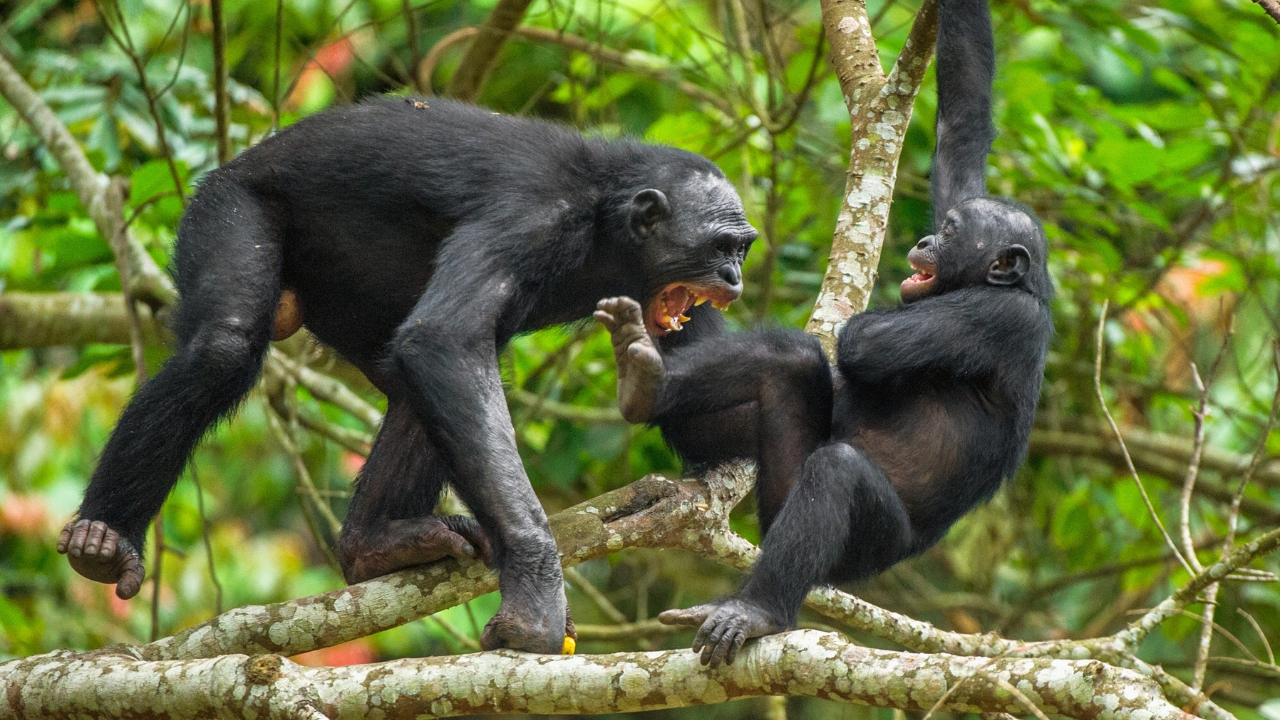
New study suggests bonobos may be less peaceful than previously believed
For decades, bonobos have been cast as the gentle foil to violent chimpanzees, the “make love, not war” apes that offered a hopeful mirror for human nature. New research now suggests that picture is incomplete, with several teams finding that bonobos can be just as aggressive as their cousins and sometimes more so.
The emerging evidence does not turn bonobos into villains, but it does erode the simple contrast that once defined them. Rather than a peaceful species opposed to brutal chimpanzees, scientists now describe two closely related apes whose conflicts play out in different ways within their groups.
From “hippy apes” to harder data
Bonobos are a species of great ape that live in the Central African rainforest and share close genetic ties with humans and chimpanzees. They have long been known for frequent sexual behavior, strong bonds among females and a reputation as the “hippy apes” of popular culture, a view reinforced by many early field reports and by general reference sources on bonobos.
That narrative is now under pressure from a wave of observational and comparative studies that tally aggression with more precision than before. Instead of relying on impressions, researchers are counting every bite, chase and coalition attack in both wild and captive groups.
One influential line of work comes from long term monitoring of wild bonobos at Kokolopori in the Democratic Republic of Congo and chimpanzees at Gombe in Tanzania. In a study highlighted in Current Biology, scientists compared male behavior at the two sites and found that Kokolopori bonobos show higher rates of male-male aggression than Gombe chimpanzees.
The same analysis reported that those results held up even after controlling for factors such as party size and observation time, which suggests that the pattern is not a statistical fluke. Male bonobos in Kokolopori were recorded fighting more often and forming coalitions less often than males in Gombe, a pattern that complicates the idea that chimpanzees are always the more violent ape.
A separate commentary on these findings described the work as a tale of two apes, noting that the team analyzed rates of aggression in Kokolopori bonobos and in chimpanzees from the Kalinzu Reserve of Uganda as well as Gombe. That broader comparison, discussed in follow up analysis, reinforced the core result that male bonobos can be highly combative.
Earlier coverage of the Kokolopori work emphasized just how stark the numbers looked. One summary put it bluntly, reporting that male bonobos fight roughly three times as often as chimps, a point that drew attention because it ran against decades of popular science books that framed bonobos as a pacifist species.
New challenges to the “peaceful bonobo” myth
Captive studies are now echoing those wild observations. A large scale comparison of bonobos and chimpanzees housed in zoos and sanctuaries across Europe and North America found similar overall levels of aggression in the two species. That work, described in a peer reviewed article in Science Advances, tracked antagonistic interactions such as wrestling, hitting and biting.
The team behind the captive study reported that chimpanzees still engaged in lethal violence and infanticide, while bonobos did not, yet everyday conflicts were not dramatically lower in bonobo groups. Instead, aggression in bonobos was mostly directed at males, which fits with field reports that males often bear the brunt of coalition attacks led by females.
Researchers involved in that project argued that the findings weaken the classic picture of peaceful bonobos and warlike chimpanzees. In a summary from Utrecht University, they explained that chimpanzees have a reputation for being aggressive, while bonobos are often seen as their peaceful counterpart, but the data showed similar levels of aggression in zoos for both species. The same report noted that aggression in bonobos is mostly directed at males within their own groups, a pattern that challenges simplistic labels.
A separate commentary from zoo based scientists went further and described the “peaceful bonobo” myth as somewhat overstated. That piece, published by a Belgian research group and available through their own blog, stressed that bonobos do show high levels of social tolerance, but also frequent aggression, especially toward males.
Media coverage of these findings has often highlighted the surprise among scientists who built careers studying bonobo cooperation. One report quoted lead author Nicky Staes, who explained that bonobos live in matriarchal societies where females form strong alliances and that these alliances can translate into coordinated aggression against males. Another story carried the line that there is no “hippie ape,” because more recent research has shown that bonobos live a more aggressive life than their reputation would suggest.
Popular summaries have also picked up on the mating consequences. An article on male aggression reported that male bonobos that are more aggressive obtain more copulations with females, which is something many scientists did not expect in a species famous for female choice and sexual diplomacy.
Rethinking self domestication and human parallels
The new research also feeds into a broader debate about self domestication, the idea that some species, including humans, evolved to be less reactive and more tolerant over time. Bonobos have often been held up as a possible example of this process because they appear less prone to lethal violence than chimpanzees.
A recent synthesis, described in coverage on rethinking self domestication, argues that high rates of non lethal aggression in bonobos make the story more complicated. If bonobos are less deadly but still often aggressive, then self domestication might involve shifts in the form of conflict rather than a simple reduction in all kinds of aggression.
Comparisons between wild and captive populations add another wrinkle. The Kokolopori and Gombe study, which documented higher male-male aggression in bonobos, focused on free ranging animals in large forest habitats. The Science Advances work, by contrast, measured antagonism in zoos, where space is limited and food is provided.
Some researchers suggest that captivity might dampen or redirect aggression in both species, which makes the finding of similar aggression levels in zoos all the more striking. If bonobos and chimpanzees behave alike under the same captive conditions, then the sharp contrast between them in the wild could be driven by ecology, group structure or historical accidents rather than fixed temperament.
What aggression looks like on the ground
Behind the statistics are vivid scenes from field sites. At Kokolopori, observers have documented male bonobos being chased, bitten and pinned down by coalitions of females and their juvenile offspring. These attacks can leave males injured and temporarily excluded from mating opportunities.
At Gombe and in the Kalinzu Reserve, male chimpanzees are more likely to form alliances with one another and direct their most intense aggression toward neighboring groups. That pattern is associated with border patrols and occasional lethal raids, behaviors that have no clear counterpart in bonobos.
The Kokolopori data, summarized in a focused section on rates of aggression, show that male bonobos fight more often inside their own communities, while male chimpanzees reserve their worst violence for outsiders. This internal versus external focus may be one of the key behavioral differences that survive the current reappraisal.
For zoo housed apes, aggression often looks less dramatic but no less real. Researchers recorded frequent wrestling, hitting and displacements in both bonobo and chimpanzee enclosures, with keepers sometimes stepping in to separate individuals after repeated conflicts.
Why the story changed so late
Given that bonobos were scientifically described in the twentieth century, some readers may wonder why it took so long to question their peaceful image. Part of the answer lies in access. Bonobos live south of the Congo River in regions that have seen war, political instability and limited infrastructure, which has constrained long term fieldwork.
Sampling bias is another factor. Early research often focused on a few well known communities that happened to be relatively tolerant, while more aggressive populations remained unstudied. As new sites like Kokolopori and the Kalinzu Reserve came online, the range of observed behavior widened.
Like Fix It Homestead’s content? Be sure to follow us.
Here’s more from us:
- I made Joanna Gaines’s Friendsgiving casserole and here is what I would keep
- Pump Shotguns That Jam the Moment You Actually Need Them
- The First 5 Things Guests Notice About Your Living Room at Christmas
- What Caliber Works Best for Groundhogs, Armadillos, and Other Digging Pests?
- Rifles worth keeping by the back door on any rural property
*This article was developed with AI-powered tools and has been carefully reviewed by our editors.