Ohio Rural Landowner Finds the Neighbor Moved Survey Stakes Thirty-Five Feet to Expand a Horse Fence — Then Learns He Pulled the Same Move Thirty Years Earlier and Got Caught That Time Too
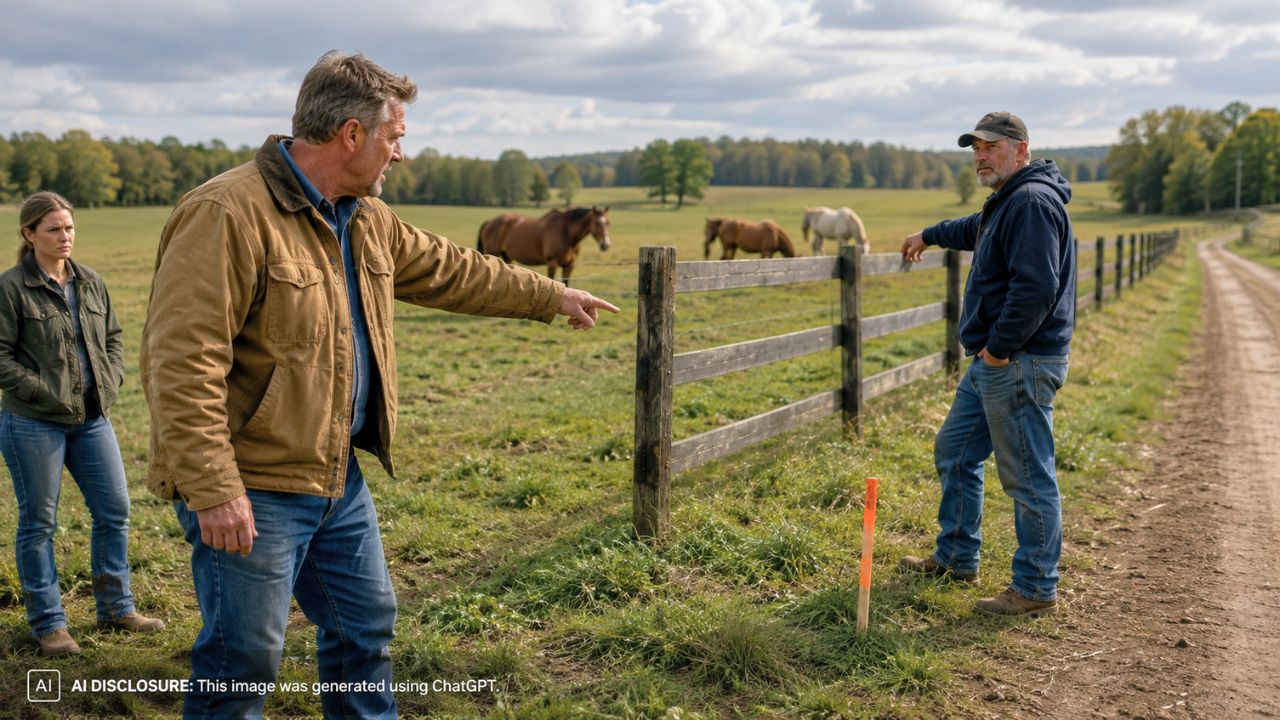
Photo credit: AI-generated image created using ChatGPT. Illustrative only.
In the kind of rural stretch where tree lines hide whole corners of a property, a boundary can feel like a suggestion until something physical shows up. One Ohio landowner found that out the hard way after taking his dogs down the back trails and noticing the neighbor’s “new” line didn’t match the land he’d always treated as his.
In the original post, the homeowner described a neighbor who’d recently paid for a survey before expanding and renovating a fence used for large animals—first cows and pigs, now horses. But out in the back where no one’s watching from a kitchen window, the homeowner says the survey stakes had been shifted an estimated 35 feet, pushing the supposed boundary to the far side of a trail and swallowing a long strip of land.
A quiet walk turned into a “wait, that wasn’t there” moment
The homeowner wasn’t out looking for a fight. He was walking dogs along back trails—normal country routine—when the markers looked wrong. Not just “off by a foot,” but off by enough that a familiar trail suddenly sat inside the neighbor’s claimed area.
That’s when the practical reality hit: fence work had already followed the moved stakes. What could have been dismissed as confusion became something harder to ignore, because the neighbor had placed part of the horse fence onto the homeowner’s property, effectively converting someone else’s ground into “inside the pasture.”
In rural living, that changes everything. Fences decide where animals graze, where you can safely walk, where you can run equipment, and where you can cut brush without starting a dispute. Once posts go in, the land starts to look “owned,” even when it isn’t.
It wasn’t the first time—just a much bigger bite
The homeowner said there was history here, and it’s the kind that makes your stomach drop because it turns a neighborly misunderstanding into a pattern. When he first bought the house nearly 30 years earlier, the same neighbor—and the neighbor’s mother—had moved markers before.
Back then, the homeowner said the shift was around 10 feet. A surveyor “promptly told him that the markers (that he had moved) were wrong,” and the matter didn’t end in legal action. The landowner also noted that both the neighbor and the neighbor’s mother were “not mentally sound,” and he’d preferred not to escalate unless there was a solid reason.
This time didn’t feel like a small nudge. Thirty-five feet isn’t an accident you wave away. It’s a land grab you can measure in steps, mowing hours, and lost access.
The fence made it real, and that’s what forces a decision
A moved stake is one thing; a fence is another. Stakes can be re-set. Fence posts mean labor, materials, and a new “normal” that’s hard to unwind without a confrontation.
For the homeowner, the worry wasn’t just the acreage. It was what comes with a fence line that’s suddenly wrong: the risk of escalating with someone he described as unstable, the possibility of retaliation, and the fear that even a clear boundary won’t stay clear if the stakes can be moved again “at his convenience.”
There’s also a safety angle people outside the country miss. Horses and large animals come with their own risks—spooked animals, damaged fencing, and liability questions if the boundary is disputed and someone gets hurt trying to “fix” it themselves. Even walking dogs gets complicated when a trail you used for years is suddenly framed as trespassing.
Money pressure: the cheapest fix still feels like a trap
What pinned the homeowner in place was the cost-to-certainty ratio. He figured sending out a surveyor would cost about $500, and he didn’t have much money to burn. Paying that just to watch the markers get moved again felt like throwing cash into the woods.
That’s a familiar rural problem: you can be right and still be stuck. Legal fights can drag out, and even “winning” might only get you what you already had—your own property—after months of stress. The homeowner openly admitted that if a lawsuit’s end result was simply getting his land back, it didn’t feel worth the risk of provoking an already tense neighbor dynamic.
But ignoring it also has a cost. Once a fence sits in place long enough, people start behaving like it’s the actual boundary. That’s when future buyers, family members, or contractors end up confused, and the original owner is left explaining why a pasture exists where his deed says it shouldn’t.
Reactions leaned toward proof, paper trails, and not going it alone
While the post itself focused on the homeowner asking what options he had, the practical undertone is what people always circle back to in property-line fights: proof beats opinions. When boundary markers are being moved, verbal agreements and “we’ve always used this trail” don’t carry the same weight as clear documentation of where the line is supposed to be and when it was altered.
In disputes like this, the first instinct is often to march over and argue. But with a neighbor described as dangerous and unstable, the more realistic approach is usually to document first and avoid a direct confrontation that can’t be taken back.
Even in the homeowner’s own retelling, the only thing that stopped the earlier attempt decades ago was outside authority: a surveyor telling the neighbor the moved markers were wrong. That detail matters because it hints at what actually changes behavior—someone neutral, with credentials, putting the line back where it belongs.
Living next to someone unpredictable is its own kind of property damage
What makes this story stick isn’t just the shifted stakes. It’s the long-term stress of sharing a boundary with someone who has already tested it before. Thirty years is long enough to build routines, cut trails, plant trees, and feel settled. Having to re-litigate the edge of your own land after all that time is exhausting in a way that doesn’t show up on a plat map.
The homeowner wasn’t looking for revenge or a payday. He was looking for a way to stop the behavior without setting off something worse. That’s a brutal tradeoff in rural areas where law enforcement may be far away, neighbors are far apart, and you can’t easily “just move” when the problem is literally next door.
For now, the fence sits where it sits, and the homeowner is left weighing costs, safety, and how much land he can afford to lose—financially or emotionally—before he has no choice but to push back. In the country, a boundary dispute doesn’t stay on paper. It ends up in the dirt, one fence post at a time.
Like Fix It Homestead’s content? Be sure to follow us.