Rural Landowner Finds a New Neighbor’s Clearing Crew Destroyed the Fence and Cut Down Trees Entirely on His Property — Then Police Refuse to File a Report While the Crew’s Boss Only Offers Empty Promises to Fix It Someday
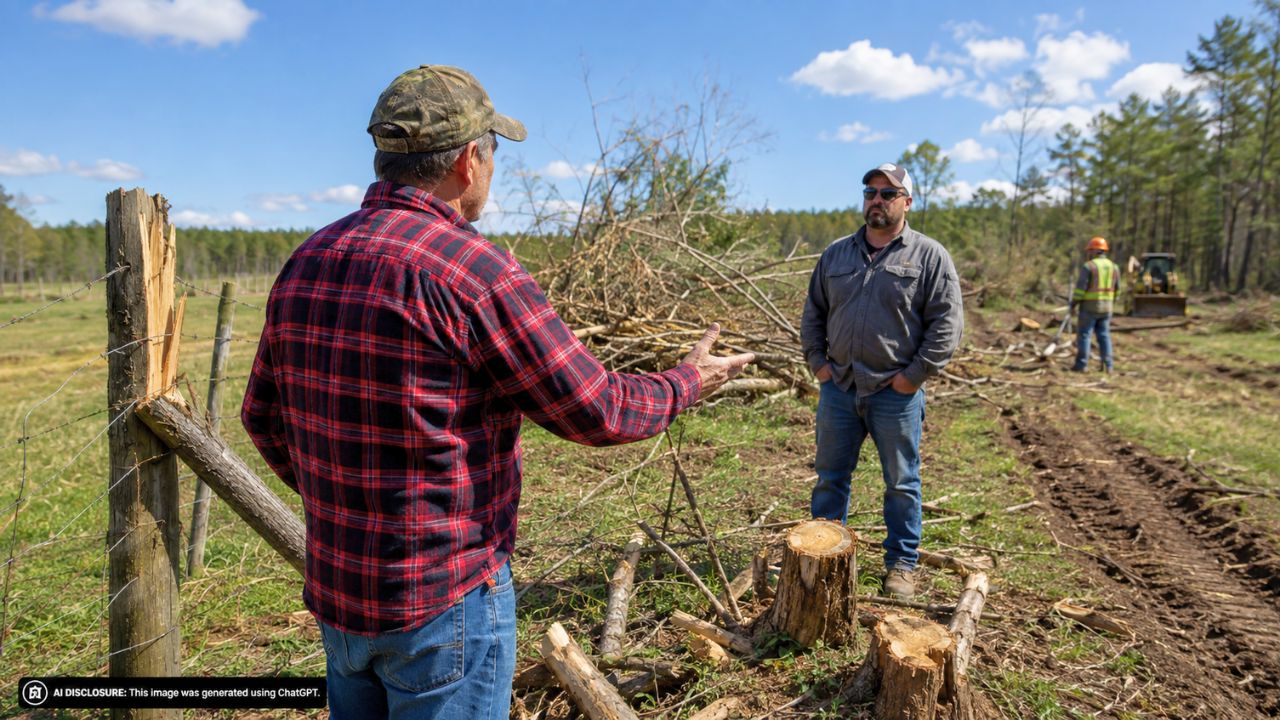
Photo credit: AI-generated image created using ChatGPT. Illustrative only.
The sound of land getting “cleaned up” can be oddly comforting in the country—chainsaws in the distance, brush piles growing, a new place finally getting some attention. But one North Carolina rural landowner says that familiar noise turned into a stomach-drop moment when the clearing crossed a line that wasn’t up for interpretation: his property line.
In the original post, he describes walking out to find his fence “obliterated” and several large trees cut down that he says were “100% on my property.” The new neighbors, he says, had hired “random unskilled people” to clear their newly purchased lot. And now the damage was sitting on his side of the boundary, like it belonged there.
A clearing job that didn’t stop at the property line
The homeowner’s description is the kind that makes other landowners instantly picture the mess: heavy equipment squeezing through, a fence line treated like a suggestion, mature trees dropped without a second thought. A fence isn’t just decoration out in rural areas—it’s a boundary marker, a livestock barrier, a dog barrier, and sometimes the only thing keeping someone’s “work” from becoming your problem.
He says the crew didn’t just bump the fence or loosen a section. They “obliterated” it. And the trees weren’t questionable saplings growing near a shared edge—he says they were large trees entirely on his property, meaning someone had to push past the fence line (or remove it) to take them.
When he confronted the workers, he tried to keep it calm. The response he says he got back was the brush-off: “Sorry no speak English sir.” Whether that was true, an excuse, or just a way to end the conversation, it left him staring at damage with no on-site accountability.
When the police won’t even write it down
Here’s where the story takes a turn that many homeowners will recognize: the moment you realize you can’t count on a quick official record to anchor the whole thing. The homeowner says his wife got home first and called the police, but they “wouldn’t even make a report.”
For anyone dealing with property damage, that matters. A report isn’t just about getting someone arrested; it’s a timestamp. It’s a formal note that something happened on a certain day, at a certain place, with a certain kind of damage. Without it, you’re often left trying to build your own paper trail from scratch while the other side has plenty of time to change their story—or simply vanish.
And in rural disputes, “vanish” can be literal. A clearing crew can be there one day and gone the next, leaving behind ruts, stumps, and a broken fence as proof they existed.
The only name he got came with “someday” promises
After the police wouldn’t document it, the homeowner’s wife managed to get the name of the “owner” of the clearing company. That should have been progress. Instead, the next part will sound familiar to anyone who’s ever tried to get a contractor to take responsibility after the check clears.
He says the clearing company boss offered “empty promises of fixing the fence at some future date.” Not a scheduled repair. Not a written commitment. Not a plan to replace the trees or even discuss what was cut. Just vague assurances that something might be done later.
Meanwhile, the homeowner couldn’t even track down the actual owner of the neighboring property. That detail makes the whole thing feel especially unstable. If you can’t identify who hired the crew, you’re stuck negotiating with the hired help—or their boss—while the real decision-maker stays out of reach.
It’s the kind of limbo that turns a straightforward boundary violation into a slow-burn mess: broken fence today, animals wandering tomorrow, and a lingering worry that the crew will come back and “finish” the job the same way they started it.
The damage isn’t just wood and wire—it’s time, money, and leverage
The homeowner’s question is blunt and practical: should he call a lawyer? He’s already thinking about the math. He worries that legal costs could match—or exceed—what he’d recover “years from now,” making it feel like a waste of time.
That’s the trap with rural property damage. The physical items have a price—fence materials, posts, hardware, labor, cleanup. But the bigger cost is the leverage you lose when you don’t have clear documentation and the other side is dragging their feet. Every day that fence sits broken is another day the damage becomes “old news,” another day weather and animals can make it worse, another day the other party can claim it “must have already been like that.”
And with trees, the stakes can climb quickly. A large tree isn’t just a trunk on the ground. It’s shade, windbreak, privacy, erosion control, and time—decades of growth that can’t be replaced with a quick trip to the nursery. Even if the neighbor pays something later, the land doesn’t rewind.
The homeowner also points out he’s in North Carolina. In many states, tree disputes can turn into a specialized corner of property law, and it’s one reason people seek targeted advice when timber gets cut on the wrong side of the line.
How readers sized it up: prove it, then move fast
Even from the limited details, the reactions this kind of story tends to draw are predictable for one reason: it’s hard to win a property-line fight with just frustration. People tend to push the same theme—get proof before the trail goes cold.
In situations like this, readers often focus on documenting the boundary and the damage immediately: photos of the broken fence line, stumps, tire tracks, and any remaining markers; preserving any receipts or records of the original fence installation; and writing down the timeline while it’s fresh. When the police won’t write a report, that documentation becomes even more important because it’s all you have to show this wasn’t some long-running fence issue.
There’s also the practical advice people lean on in boundary disputes: identify the actual landowner and put communication in writing. A clearing company might offer apologies, but the neighbor who hired them is often the person with the property interest—and the one who may be responsible for what happened. The homeowner’s struggle to find the new owner’s name is a big flashing warning sign that he may need to pull property records or otherwise confirm who he’s dealing with.
And yes, the “call a lawyer” refrain shows up for a reason. Not because everyone wants to escalate, but because once trees are gone and fences are down, the question becomes less about neighborliness and more about liability.
A rural boundary dispute that doesn’t fix itself
The hard part of this story is that it’s already past the point where a simple handshake fixes it. The fence is down. Trees are gone. The workers won’t talk. Police wouldn’t document it. The clearing boss is offering a vague “someday” repair. And the homeowner still can’t even identify the neighbor who should be stepping up.
Out in the country, you can tolerate a lot—noise, dust, equipment on the road, projects that take longer than planned. But you can’t tolerate a moving property line, especially when it’s enforced with a chainsaw. Whether this ends in a repaired fence and a check, or months of stalling and finger-pointing, it’s already become the kind of conflict that changes how you look at your own boundary markers.
For now, the homeowner is left with the most aggravating kind of damage: the kind you didn’t cause, can’t ignore, and can’t neatly undo. And until someone takes real responsibility, the property line isn’t just a line on a map—it’s the next place he’ll be watching.
Like Fix It Homestead’s content? Be sure to follow us.