Rural Property Owner Finds a Neighbor’s Water Line Running Sixty Feet Across the Land With No Recorded Easement — Then the Neighbor Says the Pipe “Has Squatter’s Rights by Now”
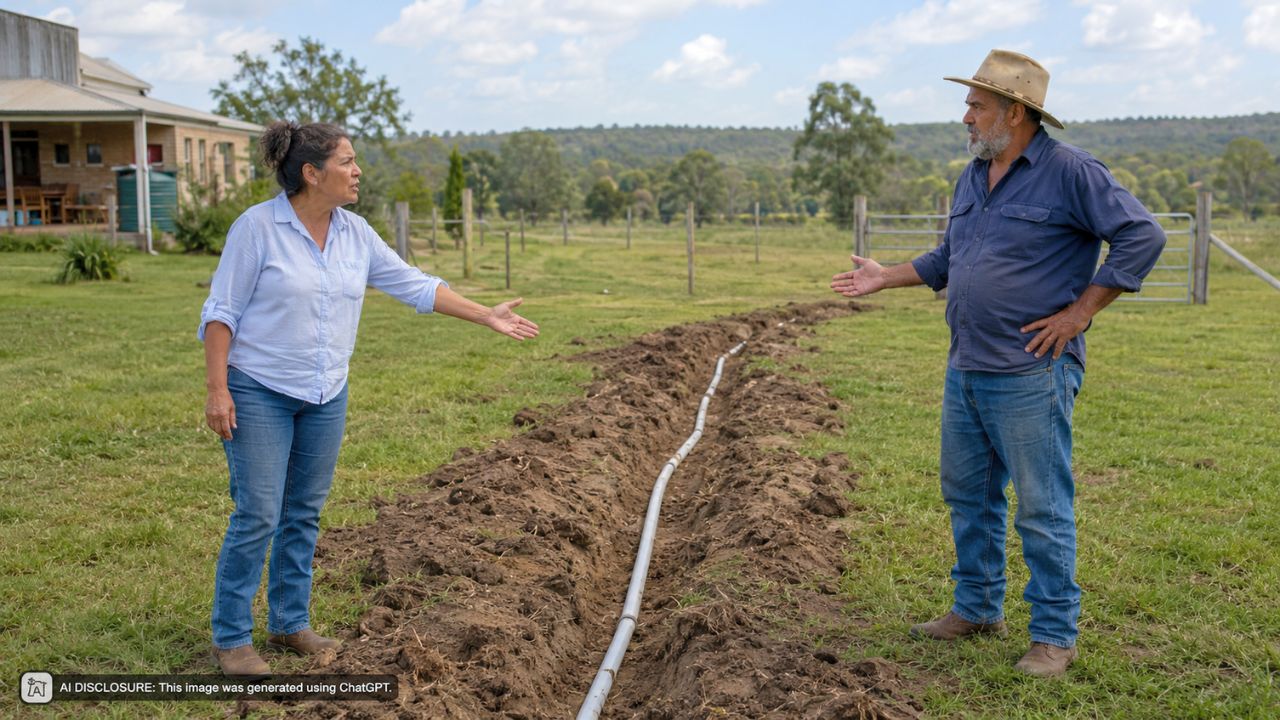
Photo credit: AI-generated image created using ChatGPT. Illustrative only.
It started with something that looked like a simple yard problem: water bubbling up in the corner of a rural property owner’s lawn. Not a puddle from rain, not a soggy patch from a downspout—water coming up from below, the kind that makes you think “broken line” before you think “neighbor drama.”
When the city investigated, the homeowner learned the leak wasn’t even on their service. It was the next-door neighbor’s water line—running across the homeowner’s yard. And according to the homeowner’s follow-up with city hall, the deed, the plat survey, and the water utility, there was no recorded easement allowing it. The details were shared in the original post, and the deeper they dug, the messier it got.
The first sign was water where it didn’t belong
The homeowner said they discovered the problem about 3½ years earlier, when water surfaced near the corner of the yard. After the city traced the issue, it pointed straight to the neighbor’s line—apparently routed across the property instead of staying within the neighbor’s boundaries.
In the moment, the homeowner did what a lot of people do when they’re trying to keep things peaceful: they agreed to let the neighbor fix it. The repair, they were told, would only go about 10 feet into the yard. No big trench. No yard overhaul. Just a targeted dig and a promise to restore what got disturbed.
A “simple repair” turned into a yard makeover nobody asked for
The corner of the yard wasn’t just open grass. The homeowner described a privacy border—bushes roughly 8 to 10 feet tall—doing the job that fences and distance do for a lot of rural properties: blocking sightlines and creating a clear “this is my space” boundary.
Instead of a small repair, heavy equipment showed up. A backhoe was parked inside the yard, and the homeowner says the work destroyed an additional 40 feet of those privacy bushes beyond what they expected to be impacted.
Then came the “fix.” The neighbor replaced the tall privacy bushes with 18-inch shrubs, leaving the homeowner’s yard exposed. The homeowner said they expected something more like 4- to 6-foot bushes—still not the original mature barrier, but at least something that could function as privacy sooner rather than years later.
No easement on file, but the pipe is already in the ground
Once the dirt is disturbed and the landscaping is gone, the question stops being theoretical. It becomes: what rights does the neighbor actually have to keep a water line running across someone else’s land?
The homeowner checked with city hall and also reviewed the deed, plat survey, and information from the water utility. They said all of it showed the same thing: no easement. In other words, nothing recorded that would give the neighbor permission to occupy that strip of land underground with a private water line.
That’s when the homeowner’s focus shifted from “please restore my bushes” to “can I make him remove it or stop using it?” Because even if the neighbor patched the leak perfectly, the line was still there—still crossing the yard, still something that might need future repairs, and still a reason for equipment to show up again.
The homeowner fell into the “how long do I have?” trap
Trying to make sense of the situation, the homeowner started reading Wisconsin statutes and ran into the same buzz saw that confuses regular people every day: multiple legal time clocks that sound similar but mean different things.
They referenced a section about actions concerning real estate that mentions 30 years, but they also found language about prescriptive rights by adverse use that mentions 20 years. That sent them into a spiral of uncertainty: do they have decades to sort it out, or does waiting risk the neighbor gaining some kind of permanent right to keep that line there?
The homeowner’s fear wasn’t abstract. Their property had already been altered. The corner was “ruined” in their words, and the big privacy screen they’d relied on was gone, replaced with small shrubs that would take years to do the same job—if they ever did.
What people keyed in on: documents, boundaries, and not giving away rights
Even without a full comment thread included in the source material, the homeowner’s update hints at the kind of guidance property owners tend to hear in these moments: verify everything in writing, and don’t rely on verbal assurances when underground utilities and property rights are involved.
The homeowner did one important thing early—getting confirmation from official sources that no easement existed in the usual places (city hall, deed, survey, utility records). That sort of paper trail matters because a neighbor’s confident statement can sound like “truth” until you realize it’s just a claim.
And once a neighbor has already brought in heavy equipment, “being nice” stops feeling like a harmless choice. Letting someone dig once can turn into repeated access later. It can also create an argument—fair or not—that permission was granted and should continue. That’s why these disputes often turn into a race to document: photos, dates, property records, and exactly what was agreed to when access was first allowed.
The real damage wasn’t only the leak—it was the precedent
A leaking water line can be fixed. A patch of torn-up yard can be reseeded. But a buried line crossing a property without a recorded easement is the kind of thing that comes back, especially when the neighbor now knows the route is “available” and repairs can be made through someone else’s yard.
The homeowner’s frustration wasn’t just about shrubs. It was about losing control over their own land—watching a 10-foot repair expand into significant destruction, then getting a minimal replacement that didn’t restore the privacy they had before.
And hanging over all of it was the underlying question: if the neighbor keeps using this line for long enough, can time itself turn an unauthorized setup into a right? That’s the kind of claim that fuels hard feelings fast, because it frames the homeowner’s land as something the neighbor can eventually acquire use of simply by continuing to use it.
For now, the homeowner is left with an exposed yard edge, a neighbor’s utility line under their soil, and a set of statutes that don’t read like plain English. It’s the kind of property problem that starts with water in the grass and ends with you staring at your boundary line wondering how much of it you actually control.
Like Fix It Homestead’s content? Be sure to follow us.
- Man Says He Found Out the Fence He Paid For Wasn’t Actually on His Property
- Woman Says Her Neighbor Started Taking Mulch From Her Delivery Pile Before She Could Even Spread It
- I made Joanna Gaines’s Friendsgiving casserole and here is what I would keep
- What Caliber Works Best for Groundhogs, Armadillos, and Other Digging Pests?