Rural Property Owner Finds a New Gravel Lane the Neighbor Graded Straight Across the Back Forty — Then the Neighbor Says the Access Road Was Already Agreed to Years Ago
Photo credit: AI-generated image created using ChatGPT. Illustrative only.
It started the way a lot of rural boundary problems start: a neighbor “fixed” something with a machine, and the change looked permanent before anyone had time to measure it. A property owner noticed a driveway that didn’t quite sit where it felt like it should—just enough of a drift to nag at the back of your mind, but not enough to justify the cost and drama of a survey at the time.
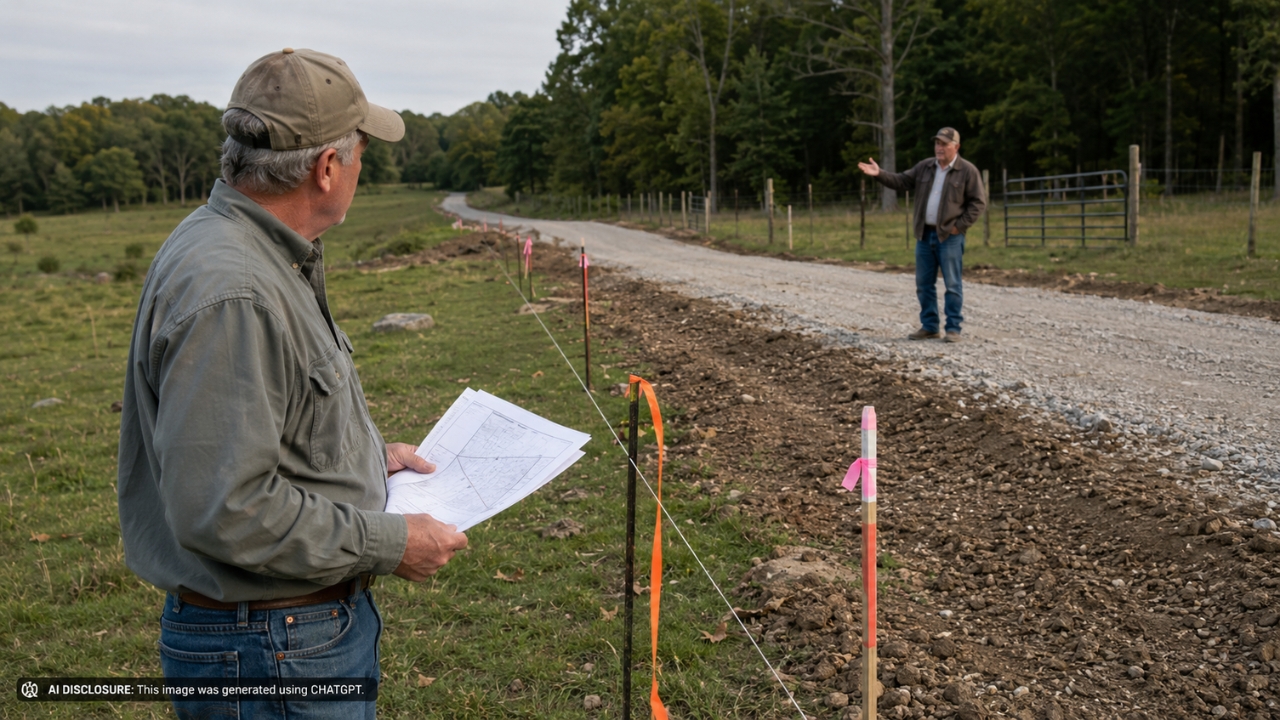
Years later, the tape measure finally came out, and the numbers weren’t small. In the original post, the homeowner explains that a surveyor recently showed them a marker sitting right on the driveway line, confirming the neighbor’s driveway is about 1.5 feet inside their property.
The first sign was easy to brush off
The homeowner says they were skeptical when the driveway work happened a few years ago. They didn’t like the look of where the edge fell, but they also didn’t want to stir up trouble—especially with “old neighbors” they describe as terrible. And in the country, that decision makes a certain kind of sense.
Surveys cost money. Fights cost peace. And when you’re not planning to build a fence, sell the place, or pour concrete, a foot or two can feel like something you can live with.
Except it never really goes away. It sits there in your peripheral vision every time you mow, every time you walk the line, every time you think about where the real boundary is.
A dog fence turned a nagging worry into a real number
The reason this bubbled back up wasn’t a feud. It was a fence. The homeowner finally ordered a survey because they want to put in a dog fence in the backyard. That’s when the driveway stopped being a suspicion and became a marked point on the ground.
The surveyor didn’t just tell them “it’s over the line.” They showed the homeowner the marker on the driveway and made it clear the encroachment was “significant.” In a tight suburban lot, 1.5 feet might be the difference between fitting a gate or not. In a rural setting, the bigger issue is what that 1.5 feet represents: an established use, improved access, and a visible claim that can get more complicated the longer it sits.
And there’s another twist. The difficult neighbors are gone. The new neighbors are, by the homeowner’s account, “great.” That changes the emotional temperature completely—because now it’s not about punishment or winning. It’s about preventing a future mess while keeping a good relationship intact.
The awkward part: “I don’t want to make this an issue”
This is the kind of property dispute that can go sideways even when nobody wants it to. The homeowner is clear: they don’t plan on making it an issue for the current neighbors. They’re not looking to rip up a driveway, demand cash, or start a boundary war.
But they also don’t want a quiet encroachment turning into a headache later—especially if they sell. A new buyer, a picky lender, or a title company can turn “we all get along” into “this needs to be resolved before closing.” And once a sale is on the line, everyone’s stress level goes up.
The homeowner’s bigger fear is what happens if the driveway stays right where it is without any documentation. They don’t want the neighbors to “take over the land if it sits this way.” Even without diving into legal jargon, most rural owners understand the common-sense version of that worry: if someone uses a piece of your property openly for a long time, it can start looking like it was always theirs.
The surveyor’s advice: tell them, and get it in writing
The surveyor’s recommendation was straightforward: inform the neighbors and get something in writing. Not as a threat, but as a way to keep the record clean so it doesn’t become a surprise problem later.
That’s where the homeowner’s questions get very practical, very fast. What is the “proper way” to document it? What wording should be used? Is an email enough, or does it need to be notarized?
Those questions reveal what this really is: not a feud, but a documentation problem. The driveway isn’t new anymore. It’s been there for years. The neighbor relationship is good now. The homeowner is trying to take the temperature down while still putting a fence—literal and paper—around what they own.
Because in real life, boundary trouble often isn’t about the first person who did the grading. It’s about the third person, years later, who pulls out a plat map and decides they’re done being flexible.
Readers zeroed in on proof and paper, not a showdown
Even without a blow-by-blow argument in the post, the direction is clear: this is one of those moments where homeowners start thinking like record-keepers. The survey already created a “before and after” line in the sand, and the surveyor’s push to document it highlights a common rural reality—verbal understandings don’t always survive a move-out truck.
When a driveway crosses a line, it’s not just a strip of gravel. It’s access. It’s maintenance. It’s plowing. It’s who can widen it, who can ditch it, who can put in a culvert later. And once you’ve got a fence planned for a dog, the physical layout of the yard suddenly matters every day.
That’s why so many people in these disputes focus on keeping things calm but formal: clear communication, clear boundaries, and something that can be handed to a future buyer without a long story attached.
Living with it versus fixing it: the tension that doesn’t go away
The homeowner is caught in a familiar homestead bind. If they push too hard, they risk souring a good neighbor relationship over a mistake made by someone else. If they do nothing, they risk turning a small encroachment into a future transaction-stopper—or a long-term claim that becomes harder to untangle.
And meanwhile, there’s a dog fence to build. Posts and panels don’t care about anyone’s intentions; they care about where the line is and where the driveway sits. If the fence goes up tight to the surveyed boundary, it could spotlight the driveway’s position in a way that feels like an accusation even if it isn’t meant to be.
This is the rural property version of a hairline crack in a foundation: you can ignore it for a while, but eventually you need to know whether you’re looking at cosmetic annoyance or the start of something that changes the value and usability of the place.
For now, the homeowner seems to be aiming for the least dramatic path—notify the neighbors, document the reality on the ground, and keep everyone friendly. It’s not the loudest kind of property fight, but it’s the kind that can quietly shape what your land is worth, what you can build, and how easy it is to hand the keys to the next owner without leaving them a boundary problem as a housewarming gift.