Rural Property Owner Finds a Padlocked Gate the Neighbor Installed Across a Recorded Easement — Then the Neighbor Says the Road Is Now on Private Property
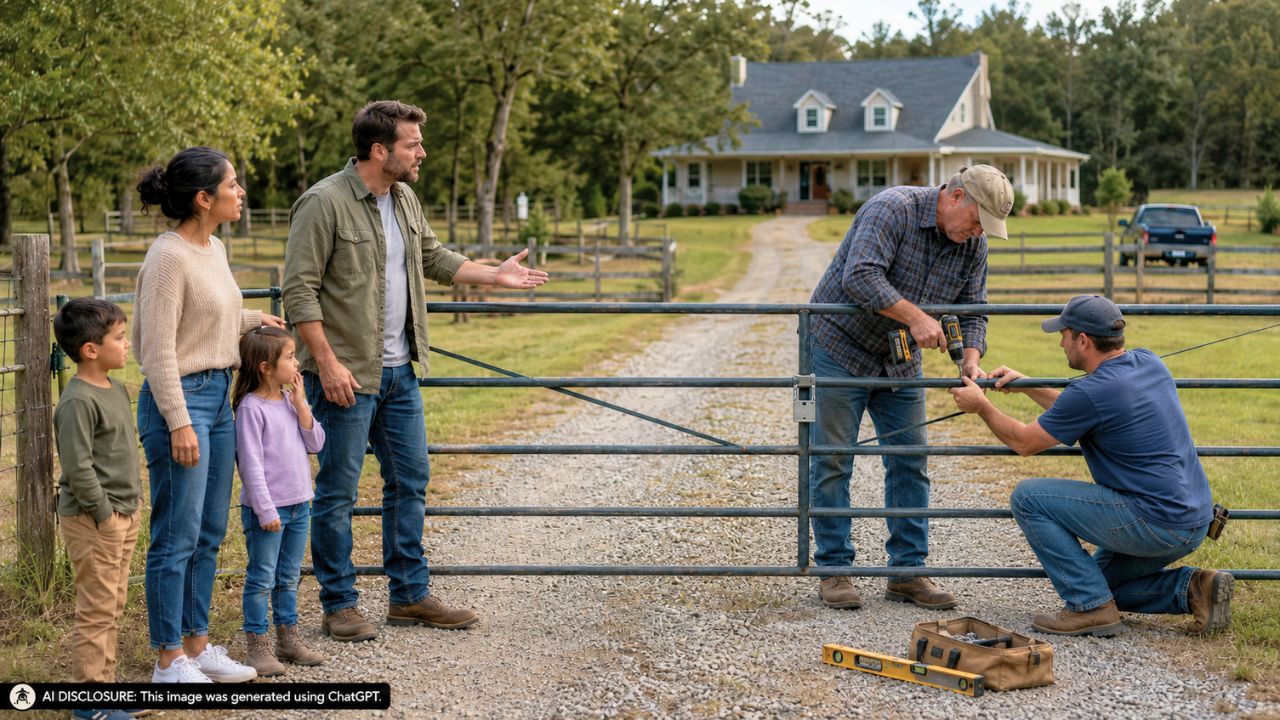
Photo credit: AI-generated image created using ChatGPT. Illustrative only.
The house came with a long driveway, two small kids, and the kind of shared-access setup that looks harmless on closing day. Then, a few weeks after moving in, the new owners heard banging so hard their house shook. When they looked outside, someone was installing a gate across the drive—right on their side of the line.
In the original post, the homeowner describes buying a property where a recorded easement lets the neighbor pass over part of the driveway to reach parking by his house. There’s also an old, unusual detail: a garage and a back portion of driveway were sold off decades ago (the homeowner says around 1942, for $1), leaving today’s lots tightly interlocked with no clear separation between the yards.
The first sign was easy to brush off
At first, the homeowners tried to assume the best. The neighbor—an older man who lives alone—had been away when they moved in, so introductions hadn’t happened yet. A friend who lives nearby explained the neighbor worried someone would start driving to the back and block his garage, where he keeps a boat and a vintage car.
The new family didn’t plan to drive into the back anyway, so the gate looked like a nervous but understandable move. The husband even went to the neighbor’s door to introduce himself and reassure him, but no one answered. When they finally met outside, the neighbor said he put up the gate because he didn’t want anyone bringing cars back there, but told them they could open it any time they needed.
That sounds almost cooperative—until the gate became the opening move in a much bigger argument about what the neighbor believed he was entitled to use.
A gate turns into a claim on the backyard
The homeowners told the neighbor they planned to fence their yard, partly because the properties aren’t separated and they have small children. According to the post, the neighbor immediately said they couldn’t, because there was “an easement in the back.”
The homeowners checked what they had: the survey, their purchase paperwork, and town records. They found documentation for a front easement/shared driveway access, but nothing recorded in the back. The neighbor still insisted they couldn’t put the fence where their line actually ran, because he “needs to be able to back his car into our yard to get his boat out of his garage.”
That’s where this starts to feel less like a parking concern and more like a slow-motion property grab. The fence line wasn’t just about keeping kids safe—it would also prevent the neighbor from using their yard as a turning radius.
The building expansion brought a new map—and new pressure
Then came the letter that changed the tone. The homeowners received notice from an architect: the neighbor planned an addition, including a master suite, because his current bedroom is upstairs. When the homeowners reviewed the blueprint, they say it included a proposed property line and a back easement that didn’t match the records they’d found.
They went to a board meeting and objected to what they were seeing. Per the post, the town approved the plans but without including the new easement. Another meeting was expected for the final blueprint, and the homeowners planned to attend again to make sure the back easement didn’t quietly reappear.
In the middle of that, the architect reportedly asked where the fence would go. The homeowner drew a straight line down the property boundary shown on the survey. The reply came back: the neighbor preferred the fence be installed “per the sketch,” working around the paved blacktop. The homeowner says that “per the blacktop” would sit 20–30 feet away from the actual line—space that would effectively become the neighbor’s maneuvering room.
So now it wasn’t only a conversation on the sidewalk. It was being reflected in plans and drawings, where a “preferred” line can start to look official if nobody pushes back.
The padlock is one problem. The water is another.
The homeowners’ biggest day-to-day concern wasn’t just access—it was the house itself. After a rainstorm, they got water in their basement for the first time. Not during earlier major storms, they said, but after the gate had gone in.
What made it feel connected was the location. The water appeared on the same side of the house where the gate had been installed, essentially above the basement area that got wet. It wasn’t a lot of water yet, but homeowners know how that story can go: a little becomes recurring seepage, then mold, then damaged finishes, then the question nobody wants—what changed outside to send water toward the foundation?
Even if the gate wasn’t the direct cause, the timing was bad. Any digging, post holes, changes in grade, compacted soil near the foundation, or redirected runoff can turn “never had an issue” into “why does my basement smell damp now?” And in neighbor disputes, the practical problem becomes proof: documenting what happened, when, and what the property looked like before it was altered.
What people told them to do next: document first, then enforce the paperwork
The homeowner was looking for guidance and next steps, especially around the gate and the alleged back easement. The post notes that the town made the neighbor remove the gate because it was installed without permits. That removal matters, because it shows two things at once: the gate wasn’t authorized, and the town was willing to act when asked.
In disputes like this, the most consistent advice tends to be boring but effective: keep everything in writing, stick to surveys and recorded documents, and don’t let “everyone knows this is how it’s been” replace what’s actually filed. The homeowner had already done some of the hard, unglamorous work—checking the survey, confirming what the town had on record, and showing up at meetings when a new easement appeared on a drawing.
And while the post itself focuses on the facts on the ground, the underlying theme is familiar to anyone who’s lived next to a shared driveway: an easement can be real and still limited. Access is not the same thing as permission to expand the use, widen the turn, move the boundary, or install obstacles. When one neighbor starts treating “needs room” as a legal right, the only way to keep the peace is often to keep the record straight.
Two families, one strip of pavement, and no room for assumptions
By the time the gate was removed, the homeowners were left with a yard they still wanted to fence, a neighbor who still claimed a back easement without producing documentation, and a basement that had suddenly taken on water. The neighbor’s expansion plans added another layer of urgency, because drawings and approvals have a way of turning temporary demands into permanent realities.
This is the kind of homeownership problem that doesn’t stay theoretical. A few feet of driveway and a patch of backyard can turn into access issues, kid-safety issues, construction issues, and drainage issues all at once. And once someone starts acting like your property is theirs to use, the cost isn’t just measured in repairs—it’s measured in how quickly you have to become the kind of homeowner who keeps records, attends meetings, and refuses to accept a padlock as a new normal.
Like Fix It Homestead’s content? Be sure to follow us.