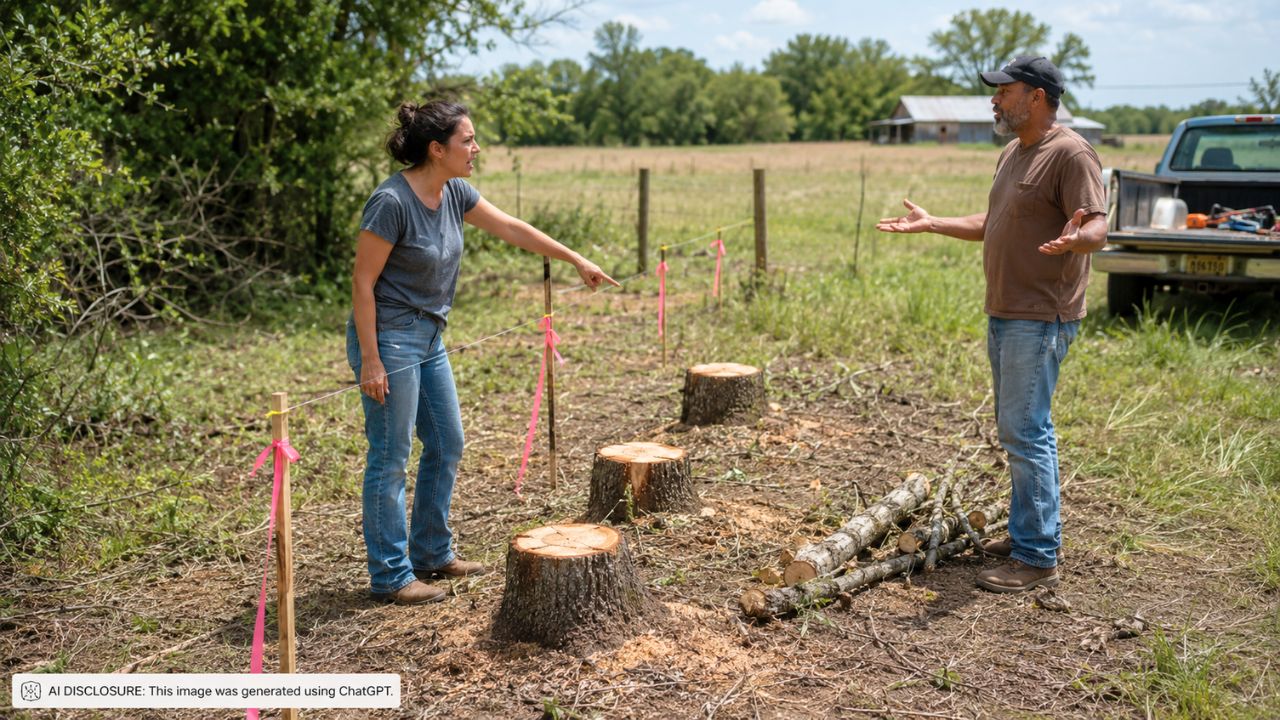
Rural Property Owner Finds the Neighbor Removing Three Boundary Trees Right After a Survey Crew Marked the Line — Then the Neighbor Says the Stakes “Don’t Mean Anything Legally”
Photo credit: AI-generated image created using ChatGPT. Illustrative only.
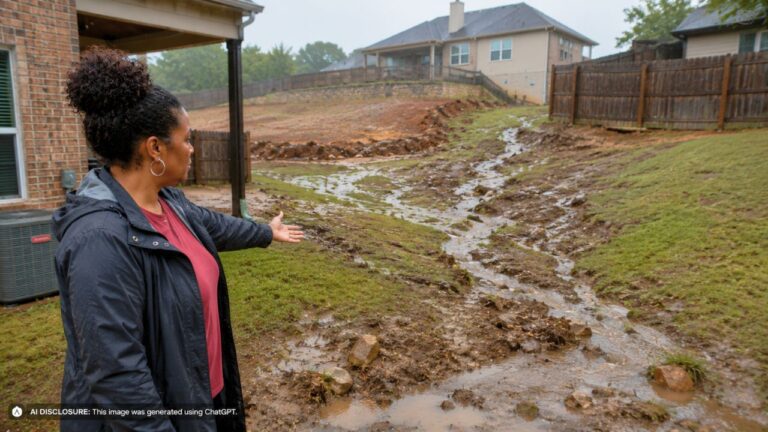
The homeowner thought the fence line was doing its job—quietly, reliably, and without drama. Then one day the “privacy barrier” behind it was just… gone. Huge trees that had blocked sightlines and noise were suddenly torn down, leaving a wide-open gap and that exposed, uneasy feeling you get when a property stops feeling like yours.
In the original post, the property owner explained they believe their land extends beyond the fence and that the removed trees may have been on their side of the true boundary. The neighbor insisted the opposite—that their property was already surveyed and runs right up to the fence—then tried to shut down any further back-and-forth by pushing the homeowner toward the HOA instead of a direct conversation.
A fence line is not always a property line
This is the part that trips up a lot of otherwise careful homeowners: fences are often installed for convenience, livestock, terrain, or old handshake agreements. They can drift off the true line over the years, especially on lots where nobody has checked the corners in a long time. A fence can feel like “the line” for decades, right up until someone makes a permanent change—like cutting down mature trees.
The homeowner said satellite imagery shows the property line beyond the fence, which only added to the frustration. On a practical level, they didn’t just lose trees. They lost screening, shade, and a sense of separation—things that take years to grow back. And once trees are down, you don’t get to “undo” it while everyone sorts out whose dirt they were rooted in.
When the trees came down, the real damage wasn’t just the view
People who don’t live with a rural or semi-rural edge sometimes underestimate what a line of big trees actually does. It blocks headlights. It dulls sound. It keeps dogs from pacing the fence. It discourages casual wandering. It also helps with wind, dust, and even how water moves during heavy rain.
So when the neighbor removed the trees behind the fence, it wasn’t just an aesthetic loss. It created a “gaping hole,” the homeowner wrote, where privacy used to be. That changes how you use your yard. It changes how safe you feel letting kids or pets out. It can even change whether you feel comfortable keeping curtains open in your own house.
And then there’s the money side. Mature trees aren’t like a broken gate latch you can fix in an afternoon. Replacing them means years of growth—if replacements survive at all—plus the cost of planting, watering, fencing off deer, and hoping the neighbor doesn’t complain when the new trees start “encroaching.”
The neighbor’s stance: “We already know it’s ours”
The homeowner planned to get a survey, which is usually the first solid step when the only thing everyone agrees on is that they disagree. But the neighbor reportedly said they wouldn’t allow a surveyor onto what they “already know is their property.” That’s the kind of statement that makes a boundary problem feel less like confusion and more like a power move.
Instead of engaging directly, the neighbor told the homeowner to go to the HOA. And they offered a blunt workaround: plant new trees on your side of the fence, because they’re “not responsible” for the homeowner’s privacy.
Whether that response is legally meaningful or not, it’s socially meaningful. It signals the neighbor isn’t interested in compromise, and it puts the homeowner in a bind: accept the loss and start over, or spend the time and money to prove where the line actually is—after the trees are already gone.
The survey problem: proof costs money, but guessing costs more
Once trees are removed, the question becomes painfully specific: where were the trunks relative to the boundary? Not the fence. Not the “usual understanding.” The actual line. Without a current survey, the homeowner is left trying to build certainty out of imperfect tools like satellite images and old assumptions.
Satellite imagery can be helpful for getting oriented, but it’s not a boundary determination. It can make you feel more confident—or more suspicious—but it won’t settle anything on its own. That’s why the homeowner’s instinct to get the property surveyed matters, even if it feels late.
The neighbor pushing back on survey access adds a layer of tension. Even if a surveyor can do much of the work from the homeowner’s side and from public points, boundary work often involves locating and verifying monuments or corners that may sit near or across the disputed area. When one neighbor tries to block that process, it can slow everything down—and it can make the homeowner feel like they’re being boxed out of their own documentation.
What people urged: document first, then decide who to fight with
The homeowner came looking for thoughts and advice, and the theme that tends to surface in these disputes is the same: stop relying on what anyone “believes,” and start collecting what can be proven.
In practical terms, that usually means getting a professional survey (not an app), keeping communication in writing when possible, and documenting what changed on the ground—photos of the gap, the remaining stumps if any exist, the fence line, and any recent markers. Once a tree is gone, the stump location can become one of the only physical clues left about where it stood.
The HOA mention is also telling. HOAs sometimes control fencing rules, architectural changes, and common-area issues, but they’re not automatically the authority on property boundaries. The neighbor steering the homeowner to the HOA can be seen as an attempt to shift the battlefield to a venue that’s slower, political, and often more focused on appearances than land records.
Now the homeowner has a bare spot—and a long road back to normal
No matter how the boundary question eventually shakes out, the homeowner is stuck living with the aftermath right now. There’s a hole where the privacy barrier used to be, and that hole comes with daily reminders: more visibility, more noise, and that awkward feeling of being watched from an angle that used to be blocked by foliage.
If the trees truly were on the homeowner’s side, the loss could be significant in a way that’s hard to measure without experts. If they were on the neighbor’s side, the homeowner still has to deal with the practical reality that their yard has changed and the fence no longer feels like a buffer.
That’s the miserable truth about boundary-tree disputes: you can be completely right and still be the one staring at an empty skyline while paperwork crawls forward. And once neighbors start treating stakes, fences, and “what we already know” like weapons, the land itself becomes secondary to the standoff. The homeowner just wanted their quiet back. Now they’re staring at open space and trying to figure out what, exactly, they still own.
Like Fix It Homestead’s content? Be sure to follow us.