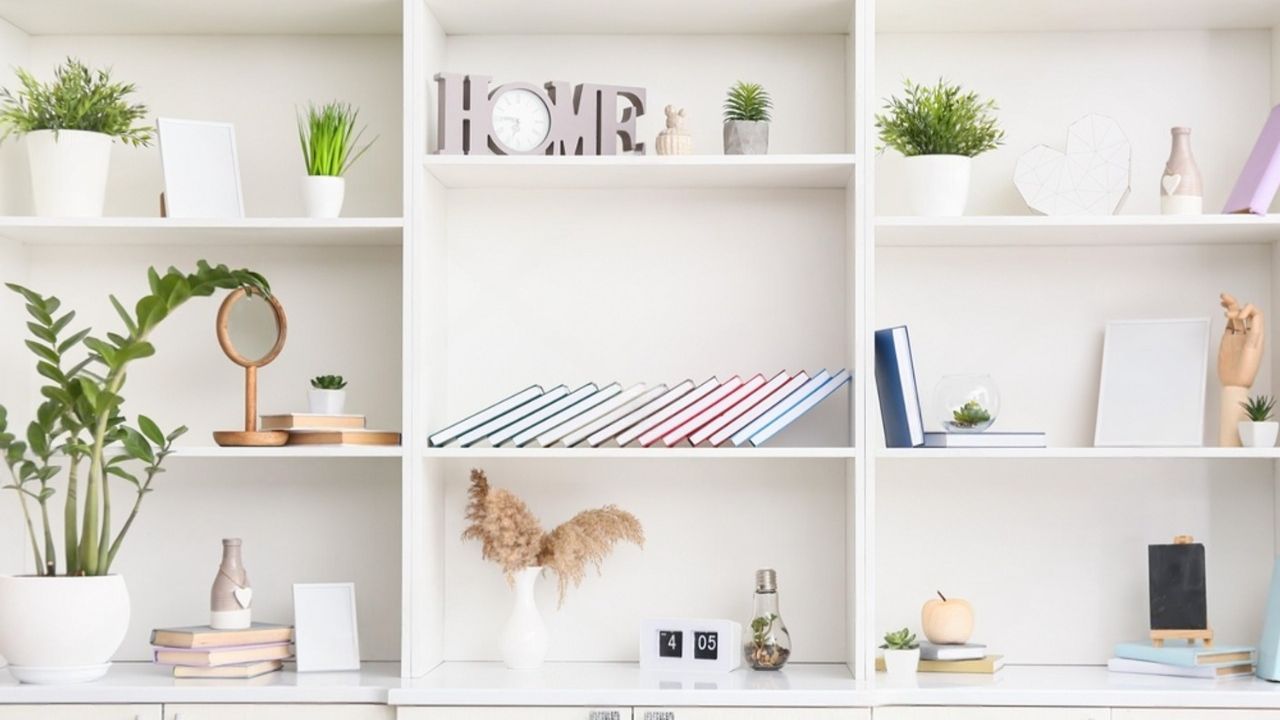
The shelf styling mistake that makes a house look cluttered even when it’s clean
Photo credit: Pixel Shot/Shutterstock.com
Even the most spotless room can feel chaotic if your shelves are visually noisy. The biggest culprit is not dust or grime but the way you arrange what you own, a styling misstep that makes every surface read as clutter even when you have just cleaned. Once you understand how that mistake works, you can turn the same objects into a calm, intentional backdrop instead of a constant source of visual stress.
The core problem is overcrowding: packing in too many small, unrelated pieces so your eye has nowhere to rest. When you learn to edit, group, and scale your decor, your shelves start to frame your life rather than shout over it, and the rest of the room instantly feels more ordered and polished.
The real mistake: treating shelves like storage, not composition
The most common styling error is using every inch of shelf space as if it were a storage unit. When you line up books edge to edge, stack trinkets in front, and tuck extra items into any remaining gap, you create a dense wall of stuff that reads as clutter, no matter how clean it is. Designers repeatedly warn that displaying too much on open shelves makes them appear cramped and messy, even if every object is technically in its place.
When you stop thinking of shelves as storage and start treating them as a composition, the visual noise drops immediately. That shift means accepting that not everything you own deserves a permanent front-row seat, and that negative space is as important as the objects themselves. It also means paying attention to how your eye travels across a wall, rather than how many items you can squeeze in, which is why stylists talk about balance, rhythm, and focal points instead of “fitting one more thing.”
Why “too many smalls” make a clean room feel chaotic
Even if you are not technically overcrowding, you can still fall into the trap of filling shelves with dozens of tiny objects. A cluster of miniature vases, figurines, and souvenirs might each be charming, but together they fragment the view into visual static. One home decorator summed it up bluntly in a Reddit thread, noting that the problem was “Right. There are too many ‘smalls’ and not enough ‘bigs’”, a diagnosis that applies to countless shelves.
Designers echo that logic when they warn that tiny decor items might seem harmless individually but quickly crowd a space when grouped without intention. Your eye has to stop and process each little piece, which creates a sense of busyness that spills into the rest of the room. Replacing a scatter of smalls with a few larger, more substantial objects instantly calms the composition and makes the entire wall feel more deliberate.
Overcrowding: the fastest way to make shelves look messy
Overcrowding is the shelf styling mistake that does the most damage in the least time. When every shelf is packed edge to edge, you lose any sense of hierarchy, and the whole unit reads as a single, overwhelming block. Experts list Overcrowding, too many trinkets, busy color schemes, and open storage bins among the top reasons shelves always look cluttered, even when you have just dusted.
That same logic shows up in broader decorating advice that warns against Crowding Open Shelves. Open shelves are meant to showcase a curated selection, not act as a catchall for every mug, candle, and framed photo you own. When you leave breathing room around objects, you create clear sightlines and negative space, which makes the room feel larger and calmer. Editing down to what you actually want to see every day is not just a styling choice, it is a way to reduce visual stress.
The power of proportion: using “bigs” to anchor your display
Once you stop overcrowding, proportion becomes your most powerful tool. A few substantial pieces can anchor a shelf and make everything else feel intentional. Professional stylists emphasize that Proportion is as important for shelf accessories as it is for furniture, recommending a handful of larger objects such as sculptures, vases, or framed art instead of a long line of items that are all the same height.
That advice dovetails with the “too many smalls” problem you see in real homes. When you Use your smalls to make bigs, for example by grouping several tiny vases on a tray or stacking books to create a pedestal for a single object, you transform scattered bits into a single, legible focal point. The shelf suddenly has structure: tall pieces at the back, medium elements filling the middle, and a few low items in front, which creates depth instead of chaos.
Color and theme: why a cohesive palette matters more than you think
Even if you nail proportion, a chaotic color story can undo your work. When every spine, frame, and object introduces a new hue, the shelf becomes a patchwork that feels busy at a glance. Stylists advise you to follow a cohesive color palette, theme, or style so your shelves read as one composition rather than a random assortment, noting that sticking to a limited range of tones helps create a more harmonious look.
That same principle shows up in social media tutorials that walk you through the process step by step. One stylist suggests you Gather all your items together and commit to a specific palette across your shelves, using variations of a few core colors to keep things cohesive. When you repeat materials like wood, glass, and ceramic in those tones, you get the “bookshelf wealth” look that celebrates personality without tipping into chaos, a trend that encourages a curated mix of books, mementos, and decor to create warm, lived-in spaces.
Editing like a pro: what to remove before you restyle
Before you can style shelves beautifully, you need to strip them back. That means pulling everything off, then making hard decisions about what returns. Experts repeatedly flag Too many mementos, open storage bins, and busy color schemes as repeat offenders, along with the dirt and dust that quietly build up on crowded shelves. If an item is there only because you did not know where else to put it, it probably belongs in a drawer, a closed cabinet, or the donation box.
Several stylists recommend a simple reset routine. You Start with a blank slate, choose a few favorite anchor pieces, then layer in supporting objects slowly instead of dumping everything back at once. Another creator suggests that if your display feels cluttered or uninspired, you should remove at least a third of what you initially planned to use, then reassess. That deliberate editing process is what separates a curated arrangement from a shelf that looks like a storage overflow zone.
Simple formulas that keep shelves from feeling cluttered
Once you have edited down, a few simple formulas can keep you from sliding back into visual chaos. One of the most reliable is the 3-5-7 rule, which is built on the idea that groupings of odd numbers, specifically three, five, or seven items, are more visually interesting and balanced than even-numbered pairs. Designers explain that this approach creates a sense of balance, but not symmetry, which keeps shelves from feeling stiff or overdecorated.
Social media tutorials translate those principles into quick, repeatable steps. One creator breaks it down into three go-to rules for Interior Design Shelf Styling Tips: create a focal point on each shelf, vary the heights of your objects, and repeat shapes or materials to tie the whole unit together. Another encourages you to Start with larger pieces and then fill in with smaller accents, rather than the other way around. These formulas do not limit your creativity, they give you a structure that keeps clutter at bay.
When “more decor” becomes overdecorated
It is tempting to respond to a bare-looking shelf by buying more accessories, but that instinct often backfires. When your home looks empty, you might feel pulled to bring home everything that catches your eye, only to discover that the result feels overwhelming. Designers warn that When your home looks bare and you rush to fill it, you can easily tip into an overdecorated space that feels busy rather than welcoming.
That warning applies especially to shelves, which are already visually prominent. If you treat every empty inch as a problem to solve, you end up with layers of objects that compete rather than complement. The fix is to embrace restraint: leave some shelves partially empty, repeat a few key materials, and resist the urge to add “just one more” candle or frame. When you do bring in something new, let it replace an existing piece instead of joining an ever-growing collection.
Putting it all together: a step-by-step reset for calmer shelves
To correct the cluttered-shelf mistake in your own home, start with a full clear-out and a quick clean so you are not styling on top of Dirt and dust. Then sort your items into categories: books, functional pieces, sentimental objects, and decor. From there, choose a tight color palette and a handful of larger anchors, like substantial vases or framed art, and place those first, using them to set the rhythm across the shelves.
Next, layer in smaller items using the odd-number rule, grouping them into threes or fives and using trays or stacks of books to turn “smalls” into visually coherent “bigs.” Step back after each round and remove anything that feels like filler. If a shelf starts to look crowded, remember the early warning about Mistake 1: displaying too much, and edit until your eye can travel comfortably from one focal point to the next. The goal is not perfection, it is a set of shelves that support the room instead of overwhelming it, so your home feels calm even on the days when life is anything but tidy.
Like Fix It Homestead’s content? Be sure to follow us.
Here’s more from us:
- I made Joanna Gaines’s Friendsgiving casserole and here is what I would keep
- Pump Shotguns That Jam the Moment You Actually Need Them
- The First 5 Things Guests Notice About Your Living Room at Christmas
- What Caliber Works Best for Groundhogs, Armadillos, and Other Digging Pests?
- Rifles worth keeping by the back door on any rural property
*This article was developed with AI-powered tools and has been carefully reviewed by our editors.