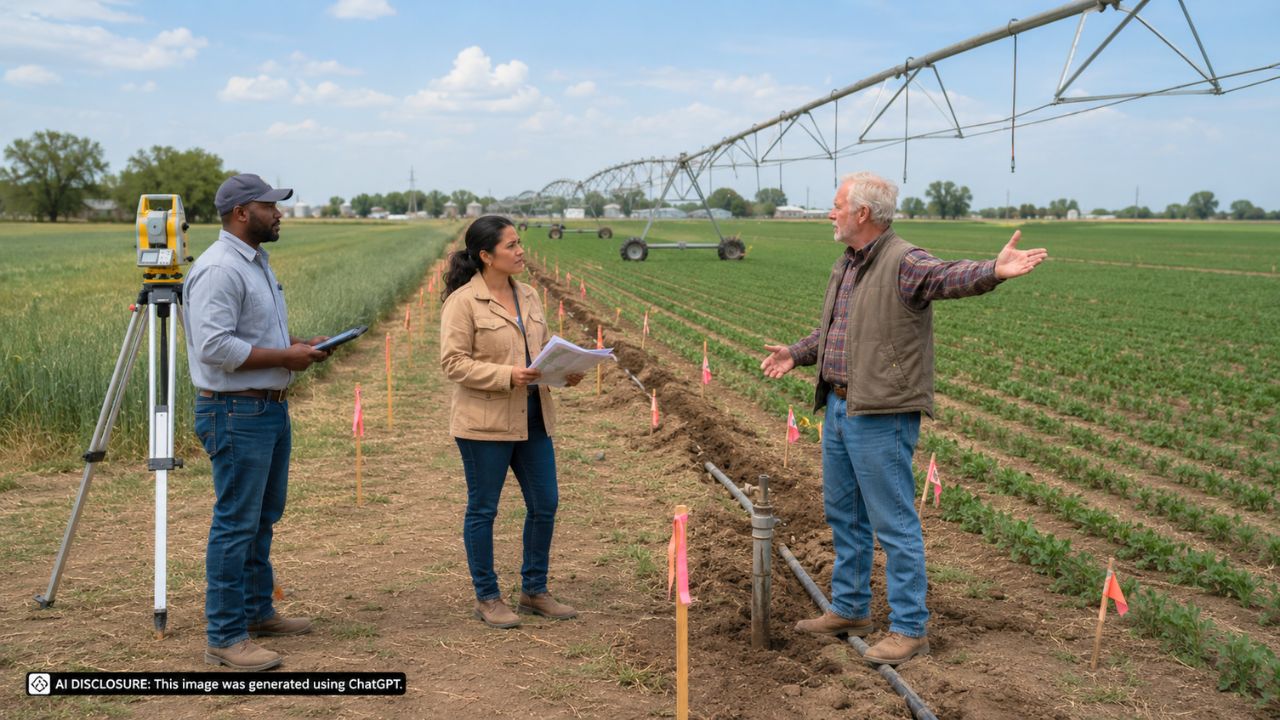
New Rural Landowner Has the Property Surveyed and Finds a Neighboring Farm’s Irrigation Line Running Across Forty Acres — Then the Neighbor Says the Crop Rotation Cannot Accommodate a New Route Without Destroying Five Seasons of Established Fields
Photo credit: AI-generated image created using ChatGPT. Illustrative only.
The new owner didn’t buy rural acreage to start a fight. They bought it for space, privacy, and the kind of quiet where your biggest “neighbor issue” is usually a stray dog or a downed fence line.
Then they did the responsible thing: ordered a full property survey. And that’s when the line on the map turned into a real-world problem—an irrigation line from the neighboring farm cutting across a huge stretch of ground the new owner now holds in fee simple. The neighbor’s response wasn’t denial. It was worse: “We can’t reroute it. Our crop rotation can’t absorb that change without wrecking multiple seasons of established fields.” A lot of rural living disputes boil down to a handshake agreement everyone forgot to write down, and in Illinois, that can get complicated fast—especially once you start talking about easements and long-term use, like the source post lays out.
The survey didn’t just draw a line—it drew a target
Before the survey, the irrigation setup probably looked like “normal farm stuff”: a buried line, maybe a valve box, maybe a strip of ground that always stayed a little different. If you’re new to the land, you don’t always know what’s yours versus what’s been “shared” for decades.
But a modern survey has a way of making old habits feel like trespassing. Suddenly it’s not just a pipe. It’s access rights, maintenance rights, and the question nobody likes asking out loud: who gave permission, and when?
And that’s where the new owner’s stress spikes. Forty acres isn’t a corner cut. It’s a major footprint, and the first thing a cautious buyer thinks is, “If something breaks, am I on the hook? If they need to dig, do I just have to let them?”
“It’s been there forever” meets “I just bought this”
The neighboring farmer’s argument is the one you hear in every long-running rural boundary dispute: this is how it’s always been done. The line was laid where it was laid, the fields were patterned around it, and the rotation plan is built on that layout.
From the farmer’s side, rerouting isn’t just moving a pipe. It’s tearing up ground, reworking a system, and potentially disrupting seasons of established planting patterns. On a working farm, that’s not a theoretical inconvenience—it’s the schedule and cash flow.
From the new owner’s side, “forever” isn’t a deed. They now own the property, and they’re staring at a piece of infrastructure they didn’t approve, didn’t negotiate, and may not even benefit from.
In Illinois, the word that changes everything is “easement”
The reason this kind of dispute turns serious is that “permission” can mean different things legally. The source material explains that an easement is a property right that allows someone else to use your land for a specific purpose. It’s not ownership, but it can be powerful—especially if it’s written broadly.
Illinois recognizes several types of easements, and the details matter here. An express easement is the cleanest: a formal agreement, usually recorded. An implied easement can arise from circumstances and preexisting use. And then there’s the one that makes new landowners’ stomachs drop: a prescriptive easement (also called presumed), which can be established after 20 or more years of continuous, uncontested, uninterrupted use.
That “20 years” number is the kind of thing neighbors start measuring with family lore. “My dad put that in.” “It was there when we bought our place.” “The old owner said it was fine.” None of that is automatically a legal right, but it’s exactly the sort of timeline people start building a case around.
Another practical kicker from the source: the party benefiting from an easement is generally responsible for maintenance. In real life, though, maintenance still means trucks, digging, and someone crossing the land to fix what they rely on. Even if the neighbor pays, the landowner still deals with the disruption.
The pressure point: control of your land versus the neighbor’s livelihood
Once the survey flags the line, the new owner is stuck making decisions they didn’t expect to make in year one. Do they tell the neighbor to stop using it? Do they demand it be moved? Do they offer a new written easement—on their terms—so at least the rules are clear?
Because leaving it fuzzy has its own cost. If a use continues without being challenged, it can strengthen the neighbor’s argument that they’ve had long-term, uncontested use. On the other hand, turning it into an immediate showdown can sour the relationship with the closest working operation next door—on land where you’ll see each other during planting, harvest, and every muddy week in between.
And there’s the landowner’s long view. Today it’s one irrigation line. Tomorrow it’s “we need a wider access strip for equipment.” Or “we need to replace the whole run.” If the new owner ever wants to fence, build, lease the ground, hunt it, or sell it, a major utility line with unclear rights can become a deal-spoiler.
People watching from the sidelines focused on proof and paper
The most practical reactions in these stories tend to sound boring, because boring wins later. Get everything in writing. Keep the survey. Photograph markers, valve boxes, disturbed soil, and any visible components. Document where vehicles enter and how often. If conversations happen, follow up with a calm written summary so the timeline is clear.
There’s also a reason folks nudge landowners to learn the vocabulary. The source breaks down how land use rights can range from full fee simple title (complete ownership) to temporary or perpetual easements. Even if no government is involved here, understanding those categories helps a landowner recognize what they’re being asked to tolerate—especially if the neighbor starts pushing for a “forever” agreement.
And if the neighbor tries to frame it like a utility would—“we have to have this”—people tend to remind the landowner that in true eminent domain cases, Illinois requires just compensation, and landowners have the right to say no to the first offer. That’s not a perfect match for a private farm-to-farm dispute, but it sets the tone: land rights aren’t vibes, they’re documents.
The hard part is that “moving it” is simple… until you price the fallout
In a vacuum, rerouting an irrigation line sounds like a straightforward fix. Dig a new trench, lay pipe, reconnect, and restore the ground. But farms aren’t a vacuum. They’re systems built around timing and soil conditions, and tearing through established field patterns can have ripple effects.
That’s why the neighbor’s “five seasons” argument lands emotionally, even if it doesn’t settle the property rights question. It’s a plea not to be forced into a redesign midstream. But the new owner didn’t agree to bankroll the neighbor’s convenience with their own acreage, either.
So the dispute sits in that uncomfortable rural space: one person wants control over their ground, the other wants continuity of operations. The survey made it visible. Now the next move is either a written agreement that spells out exactly what’s allowed—or a standoff where every growing season makes the line feel more permanent.
On land, time is never neutral. If the new owner is going to protect their boundaries without turning daily life into a cold war, they’ll have to act deliberately—calmly, documented, and with a clear understanding of what an easement is and isn’t in Illinois.