Rural Property Owner Finds the Neighbor Cut Down a Fifty-Year-Old Tree Standing Fully on the Land — Then the Neighbor Says the Tree Was “Leaning His Way”
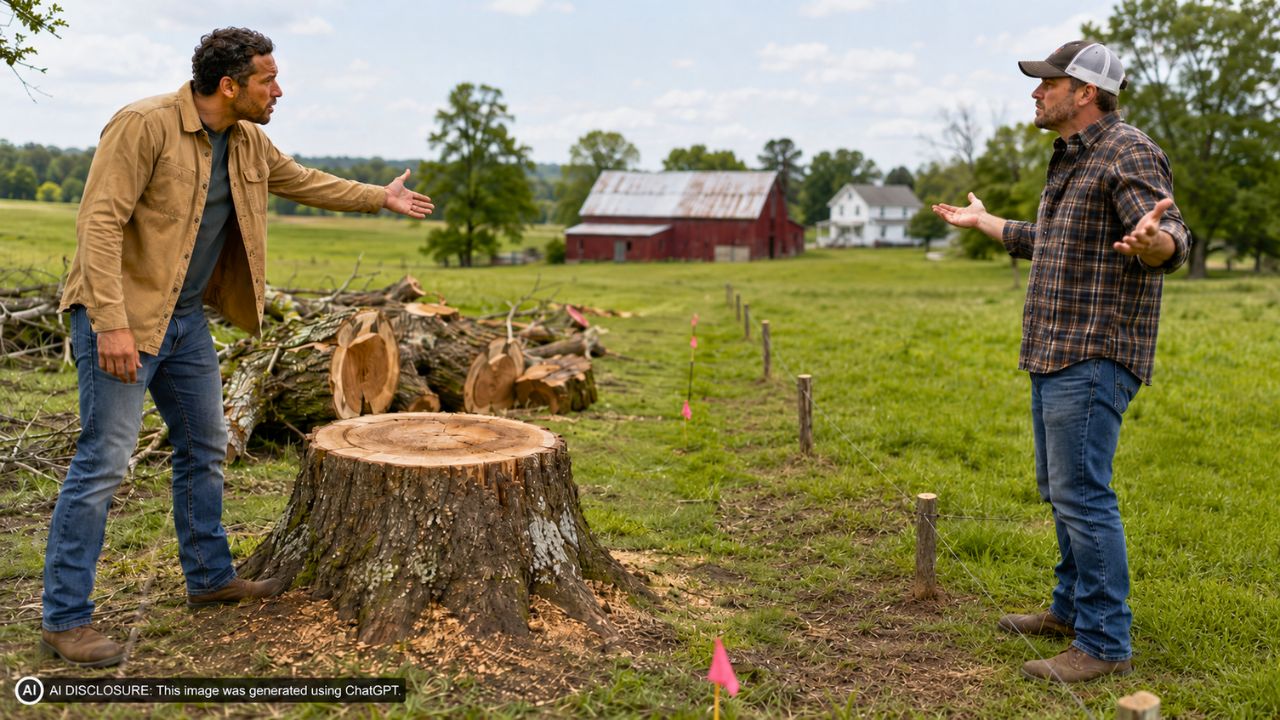
Photo credit: AI-generated image created using ChatGPT. Illustrative only.
You don’t expect to come home from work and find a backyard changed forever. But that’s what one rural property owner says happened when a neighbor cut down a mature tree that stood on the owner’s side of the fence line—without asking, without a note, and without anyone home to stop it.
In the original post, the homeowner describes a tree in their backyard “on the fence line” that was cut down about a week earlier while they were out. The bigger issue wasn’t just the missing tree. It was the feeling that the neighbor had decided they could reach over the fence and manage someone else’s property like it was their own.
A quiet day at work, then the backyard looks different
The homeowner says the neighbor cut down the tree while the household was away at work. No permission was asked. No warning was given. Just a tree—gone.
Even when a tree sits near a fence line, most people still treat it like a boundary marker: you don’t touch what isn’t yours. But when a neighbor takes it upon themselves to do the cutting, it instantly turns a “neighborly annoyance” into a property-rights fight with receipts, photographs, and hard feelings.
The homeowner’s frustration comes through as practical as much as emotional: they want the neighbor to stop “messing with us and our property.” The question they ask is the one people ask when they feel boxed in—who do you even call when the problem lives next door?
This wasn’t the first clash with the neighbors
What makes the tree story feel less like a one-off and more like an escalation is the backstory. The homeowner says they’ve already had issues with these neighbors filing complaints to the county—specifically over ladders in the backyard.
That complaint didn’t end with a warning. The homeowner says their father was fined over $600 and had to move the ladders into a storage unit. That kind of consequence changes the tone of every future interaction. It suggests a relationship where one side is willing to use official channels to apply pressure, and the other side is left paying real money to keep the peace.
So when the tree comes down, it doesn’t land as “maybe they thought they were helping.” It lands as another boundary being pushed—this time with a chainsaw.
Fence-line trees are where neighbor disputes get sharp
Trees near fences are a magnet for disputes because they combine property lines, safety worries, and personal preference in one living thing. One neighbor sees shade and privacy. The other sees leaves in gutters, roots near a foundation, or a canopy they don’t like hanging over their yard.
The homeowner describes the tree as being in their backyard on the fence line, which is exactly the kind of placement that tempts someone into “just handling it.” And it’s common for the person who did the cutting to justify it later with something like: it was leaning, it was a hazard, it was coming toward my side.
But that’s the point where rural living gets real. A “lean” is not the same as permission, and “I thought it might fall” is not the same as confirming whose land the trunk actually stands on. If the trunk base is fully on one person’s property, the neighbor’s fear doesn’t magically convert the tree into shared property.
What’s actually lost when a mature tree disappears
A mature backyard tree isn’t just landscaping. It’s shade that cools the house. It’s a windbreak that protects roofs and outbuildings. It’s a privacy screen that keeps a yard feeling like a yard.
When it’s cut down unexpectedly, the loss can show up in annoying ways first: harsher sun on the back of the home, less cover from road noise, and a more exposed fence line. Then come the longer-term headaches—stump grinding, disturbed soil along the fence, and the question of whether the cutting damaged the fence posts or roots tied into the property edge.
And there’s a personal cost too. A tree that’s been standing for decades is tied to a sense of “this is home.” When someone removes it without permission, it feels less like yard work and more like a message: I can do what I want over there.
Commenters pushed documentation and official steps, not doorstep arguments
In disputes like this, the most practical advice tends to be the least satisfying in the moment: slow down, document everything, and avoid a shouting match at the fence. When you’re already dealing with neighbors who have filed county complaints before, emotions can become evidence against you if you handle it the wrong way.
People who’ve been through property-line fights usually zero in on a few immediate realities. First: photos. If there are any “before” pictures that show the tree’s location relative to the fence, save them. Take “after” pictures from multiple angles, including the stump, the fence line, and anything that shows where the trunk stood.
Second: paper trails. If there’s a prior history with county complaints, keep those records too. Not because ladders and trees are the same issue, but because patterns matter when you’re trying to explain why you’re taking the problem seriously.
And third: outside confirmation. A property survey or other clear boundary documentation can be the difference between “it was on my side” and “it is proven to be on my side.” Fence lines aren’t always perfectly placed, and neighbors will argue over inches when the stakes get expensive.
“Who do I call?” becomes a bigger question than it sounds
The homeowner’s core question—who do I call?—is the question people ask when they want the behavior to stop, not just when they want to vent. But the right call depends on what they want to happen next: documentation, reimbursement, consequences, or simply a deterrent.
Some people start with the county office that handled prior complaints, because those departments often know how to route a property-related dispute to the right place. Others start with a non-emergency police line to create a report, especially if they want an official record that the tree was removed without permission.
And then there’s the practical homeowner angle: insurance and contractors. Even if the homeowner isn’t planning a claim, an arborist or tree service can sometimes provide a professional evaluation of what was removed and what it would cost to replace or remediate. That kind of estimate can turn “they cut down our tree” into a concrete number, which matters if the homeowner decides to pursue reimbursement.
For now, the tension is still sitting right there at the fence line—where the tree used to be. The homeowner isn’t just dealing with a missing piece of the yard. They’re dealing with the uneasy feeling that the next “fix” the neighbor decides to make could be another step onto their land, another complaint filed, or another change made while nobody is home to say no.