Rural Landowner’s Herd of Mini Highland Cows Gets a Neighbor’s Loose Bull Mixed In After It Breaks Through the Fence — Then the Neighbors Give Him “The Run Around” for Days on Retrieving It
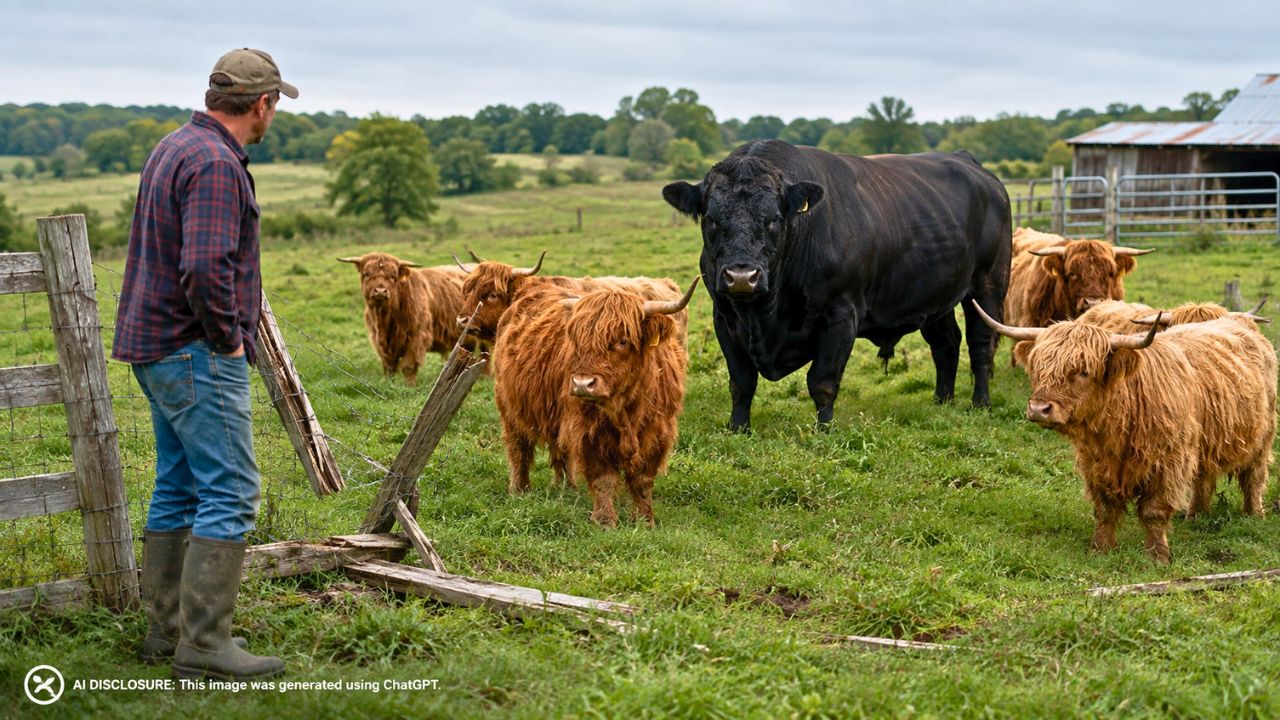
Photo credit: AI-generated image created using ChatGPT. Illustrative only.
It started as one of those rural problems that sounds almost funny until you’re the one paying for it: a stranger’s bull pushes through a fence and decides your pasture is his new home. One landowner with a small herd of six mini Highland cows said his neighbors’ “PBR looking monster bull” broke in and settled in with his animals, turning a quiet, pet-style setup into a tense standoff over responsibility and time.
In the original post, the landowner explained that the neighbors—an older couple—kept delaying every time he asked when they were coming to retrieve the bull. Four days went by with the bull still there, eating feed he didn’t budget for and standing as a 1,500-pound reminder that fences don’t care about good intentions.
A pet herd meets a full-size problem
The landowner wasn’t running a big commercial operation with working pens, a crew, and a routine for sorting cattle. His six mini Highlands were “basically pets,” the kind of herd you can manage with calm habits and familiarity, not rodeo skills and brute force.
Then a much larger bull showed up and changed the math. A bull that size isn’t just another mouth to feed. It’s weight, strength, breeding risk, and the kind of animal that can hurt someone fast if they get too close, especially if the person admits up front they’re not a “cowboy wrangler” who can just go grab him.
That mismatch is what makes these neighbor disputes so lopsided. The animal may belong to someone else, but it’s standing on your property, eating your resources, and creating your liability the entire time it’s there.
The fence breach turns into a money leak
The post wasn’t only about inconvenience. It was about feed and pasture damage—real costs that landowners track month to month. The owner said his grass was already in rough shape and that he’d been feeding hay and grain to keep his animals going.
With the herd confined to one paddock, the ground had become “sand,” which is what happens when animals repeatedly trample the same area without enough recovery time. Add a 1,500-pound bull to that setup and it’s not hard to picture the remaining grass getting stomped down, eaten off, and converted into dust.
When pasture is stressed, every extra day matters. You can’t simply rewind the season and regrow forage on command. And unlike a broken tool you can put on a shelf, a live animal keeps consuming. The bull wasn’t just visiting—he was turning the owner’s feed budget into the neighbors’ subsidy.
The runaround is the part that makes it neighbor drama
If the neighbors had shown up quickly with a plan—trailering the bull out, fixing the fence, apologizing, and offering to cover feed—it would have been a bad day and then a story. Instead, the owner described getting “the run around” each time he asked when they were coming.
That’s when a farm problem becomes a property conflict. The fence line may be physical, but the real boundary is behavioral: will the other side take responsibility promptly, or will they stall until the person hosting the problem either gives up or fixes it for them?
The owner also had another pressure point: his wife didn’t want him to escalate and “piss off the neighbors.” That’s a familiar rural bind. You might live a long way from town, but you live close to the people next door. Even when you’re right, you still have to share roads, gates, sightlines, and years of future interactions.
But four days is long enough for the patience to start costing money. At that point, the owner wasn’t only asking for courtesy—he was trying to stop the daily drain of hay, grain, and pasture wear that he couldn’t afford to donate.
The dangerous part isn’t just the feed bill
There’s an undercurrent in the post that rural readers will feel immediately: this isn’t a loose dog or a stray goat. It’s a bull. A large, intact male animal can be unpredictable, and the owner made it clear he didn’t feel equipped to go out and remove him on his own.
That fear isn’t dramatic—it’s practical. Someone without handling facilities or experience can get hurt trying to push, rope, or “just lead” a bull. And when an animal is mingling with a smaller pet herd, there’s also the risk of animals being injured in scuffles, or of unplanned breeding depending on what else is in the group.
Even if nothing violent happens, the bull’s presence can change how the owner has to move around his own property. Chores that were once routine—checking water, putting out feed, walking a fence line—suddenly require caution and extra space. That’s a subtle kind of stress that stacks up quickly.
What people urged: document first, then force a timeline
The original post was framed as a request for options: he couldn’t afford to hire someone to remove the bull, and he couldn’t afford to keep feeding it indefinitely. That’s the kind of moment where practical-minded rural neighbors tend to focus on two things: documentation and deadlines.
Even without a blow-by-blow of comments included in the source material, the problem practically invites the usual advice people give in fence-and-livestock disputes: keep communication clear, put requests in writing, and make it impossible for the other party to pretend they didn’t know or didn’t have time. When a neighbor stalls verbally, a simple text message that creates a record can shift the tone.
Another predictable thread in these disputes is the fence itself. A bull “got through the fence” means there’s a point of failure somewhere—pressure on a weak section, a sagging wire, a gate not latched, or a spot that was never bull-proof to begin with. The longer the bull stays, the more likely it is he’ll test the same place again or find a new weakness, which can turn one breach into a recurring problem.
And while nobody wants a feud, people also know that “keeping the peace” can quietly become “paying the price.” The owner’s post captured that exact tension: he didn’t want to torch the neighbor relationship, but he also didn’t want to bankroll someone else’s livestock management.
A quiet pasture doesn’t feel so quiet after four days
By the time the owner added his edit—four days since the bull broke in—the story had moved past surprise and into that grinding phase where every morning starts with the same thought: is today the day they finally come get him?
This is where rural living can feel uniquely stuck. You can’t tow a car off your property the way you might in town, and you can’t just “return to sender” a 1,500-pound animal without the right equipment and skills. Meanwhile, the bull keeps eating, the paddock keeps getting hammered, and the owner has to decide how long he can wait before “being nice” becomes the most expensive option.
For now, the bull is still part of the herd’s daily scene—an uninvited guest the owner never agreed to host. And the longer the neighbors delay, the more the fence line starts to look like more than a boundary. It starts to look like the point where accountability stopped.
Like Fix It Homestead’s content? Be sure to follow us.