New Homeowner Finds a Crumbling Retaining Wall the Neighbor Built Twenty Years Ago Along the Shared Slope — Then the Neighbor Says Repair Costs Belong to Whoever “Ends Up Owning the Dirt Under It”
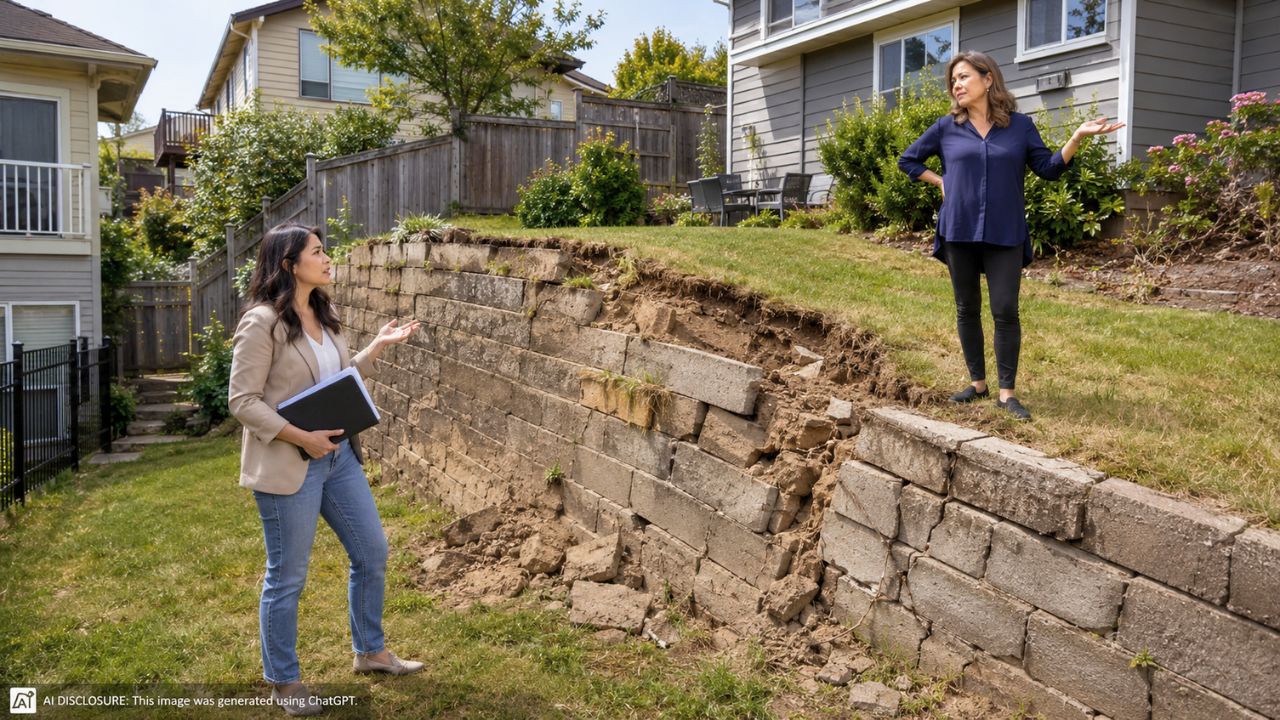
Photo credit: AI-generated image created using ChatGPT. Illustrative only.
It started the way a lot of expensive homeowner problems start: with something that looks “a little off” until you realize it’s carrying an entire hillside. A new homeowner noticed the retaining wall separating their downhill yard from the neighbor’s higher lot was leaning toward their property—and the lean wasn’t subtle anymore.
In the original post, the homeowner explained that the property line runs straight through the center of the wall. That means the structure itself sits on both parcels. But the wall was built to hold back the neighbor’s soil, and now it’s threatening to fail in the direction of the downhill home.
A shared wall that doesn’t feel shared when it starts to move
The homeowner’s description is the kind that makes your stomach drop if you’ve ever owned a house on a slope. The wall is leaning toward their side, and “needs to be repaired so it doesn’t collapse.” There’s no mention of minor cracking or cosmetic issues—this reads like a structural problem with real consequences if it gives way.
And because the wall sits between two properties, it’s not just a construction problem. It’s a neighbor problem. The homeowner believed the wall exists primarily to benefit the uphill lot by keeping that elevated soil in place, so it makes sense to them that the uphill neighbor should bear more responsibility for repairing it.
The neighbor didn’t see it that way. They told the homeowner they should pay for the repairs, and the homeowner was left staring at a leaning wall, an uncertain boundary line, and the very real possibility that waiting could turn into a collapse.
Then drainage entered the picture, and the stakes jumped
Retaining walls fail for a lot of reasons, but water is the usual accelerant. In this case, the homeowner suspected a major contributor: the neighbor’s gutters.
According to the homeowner, the gutters don’t drain away from the wall. Instead, water “flows right into the wall and into my property and under my foundation.” That last part is what pushes this beyond a typical “who pays for the wall” argument. A failing retaining wall is bad; water routing under a downhill foundation is the kind of detail that keeps people awake at night.
Now the homeowner isn’t just thinking about a repair bill. They’re thinking about long-term damage that’s harder to see—saturated soil, undermining, shifting, and whatever comes next when water starts choosing its own path.
The argument that makes everyone reach for a survey
The homeowner’s core question was simple: who’s responsible for paying for repairs—me, my neighbor, or shared? But the facts they included show why this type of dispute can turn into a stalemate.
On paper, the line running through the center of the wall feels like it should make things “shared.” In real life, homeowners tend to think in terms of who benefits from the structure and who caused the problem. The downhill owner sees a wall designed to support the uphill yard. The uphill owner sees a wall that’s half on someone else’s property and wants the costs pushed away from their own budget.
And because the wall is already leaning toward the downhill lot, the homeowner is the one who has to picture the worst-case scenario: a failure dumping material down slope, potentially damaging landscaping, fences, and anything else in the line of fire. Even if the neighbor is technically responsible for something, gravity will make sure the downhill homeowner feels it first.
People didn’t focus on the wall—first they focused on proof
The homeowner’s post didn’t include a full comment thread in the shared material, but this kind of dispute almost always triggers the same practical instincts from other homeowners: document everything before you try to “talk it out” a second time.
When a structure sits on a line and both sides claim the other should pay, proof becomes the only thing that moves the conversation. That usually means confirming the boundary (not guessing), photographing the lean and any cracking over time, and getting a professional to describe why it’s failing—especially if water management is part of the cause.
The drainage claim also changes what “proof” looks like. It’s one thing to say a wall is old and shifting. It’s another to point to a pattern of runoff being directed into the wall area and then moving onto the downhill property. Once water and foundations enter the conversation, people start thinking less about neighborly fairness and more about liability.
The scariest part wasn’t the bill—it was what happens if nobody acts
Retaining walls don’t usually fail politely. They hold until they don’t, and when they go, they can take soil with them in a hurry. The homeowner seemed to be staring down that exact fear: repair it now, or gamble on a collapse.
That urgency is what makes the neighbor’s position so frustrating. If the uphill neighbor refuses to share costs or insists the downhill owner should cover everything, the downhill owner is stuck choosing between paying to protect their own property or waiting and risking much bigger damage.
Meanwhile, the water issue keeps operating in the background every time it rains. Even a perfect wall rebuild won’t stay “perfect” if runoff continues to feed into the same area. So the homeowner isn’t just trying to figure out how to split a repair—they’re also trying to stop a repeating cause.
A problem that lives right on the line, but doesn’t stay there
This is the kind of homeowner drama that doesn’t have a satisfying quick fix, because the structure is shared but the consequences aren’t evenly distributed. The wall may sit on the boundary, yet the lean is toward the downhill property, and the reported drainage sends water toward the downhill foundation.
In the meantime, the homeowner is left with a familiar new-owner headache: inherited work they didn’t commission, built for a neighbor’s lot, failing at the exact moment it becomes their problem. A retaining wall can look like a yard feature right up until it becomes a deadline.
If nothing else, the post captures a hard truth about houses on slopes: when a boundary structure starts to move, it turns neighbors into stakeholders overnight. And once water is involved, it stops being a “wall question” and becomes a “how fast can this damage spread” question.
Like Fix It Homestead’s content? Be sure to follow us.