New Landowner Finds a Neighbor’s Structure Built Just Two Feet From the Boundary on a Ten-Acre Parcel — Then the Neighbor Says Moving It “Isn’t Physically Possible”
Photo credit: AI-generated image created using ChatGPT. Illustrative only.
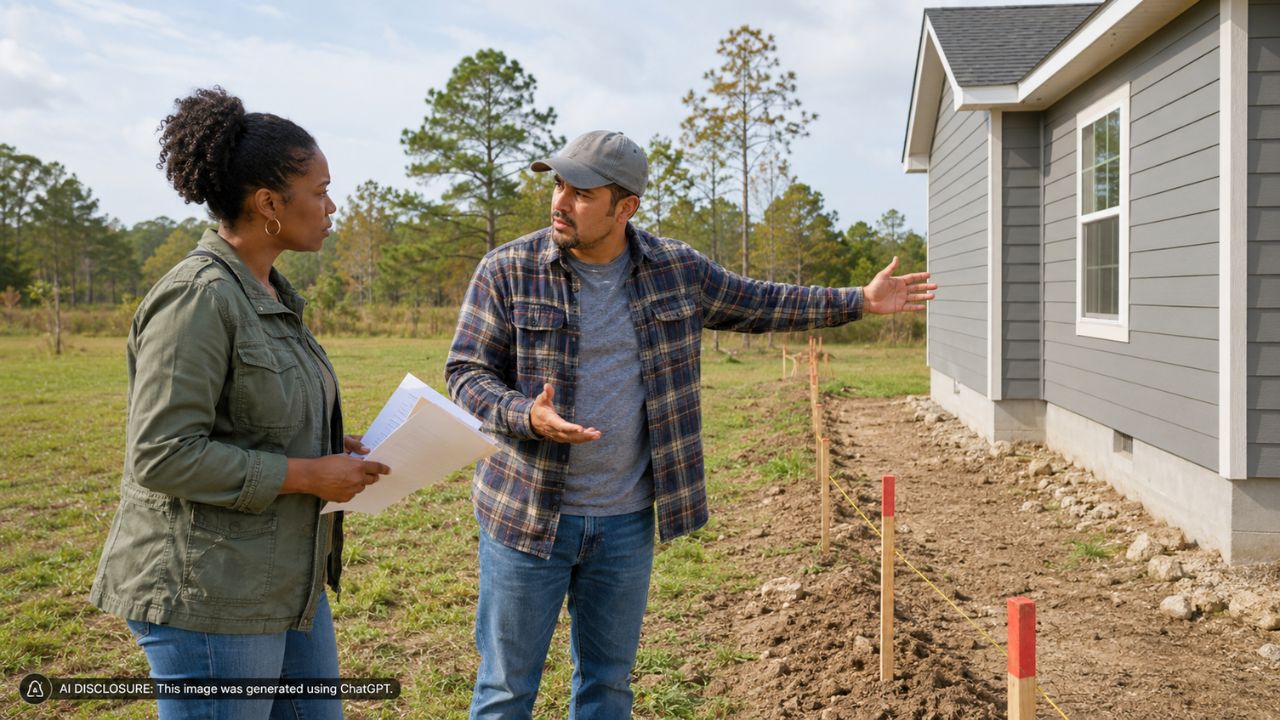
Buying or holding land is supposed to be the simple part: dirt, trees, a boundary line, and the comfort of space. But for one landowner, the “space” got a lot tighter once a neighbor’s brand-new house ended up only about 1.3 meters from the property line—despite a written agreement that it would sit 5 meters back.
In the original post, the landowner explains how a friendly yes a couple years ago turned into a post-construction scramble: the neighbor now needs a signature to legalize the build so it can be “put into use” and properly commissioned. And suddenly that signature feels less like a courtesy and more like a bargaining chip.
A handshake moment turned into a measurement problem
The landowner says the neighbor approached them before building and asked for written consent to build near the edge of the land. The deal was specific: 5 meters from the border.
Because the parcels are long and narrow, and because the landowner wasn’t planning to build anything right along that strip, consenting didn’t feel risky. It was the kind of neighborly cooperation that keeps rural or semi-rural life running smoothly—until the tape measure comes out later.
After the house was built, the landowner learned it wasn’t 5 meters off the line. It was closer to 1.3 meters. That’s not a minor oops; that’s a completely different setback.
When a house is already built, the paperwork becomes the weapon
The neighbor didn’t come back to apologize and offer a fix. They came back needing something: the landowner’s sign-off after the fact so the building can be legalized and formally approved for use.
The landowner’s read is practical. If the home doesn’t meet distance rules, getting it registered, commissioned, or cleared for occupancy could stall. And if it’s already up for sale, that stall gets expensive fast—because buyers, banks, and anyone doing due diligence tend to run from unresolved boundary and permitting problems.
This is the part that makes property-line disputes so tense: the building is standing, the money is spent, and the leverage shifts to whoever can stop the next step. In this case, that next step appears to be the neighbor’s ability to finish the legal process and sell cleanly.
The landowner’s twist: “I might want the place, just not at that price”
Instead of purely treating this as a boundary violation, the landowner admits something that complicates the whole drama: they wouldn’t mind owning the house.
They were planning to build in the area anyway, and buying an already-built home could save time and hassle. But the neighbor has it priced at €300,000, which the landowner says is wildly high compared to similar nearby homes selling for closer to €200,000.
So the question shifts from “How do I enforce the setback?” to “Do I hold the line and use this as leverage?” The landowner openly wonders whether refusing to sign could push a 30–40% price reduction, or at least force the neighbor into a payoff scenario.
In their mind, the neighbor has three options: pay for consent, sell the house to them at a realistic discounted price, or face the prospect of rebuilding or modifying whatever needs to change to comply.
Why two meters can feel like two inches
To people who don’t live on tight strips of land, a couple meters can sound petty. But once you’ve dealt with access, maintenance, runoff, and future projects, it starts to feel very real.
A house built close to a boundary can create long-term friction even if nobody argues today. How do you maintain the side of the structure near the line? Where does snow shed or roof runoff go? How does a future fence get installed? What happens if either party later wants to add a driveway, plant trees, run utilities, or build a shed?
And then there’s the uncomfortable fact that the landowner had already agreed to something reasonable—5 meters. The problem isn’t simply closeness; it’s that the build didn’t match the consent that was given.
That’s the kind of detail that makes neighbors stop waving and start documenting.
Reactions leaned hard toward documentation and lawyers
In the update, the landowner says they reached out to a lawyer and plan to follow legal advice. That move alone tells you how quickly “neighborly” situations can become contract-and-consequence situations.
Even without seeing a full comment thread, the pressure points are obvious. When someone builds outside an agreed setback and then asks for a signature afterward, people tend to focus on proof: what was signed, what was promised, what the actual measured distance is, and what local rules require.
The practical instinct in these disputes is to slow everything down and get things in writing. Not to escalate for fun, but because once a signature is on a post-construction approval, the leverage vanishes and the too-close build becomes the new normal.
That’s also where emotions can spike. The neighbor may frame it as “it’s already built, moving it isn’t physically possible,” but the landowner sees a different reality: if it truly can’t be moved, then the only path forward is permission—or a costly remedy.
The tension: a signature that could be worth a lot of money
This is the part that makes the story feel like a real homestead headache instead of a simple boundary dispute. The landowner isn’t just trying to “win.” They’re trying to make a smart financial move while protecting the future use of their land.
But leveraging a signature can be a tightrope. If the neighbor feels cornered, they may dig in, delay, or sour the relationship for years—especially with adjacent strips of land where you’ll see each other constantly. On the other hand, signing without a solid agreement could leave the landowner stuck with a permanent encroachment-adjacent problem and no compensation.
For now, everything hangs on what the lawyer says about local rules, the strength of the original consent document, and what it means to “legalize” a noncompliant build after construction. The landowner asked if the leverage is enough to force a big discount. The neighbor, meanwhile, needs that signature like a key.
Sometimes property disputes start with a fence post or a leaning tree. This one started with a house placed a few meters off plan—and ended with a landowner staring at a pen, realizing a single signature might decide whether the neighbor can sell, whether the price comes back to earth, and whether that narrow strip of land stays peaceful or turns into a permanent sore spot.
Like Fix It Homestead’s content? Be sure to follow us.
- Man Says He Found Out the Fence He Paid For Wasn’t Actually on His Property
- Woman Says Her Neighbor Started Taking Mulch From Her Delivery Pile Before She Could Even Spread It
- I made Joanna Gaines’s Friendsgiving casserole and here is what I would keep
- What Caliber Works Best for Groundhogs, Armadillos, and Other Digging Pests?