North Carolina Homeowner Warns a Landlocked Neighbor Her New Gate Blocks Twenty Feet of His Property — Then the Multi-Million-Dollar Homeowner Installs a Permanent Gate in the Same Spot Anyway
Photo credit: AI-generated image created using ChatGPT. Illustrative only.
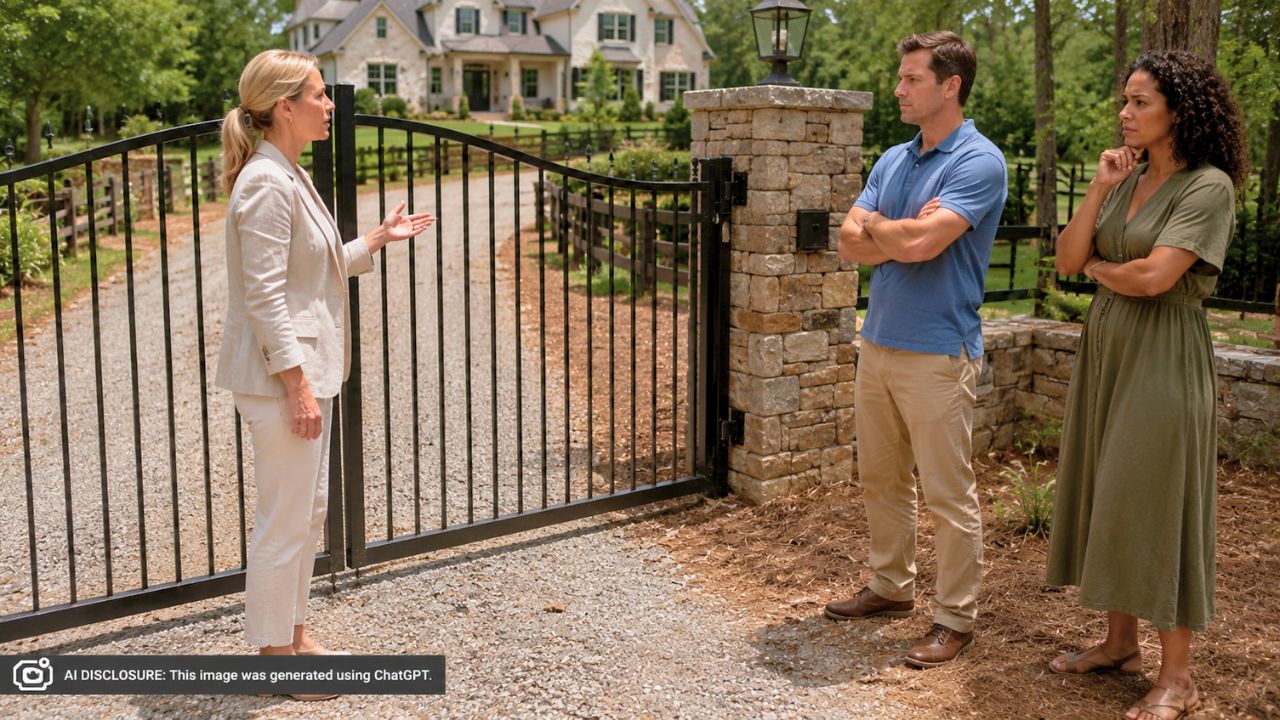
On a quiet private road in North Carolina, one new gate changed how a neighboring property could be used—overnight. A homeowner in a private subdivision said a landlocked neighbor, who built a multi-million-dollar home just outside the neighborhood, installed a gate that sat about 20 feet past the end of her property and into the subdivision, cutting off access to part of his land.
At first it was a “temporary” chain gate during construction. But when crews started putting in a permanent gate in the exact same spot, the homeowner realized the inconvenience wasn’t going away on its own. He laid out the details in the original post, looking for a way to protect access to his property now—and for the next owner after him.
A private road, a landlocked parcel, and one narrow way in
The setting matters here. The homeowner lives on a private road inside a private subdivision, and his lot borders the edge of that subdivision. Outside the neighborhood boundary, a woman bought a large chunk of land—but it came with a major limitation: it was landlocked.
Her only access was a right-of-way through the subdivision’s private road. That kind of arrangement can work for years without drama, especially if everybody treats the access route like what it is: a shared necessity that needs to be kept clear.
Then she built big. The homeowner described the new build as a multi-million-dollar home, and during construction a gate went up across the access point—something that probably felt normal from the new owner’s perspective, like a simple way to control traffic to a construction site.
The first sign was easy to brush off: a “temporary” chain gate
Temporary fixes have a way of becoming permanent when nobody forces the issue. In this case, the homeowner said that when the chain gate first appeared, he approached her and pointed out a specific problem: the gate wasn’t just on her side of the line.
He believed it was placed about 20 feet beyond the end of her property, into the subdivision. And that wasn’t just a technicality. That 20-foot shift meant he couldn’t access the lower portion of his own property the way he had before.
It’s the kind of thing that sounds minor until you live with it. Access is everything on rural-ish lots—moving equipment, checking drainage, trimming growth, dealing with downed limbs, even just walking your own boundary without feeling like you’re trespassing.
Then the permanent gate showed up in the same spot
The homeowner said the gate’s location “really doesn’t bother” him in the abstract. What bothered him was what it changed: it blocked access to part of his land, and it was being installed as a permanent feature.
That’s where neighbor issues get sticky. A permanent gate signals confidence—like the placement is settled, approved, and not up for debate. Once concrete is poured or posts are set, the owner who paid for it often becomes more entrenched. Moving it later gets harder, socially and practically.
There was also a quiet secondary pressure: the HOA. The homeowner mentioned he wasn’t sure what the HOA might say about the gate. On private roads in private subdivisions, rules and recorded agreements can matter as much as the visible property line, and HOAs don’t always love surprises that look like “somebody claimed a chunk of the road.”
He didn’t just want access today—he wanted it to follow the deed
What turned this from an annoyance into a real homeowner problem was the long-term angle. The homeowner wasn’t only worried about being able to reach the lower part of his land right now. He wanted to “assure that I have continued access to my property and that access is passed to the next owner of my property.”
That’s an experienced homeowner’s instinct. Informal agreements—“Sure, just open the gate when you need to go down there”—tend to die the moment a property changes hands, a relationship sours, or a manager gets replaced. And in neighborhoods with private roads, disputes can become expensive fast: surveyors, attorneys, title questions, and months of frustration over something as basic as walking to the back of your lot.
He reached out to the neighbor’s boyfriend/manager, who was handling some of these matters. The two agreed to figure out what legal steps were needed to protect access going forward, which suggests the homeowner wasn’t looking for a fight so much as a clean, documented fix.
Commenters pushed the usual playbook: don’t rely on a handshake
While the post itself didn’t copy-and-paste the comments, the update made it clear what kind of advice he received—and what moved the needle. The homeowner thanked people for “excellent advice” and specifically noted that “mention of a lawyer was definitely helpful.”
That tracks with the standard homeowner reality: the fastest way to get a boundary or access issue taken seriously is to treat it like a real property matter, not a friendly favor. The moment “permanent gate” enters the conversation, people tend to think in terms of surveys, easements, and recorded rights rather than neighborly flexibility.
Even when everyone wants to stay polite, having the language of documentation in the background can stop a bad decision before it’s sunk into the ground—literally.
The resolution was simple: move the gate before it became a monument
The best part of this story is that it didn’t end with years of hostility. In an update, the homeowner said the issue was resolved “in the best manner.” He had a conversation with the owner’s manager, and they agreed moving the gate was “the easiest, fastest, best long-term solution.”
That line matters. A lot of property disputes spiral because people chase the “principle” of the thing and forget the practical goal: keep access open, keep lines respected, and keep the peace. Moving a gate—before the permanent work is fully finished—can be cheaper than paying professionals to argue about it later.
It also leaves everyone with something they can live with. The landlocked owner still gets security and controlled entry, and the subdivision homeowner gets access back to the portion of his property that was effectively walled off by an extra 20 feet.
In the end, this is one of those homeowner problems that sounds like nothing until you picture your own property suddenly cut in half by a structure you didn’t approve. The fix wasn’t dramatic. It was just timely: speak up early, push for something that can be documented, and don’t wait until “temporary” turns into posts set in concrete.
Like Fix It Homestead’s content? Be sure to follow us.