Homeowner Hands the Neighbor a Survey Showing Where the Line Runs — Then He Cuts Four of Her Trees and a Jury Makes Him Pay
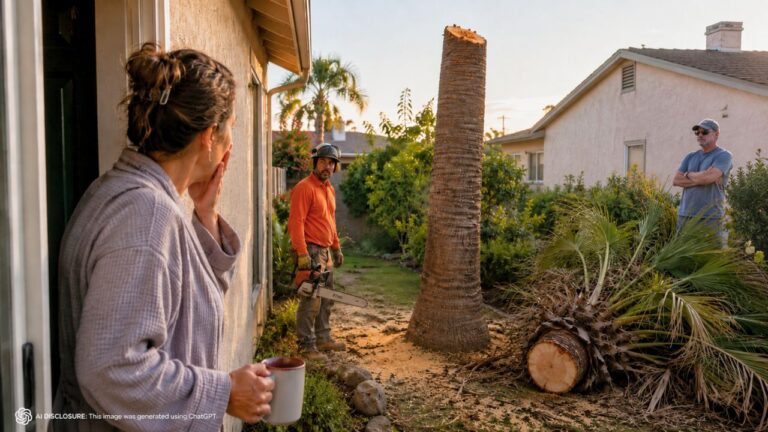
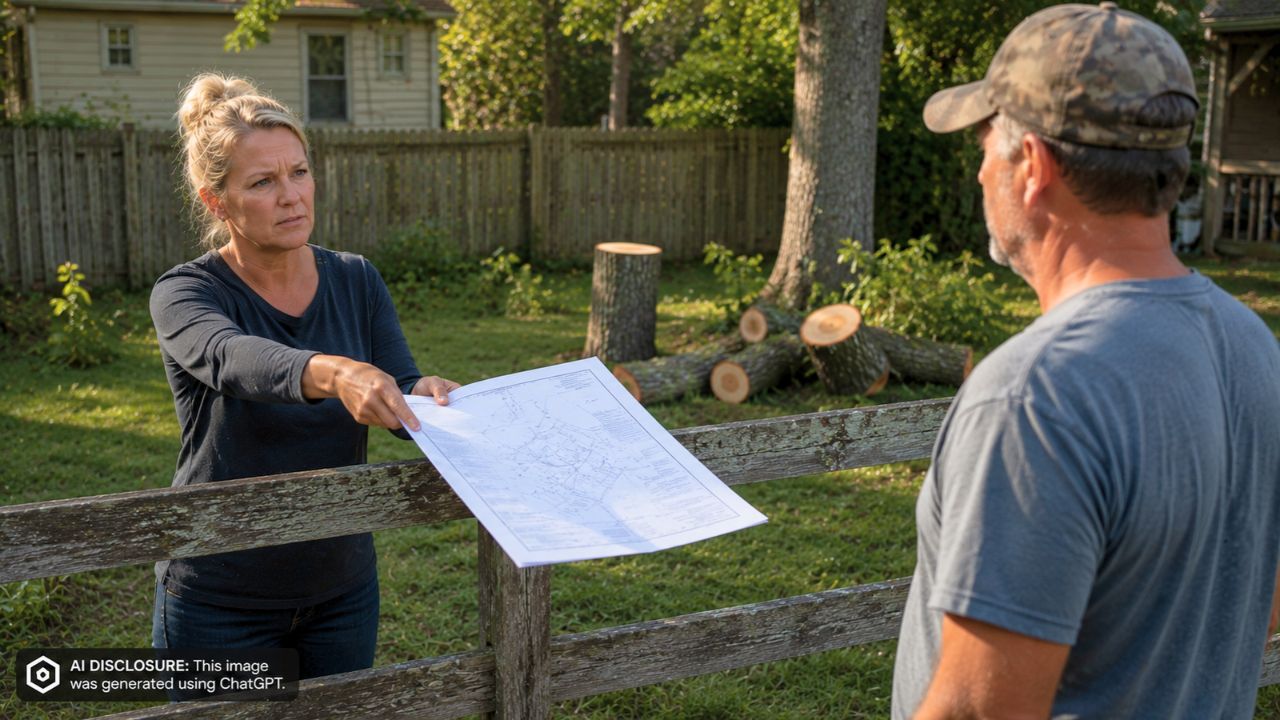
Photo credit: AI-generated image created using ChatGPT. Illustrative only.
Property-line fights usually start small: a mower path that creeps a little, a brush pile that “accidentally” lands on the wrong side, a neighbor who swears the old fence post proves everything. In Columbia County, New York, it escalated to the kind of damage you can’t unsee—cleared vegetation, lost privacy, and a landscape that suddenly drains wrong.
And the part that made it explode? The homeowner on the receiving end said she didn’t just argue about where the line was. She showed the men a survey. That detail sits at the center of the discussion that later played out in court, after trees were cut and the jury decided the defendants’ punishment needed to mean something.
The line wasn’t a mystery—she says she put it in their hands
The dispute began after Nicholas Howard bought property next to Elaine Storms in June 2021. Not long after, Howard and Micah Geraghty disagreed with Storms about where the boundary actually ran, the kind of argument that can turn a quiet stretch of land into a constant source of tension.
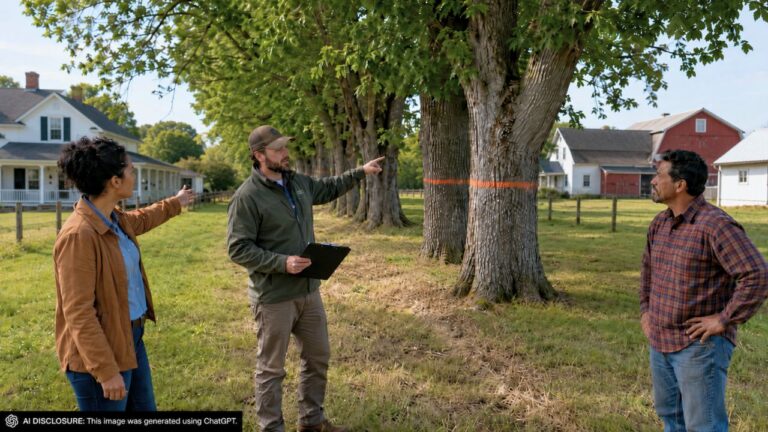
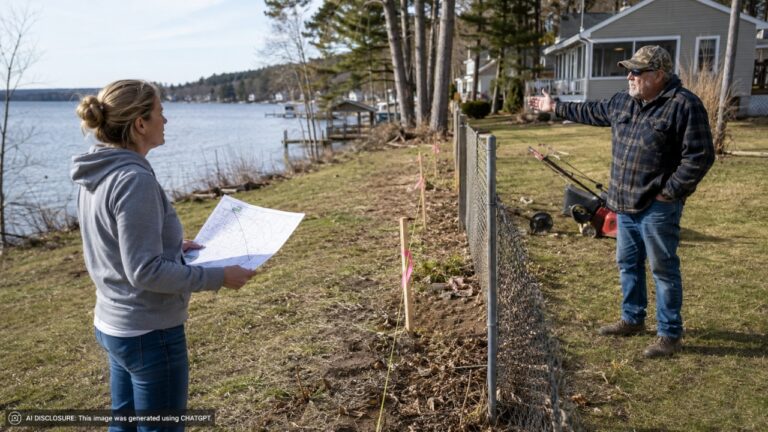
Storms’ move was straightforward: she showed them a survey that backed up her description of the property line. Another neighbor also confirmed the line was where Storms said it was. In other words, this wasn’t just a “he said, she said” shouted across a yard—there was paper, and there was local knowledge, and both pointed the same way.
But the disagreement didn’t cool off. It sat there for a couple of weeks, apparently unresolved, until it turned into action.
Two weeks later, the equipment showed up and the view changed
About two weeks after Storms said she showed them the survey, Howard and Geraghty returned and used equipment to partially clear the disputed area. They did it without getting their own survey and without taking other steps to confirm the boundary before going onto the land Storms said was hers.
This is the part homeowners instantly recognize: the moment you realize you’re not dealing with a misunderstanding anymore, you’re dealing with someone making permanent changes. Storms testified the clearing “devastated” part of her property. Vegetation that had provided privacy was gone, and she said new drainage problems appeared that hadn’t existed before.
That’s not just aesthetic damage. When a previously stable area starts moving water differently, the costs can multiply fast—erosion, pooling, washouts, and a yard that never quite behaves the same again.
It wasn’t just trees—privacy and drainage can be the real price tag
Storms put numbers to what she said it would take to make things right. She estimated restoration at about $14,330, with the possibility of going up to $20,330 if additional drainage work became necessary. Anyone who has dealt with grading knows how that happens: what looks like “a little smoothing out” turns into reworking flow paths, adding material, and trying to stabilize soil that’s already been disturbed.
She also presented evidence suggesting the overall property value dropped—from roughly $335,000 to $285,000—after the clearing. Whether that valuation would hold in every market is the kind of thing people argue about, but the core reality is familiar: privacy screens and mature vegetation aren’t just nice-to-haves. They’re part of what makes land feel livable.
On top of the broader clearing, a jury later found Howard and Geraghty unlawfully cut or destroyed four trees. Four trees can sound small until you picture the exact four that blocked a view, muffled a road, shaded a yard, or anchored a slope.
The jury punished the behavior—then the trial judge shrank it to pocket change
The case went to a jury, and the jury found trespass and actual damages. Interestingly, it did not award ordinary compensatory damages on the trespass claim, but it did award punitive damages: $40,000 against Geraghty and $15,000 against Howard. It also awarded $3,000 against each man for restoration under New York’s tree-damage statute.
Then came a twist that would make any homeowner who’s ever fought over property rights feel sick. The trial judge reduced the punitive awards dramatically. Because trespass supports nominal damages even without a traditional compensatory award, the court inserted $1 in nominal damages against each defendant.
And once the comparison became “punitive damages versus $1,” the judge concluded the original punitive damages were constitutionally excessive and reduced them to $3 per defendant. Three dollars. Not three thousand. Three.
The appeals court said $3 doesn’t deter anyone—and brought back $35,000
Storms appealed, and the appellate court agreed that the reduced amount didn’t match what punitive damages are for: punishing intentional misconduct and deterring similar behavior. The court openly compared the $3 to “the cost of a cup of coffee,” which is about as blunt as judges get when they think a penalty is meaningless.
The appellate court focused on the conduct leading up to the clearing. The defendants were shown information indicating the disputed area wasn’t theirs. Another neighbor confirmed the line. Yet they didn’t get their own survey or otherwise verify their belief before entering and clearing the land. The jury had specifically found their conduct wanton, reckless, or malicious.
The court also rejected the idea that punitive damages always need to stay within a simple single-digit ratio to nominal damages. It pointed out that the potential harm was bigger than the $1 number suggested—especially because repeated trespass, if unchallenged, can create serious long-term property-rights risk.
In the end, the appellate court set punitive damages at $25,000 against Geraghty and $10,000 against Howard, restoring a combined $35,000 in punitive damages while leaving the rest of the rulings intact.
Homeowners got stuck on the same point: surveys aren’t “opinions”
The practical reaction to a story like this is predictable because it’s rooted in the same fear: if someone is willing to run equipment over a line they’ve been shown on paper, what stops them next time? The details that jump out aren’t courtroom details—they’re homeowner details: documentation, before-and-after condition, and the way one day of clearing can create years of drainage headaches.
People also tend to fixate on the sequence. Storms didn’t start with a vague accusation. She started with a survey and reinforcement from another neighbor. The defendants still acted without getting their own survey. That’s the kind of choice a jury can read as “you knew better,” especially when trees are cut and the changes can’t be undone with an apology.
For Storms, the land itself was altered—privacy reduced, vegetation removed, drainage changed—and the legal side had to catch up later. The appeals court decision didn’t replant what was cut, but it did send a clearer message: when someone crosses a property line after being shown where it is, “coffee money” isn’t a deterrent.
Like Fix It Homestead’s content? Be sure to follow us.