Tulsa Homeowner Learns the Uphill Neighbor Cut Into Her Own Land to Reroute Rainwater Downhill — Then a Failed Retaining Wall Floods a Room and Draws an Eight-to-Fifteen-Thousand-Dollar Repair Quote
Photo credit: AI-generated image created using ChatGPT. Illustrative only.
It started like a lot of drainage problems do: a little water where it shouldn’t be, a little mud where you don’t want it, and a sense that something on the property has changed. A Tulsa homeowner said they’re slightly downhill from a neighbor and now watching rainwater cut new paths across their yard after the uphill neighbor altered the slope on her own land.
In the original post, the homeowner described the shift plainly: the neighbor “cut into her land” to reroute runoff, and that runoff is now pushing straight onto the downhill property. The result isn’t just soggy grass. It’s erosion, standing water after storms, and a house that has already taken a hit.
Water doesn’t argue — it just shows up where it’s pointed
The homeowner said they live slightly downhill, which makes the whole thing feel trapped from the start. Gravity is doing what gravity does, and when the neighbor changed something uphill, the downhill lot became the collection point.
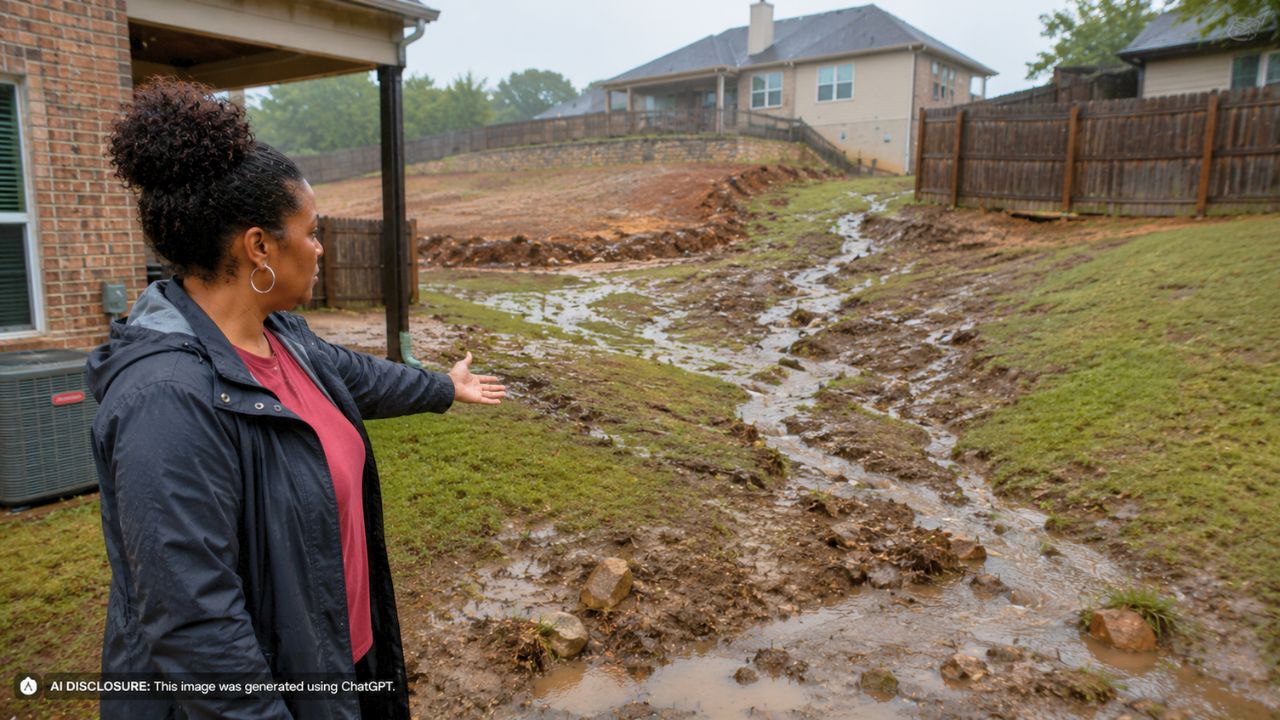
The way they described it, the yard doesn’t just get wet during a storm. It’s now channeling runoff into “three separate rivers,” and when it rains, the yard looks like a shallow lake. That’s the kind of detail homeowners recognize instantly: not normal puddling, but water moving with purpose.
The big frustration is that this doesn’t sound like a naturally swampy yard that’s always been that way. This sounds like a new pattern, one that began after the neighbor’s changes upstream. And once a drainage pattern changes, it rarely fixes itself.
The first major loss wasn’t the lawn — it was a room inside the house
Then it escalated from annoying to expensive. The homeowner said one of their rooms flooded “this week” due to water buildup along the side of the house. That’s a hard pivot point for any homeowner: the moment outdoor water becomes indoor damage.
When water stacks up against an exterior wall, the weak points don’t stay weak for long. It seeps under thresholds, finds cracks, follows foundation lines, and shows up as damp carpet, warped flooring, or wet drywall—sometimes in places that don’t seem connected to the outside at all.
Once a room floods, the worry isn’t just the visible mess. It’s what may be sitting behind baseboards, under floors, or inside wall cavities if the water lingered. And the clock starts ticking on secondary damage, even if the homeowner gets fans going quickly.
An old retaining wall met a new amount of water
The homeowner pointed to a retaining wall as a key failure point. They said it’s old and “not meant to deal with this much water,” and that it failed under the buildup. Anyone who has lived with a retaining wall knows the uneasy truth: they can look “fine” right up until the day they don’t.
Retaining walls aren’t just decorative. They’re doing structural work—holding back soil, controlling grade, and in a lot of yards, quietly steering water. When water pressure builds behind them and can’t drain properly, the wall becomes a battering ram target.
The way this was described, the wall’s age wasn’t the only issue. The water volume changed. That’s what breaks things that used to be “good enough.” A yard can handle normal flow for years, but once a new channel is carved or a slope is altered uphill, the downhill property can suddenly be acting like a stormwater system it was never designed to be.
The quote landed like a second flood
After the wall failure and the indoor flooding, the homeowner brought in a company and got an estimate: $8,000 to $15,000 to address the issue. That number is big enough to change how someone sleeps at night, especially when it comes with the added dread of “and still not sure this will work.”
Drainage work can be expensive, and part of the cost is the uncertainty. You can spend thousands regrading, adding drains, rebuilding walls, and hauling soil—then find out the upstream problem is still feeding water into your fixes.
That’s the trap in neighbor-driven runoff problems: you can try to treat the symptoms on your own property, but if the cause is uphill and ongoing, you’re paying to fight a moving river.
“Is this legal?” — the question behind the mud
The homeowner’s core question was simple: if a neighbor cut into their land to redirect water downhill, is that allowed? And if it isn’t, what do you do next—especially when the damage is no longer theoretical?
They also asked whether they should hire a lawyer. It’s the kind of question that usually comes after someone has already tried to be reasonable in their head: maybe it’s temporary, maybe it will settle, maybe it’s just a bad storm. But once a room floods and a retaining wall gives way, the problem stops being a neighborly annoyance and starts looking like liability.
The homeowner added one more detail that makes their frustration feel even more boxed in: because they’re downhill, “unless I can reverse gravity,” it would be difficult to route the water back onto the neighbor’s land. That line says a lot. They aren’t asking for a fancy solution. They’re asking to not be turned into the drainage outlet.
Readers zeroed in on proof, paper trails, and not rushing the wrong fix
Even without a long back-and-forth included in the source material, the direction this kind of discussion typically goes is predictable—and practical. When water and property lines collide, people tend to focus on documenting what changed, when it changed, and what it’s doing now.
The homeowner is already staring at evidence every time it rains: active channels, erosion, pooling, and the timing of a wall failure. But proving the source and linking it to a specific change uphill can be the difference between “my yard is wet” and “this was redirected.” That’s often why people start talking about photos after storms, notes on dates, and written estimates that describe what a contractor sees on-site.
There’s also the question embedded in that $8,000–$15,000 quote: what exactly are they paying for? A repair that holds back water? A repair that moves it? Or a repair that rebuilds a wall but leaves the water pressure problem untouched? When the homeowner says they’re “still not sure this will work,” that’s the voice of someone who’s worried about spending big and still ending up with rivers in the yard.
For now, the homeowner is stuck in that uncomfortable in-between: water still coming, erosion still happening, and a major repair decision looming. The rain doesn’t wait for neighbor conversations, and it definitely doesn’t wait for legal clarity.
And that’s what makes drainage disputes so brutal. They don’t stay on the fence line. They show up in the yard, then against the house, and eventually inside a room—where the cost stops being about landscaping and starts being about saving a home from the next storm.
Like Fix It Homestead’s content? Be sure to follow us.