Ohio Valley Homeowner’s Yard Floods Every Storm From the Neighbor’s Overgrown Lot — Then Learns the Neighbor Stopped Maintaining Her Yard on Purpose “to Spite the Previous Owners”
Photo credit: AI-generated image created using ChatGPT. Illustrative only.
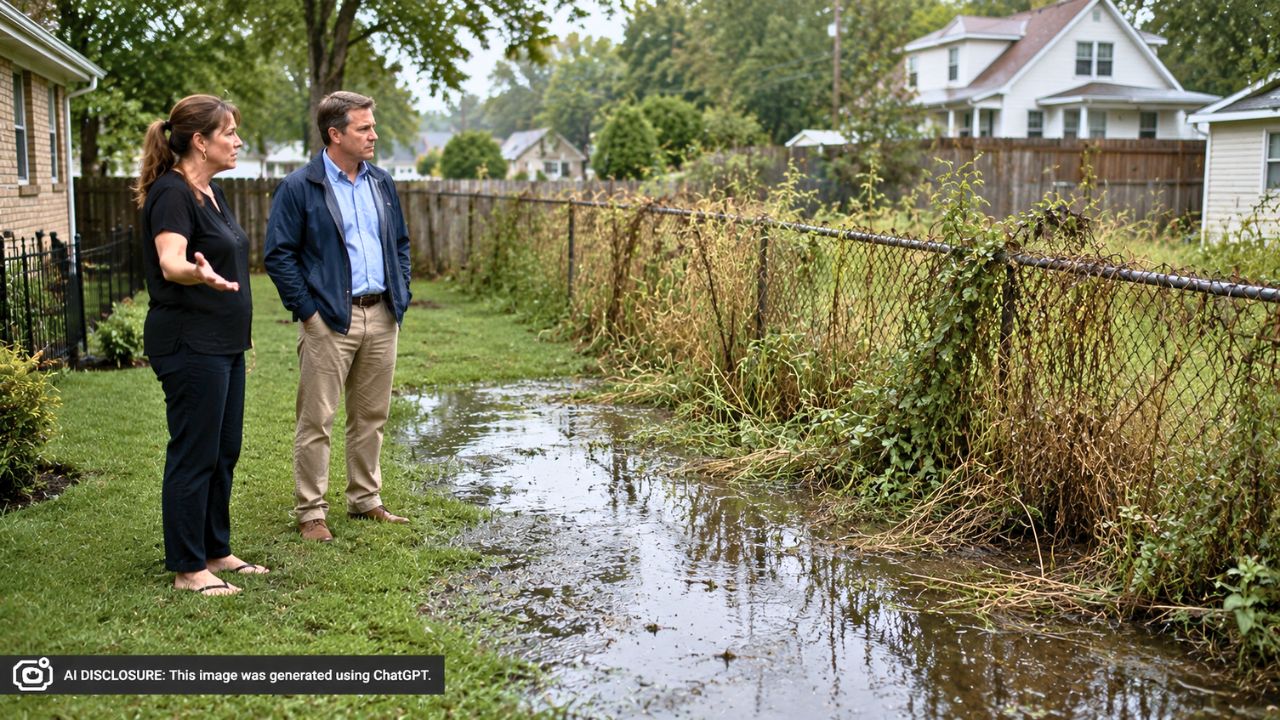
When the rain comes down hard in the Ohio Valley, you expect soggy grass and maybe a puddle or two. This homeowner walked out after a heavy storm and found something else entirely: a backyard that was “terribly flooded and holding water,” the kind of standing-water panic that makes you forget to grab your phone for a photo.
Trying to do the right thing, they rushed to clear their catch basin of leaves. That’s when they saw what looked like the real source of the sudden flooding: water pouring off a neighbor’s overgrown, long-neglected yard and spilling over an old retaining wall. The homeowner laid out the details in the source post, including a detail that turns a drainage headache into a neighbor war—this neglect wasn’t accidental.
The yard was already sloped the wrong way
The homeowner explained that the backyards in their area slope toward the houses. That’s not ideal on a normal day, and during heavy rain it can quickly turn into runoff rushing where you don’t want it—toward foundations, patios, and low spots that hold water.
They’d built their routine around that reality: keep the catch basin clear, stay on top of debris, and try to manage the flow before it becomes a problem. But this storm hit differently. The flooding wasn’t just a low spot getting overwhelmed; it was water collecting and lingering, a sign that the drainage system couldn’t keep up with what was coming in.
Then they looked over the wall
Once outside, the homeowner noticed their neighbor’s backyard had been left unattended since before they moved in. Overgrowth had taken over, and now rainwater was flowing “all” over an old retaining wall along the back hill.
The retaining wall itself is part of what makes the whole thing feel precarious. It’s described as one continuous wall that “curls around” and holds up a portion of the homeowner’s back hill. The homeowner isn’t even sure whose property it sits on, which matters—because when drainage and structures meet, responsibility gets murky fast.
In a heavy downpour, that kind of wall can act like a spillway. If the neighbor’s lot is shedding water unchecked and the wall is the low barrier between properties, the homeowner’s yard becomes the catchment area whether anyone agreed to it or not.
The neighbor admitted it was intentional
The most tense detail wasn’t the mud or the standing water. It was the neighbor’s attitude. The homeowner said the neighbor is “very rude,” and when they moved in, she openly stated she stopped taking care of her backyard to spite the previous owners—because those owners and the neighbor were “always at each other’s throats.”
That one sentence changes everything. It’s not just a messy yard next door; it’s a long-running feud that the new homeowner didn’t sign up for. And now the consequences are showing up on their side of the fence line, in the form of flooding and water that may threaten the yard, landscaping, and potentially the house if the pattern continues.
The homeowner tried to be clear about what they do and don’t care about: they’re not trying to control the neighbor’s choices. But when “negligence to maintain her property” starts pushing water downhill into someone else’s yard, it stops being an aesthetic annoyance and turns into damage risk.
The expensive part was not knowing where the line is
Instead of marching over to confront someone they already expect will react badly, the homeowner’s first move was paperwork and proof. They planned to call a surveyor to mark the property line, because they don’t know whether that retaining wall is theirs, the neighbor’s, or shared in some awkward in-between way.
That uncertainty is where homeowners get trapped. If the wall is on the neighbor’s property, the homeowner may have fewer rights to modify it. If it’s on their property, they may be the ones expected to maintain it—even if the neighbor’s runoff is what’s overwhelming it. And if it’s shared or straddling a boundary, any repair can turn into a standoff.
The homeowner also knows that how they handle the next steps could decide whether this stays a solvable drainage problem or becomes a years-long neighbor battle. They said they’ll talk with the neighbor after getting their “information in order,” but they’re already bracing for it to go poorly.
Fix it yourself, or force the issue?
With the yard flooding and the neighbor unlikely to cooperate, the homeowner floated the question a lot of people dread: is this the neighbor’s responsibility to remedy, or will the homeowner end up fixing it themselves?
The practical “fix-it” idea on the table was installing a French drain system at the base of the retaining wall to catch and divert water. That’s a real-world, get-it-done approach—dig, manage the water on your side, and try to protect your home even if the neighbor refuses to change.
But that choice comes with a sour aftertaste. A drainage system isn’t just labor and materials. It’s also an admission that you might be stuck engineering around someone else’s neglect. And if the neighbor’s runoff continues to worsen, a homeowner-installed solution may have to keep expanding, especially if the yard is already graded toward the house.
The other option the homeowner mentioned—calling the township or county—signals a different path: enforcement, inspections, complaints, and the hope that someone with authority can require action. That route can work, but it can also permanently poison day-to-day living next to someone who has already admitted to doing things out of spite.
People focused on documentation before confrontation
The homeowner’s instinct to get a survey first is the kind of move seasoned homeowners recognize immediately: don’t guess, don’t assume, and don’t argue on vibes. When property features “curl around” and ownership isn’t obvious, the fastest way to lose control of a dispute is to start making changes before you know where the legal boundaries are.
Even without getting into courtroom hypotheticals, the basic logic is simple. A survey gives you something concrete—where the line is, what sits on which side, and how to talk about the problem without it turning into a shouting match about “my yard” versus “your yard.” It also helps if the homeowner ends up needing to bring in local officials, because the first question tends to be: where is it, exactly?
And underneath all of this is the unspoken homeowner worry: water doesn’t just ruin lawns. It can soften soil near retaining walls, undermine slopes, drown plantings, and push moisture toward structures. Once water starts pooling after storms, people start picturing the next storm—then the next season.
For now, the homeowner is stuck in that miserable in-between stage: a yard that floods, a neighbor who has already framed neglect as a weapon, and a retaining wall that may or may not be theirs to touch. The next step isn’t a shovel or a pipe. It’s a survey stake in the ground—because in disputes like this, the line matters almost as much as the water.
Like Fix It Homestead’s content? Be sure to follow us.