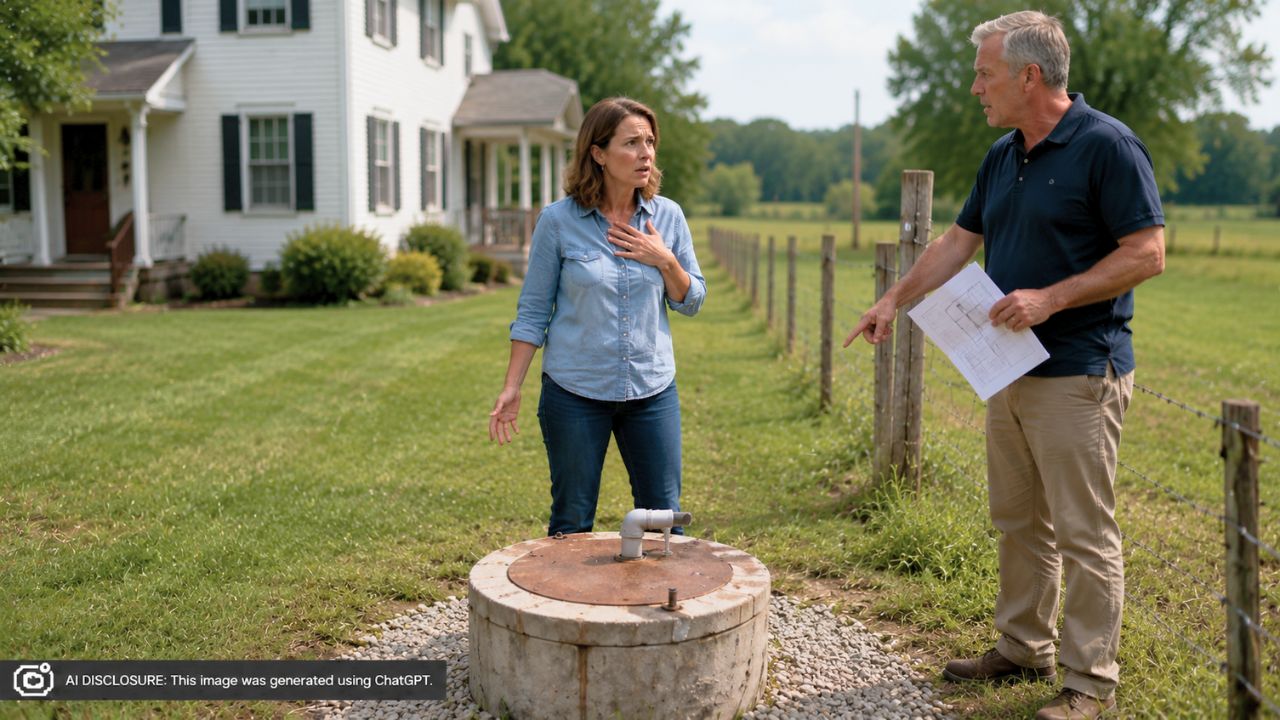
Homeowner’s Only Water Well Turns Out to Sit a Couple of Feet Over the Property Line — Then the Neighbor Claims a Single Survey Gives Him the Right to Cap It Immediately
Photo credit: AI-generated image created using ChatGPT. Illustrative only.
There are few homeowner surprises worse than the kind that threatens basic survival: water. One day you’re just living in your house like normal, and the next you’re being told your only well is allegedly sitting a couple feet onto the neighbor’s lot—and that the neighbor thinks he can shut it down whenever he feels like it.
That’s the gut-punch described in the original post, where a homeowner says a neighbor recently came over waving a new land survey. According to the neighbor, the survey proves the well is over the property line, which in his mind translates to immediate control: cap it, alter it, “do anything he wants with it whenever he wants.”
A well isn’t a fence—this one keeps the house running
Property-line disputes can be annoying when it’s a strip of grass or a fence post. A well is different. It’s not cosmetic, not optional, and it’s not something you can ignore while everyone cools off.
The homeowner says this well is the only source of water feeding the home. No city connection in the background, no second line to switch over to. If that well gets capped, daily life stops: toilets don’t flush, showers don’t run, and you can’t even reliably wash hands or dishes.
That’s what raises the stakes so fast. The neighbor isn’t talking about “let’s sort this out.” He’s talking like the survey is a green light to shut off the homeowner’s water on the spot.
The neighbor’s survey vs. the homeowner’s permit
The homeowner isn’t empty-handed. They say the well has a permit from the state engineer, and that permit shows it was installed on the homeowner’s lot. In other words: the official paperwork they have doesn’t match what the neighbor is claiming.
That’s where this kind of homestead drama gets messy. Surveys can differ, records can be wrong, pins can be missing, and old descriptions can be vague. But to a neighbor who’s decided he’s right, the details become less important than the power move—especially if he thinks he can force the issue by taking physical action first.
The homeowner’s question is straightforward and urgent: does a neighbor really get to “claim” a working well based on one survey and cap it immediately, or is there some legal process that has to happen before anyone touches it?
What “a couple of feet” can do to a property relationship
This is the part that anyone in a rural area recognizes. Things can be friendly for years, and then a measuring tape changes the tone of every conversation.
The homeowner describes the neighbor treating the survey like it “essentially gives him the right” to the well. That’s not just a disagreement—it’s a posture. Once a neighbor starts speaking in absolutes about something as essential as water, it’s hard to interpret it as anything but a threat.
And the timing matters. If a neighbor really believes he can cap a well “immediately,” the homeowner is suddenly on a clock they didn’t know existed. This stops being a slow-motion boundary dispute and turns into a fear that you’ll come home one afternoon and the water won’t work.
Even if the neighbor never touches the well, the homeowner now has to live with the idea that they might.
The practical consequences are immediate, even before anyone acts
When your only water source is under threat, you start thinking like someone preparing for a storm. Not because you want drama—because you need to keep your household functioning.
The post hints at that panic without spelling it out. If the neighbor is serious, the homeowner could be pushed into emergency planning: bottled water, temporary storage, and figuring out how long a home can operate without a well. In cold climates, the worry can expand to pipes, heating systems that rely on water, and the possibility of property damage if systems are shut down improperly.
And then there’s the money. If this turns into a fight over boundary lines, surveys and professionals come into the picture fast. If it turns into a fight over access to a well, the costs can get even uglier, because “just drill another one” isn’t a casual weekend project.
But the biggest risk is simple: if the neighbor takes action first, the homeowner’s day-to-day life is disrupted in a way that’s hard to undo quickly.
Reactions centered on documentation and stopping a “self-help” shutdown
Even without a big thread of comments included in the source material, the direction this kind of question usually goes is predictable: don’t treat it like a handshake problem once someone is threatening to physically interfere with essential utilities.
In situations like this, homeowners tend to focus on proof and paper. If one person has a single survey and the other has a state engineer’s permit that shows a different location, the next steps are often about verifying what’s actually true before anyone puts hands on equipment.
There’s also a strong practical instinct in these disputes to prevent “self-help” behavior—where a neighbor decides they’re judge and jury and takes action because they feel justified. When the threatened action is capping a well, it’s not just petty. It’s potentially catastrophic for the household that relies on it.
And because the homeowner says the well is permitted and the only source of water, that paperwork becomes more than a file folder item. It’s leverage, and it’s also the starting point for any official conversation about what can and can’t happen next.
The tension: one wrong move, and the problem gets physical
The reason this story feels so tight is that it sits right at the edge of becoming a hands-on fight over equipment. A fence argument can simmer for months. A well argument can turn into a same-day emergency if someone decides to make a point.
The homeowner isn’t asking how to win a neighbor feud. They’re asking if there’s any protected amount of time to “look into this situation” before the neighbor can act on what he believes a survey grants him.
That line tells you everything. The homeowner is trying to slow the moment down long enough to confirm facts and figure out what’s enforceable. The neighbor, at least as described, is doing the opposite—speeding it up by claiming immediate rights.
For now, it’s a standoff built on inches and paperwork, with a working well in the middle. The hard part isn’t just where the property line truly sits. It’s that the homeowner has to treat a basic necessity like it could be switched off at any moment—simply because a neighbor thinks one survey is permission to act first and sort it out later.
Like Fix It Homestead’s content? Be sure to follow us.