New Homeowner Learns a Neighbor Quietly Claimed Part of the Lawn Years Ago by Having Her Landscaper Mow It Regularly — Then Chases the New Owner’s Three Kids Off What She Calls “Her Land”
Photo credit: AI-generated image created using ChatGPT. Illustrative only.
It started as a normal new-homeowner annoyance: kids playing outside, a cranky neighbor next door, and a porch-side voice that seemed to be waiting for the chance to yell. But after one heated exchange, an unexpected detail surfaced—one that turned “get off my lawn” into something far messier.
In the original post, a homeowner in Upstate New York says another neighbor quietly let them know that the grumpy older woman next door may have been treating a big slice of the poster’s yard like it belonged to her for years—back when the house was derelict and before the current owner ever moved in.
A skinny lot, three kids, and a neighbor who never uses the space
The homeowner describes living on what should be a regular lot, except it doesn’t feel like one. Because of where the neighbor “assumed property rights,” the yard now reads as “extremely skinny,” especially compared to other properties nearby.
That’s what stings: the neighbor isn’t someone who’s out gardening, hosting cookouts, or even enjoying the lawn. The homeowner says she “does not in any way, shape, or form, come outside, use her lawn, etc,” yet she has “two gigantic side lawns” she doesn’t use.
Meanwhile, the homeowner has three kids. And those kids keep getting treated like trespassers.
The porch yelling wasn’t just rude—it was a boundary line being enforced
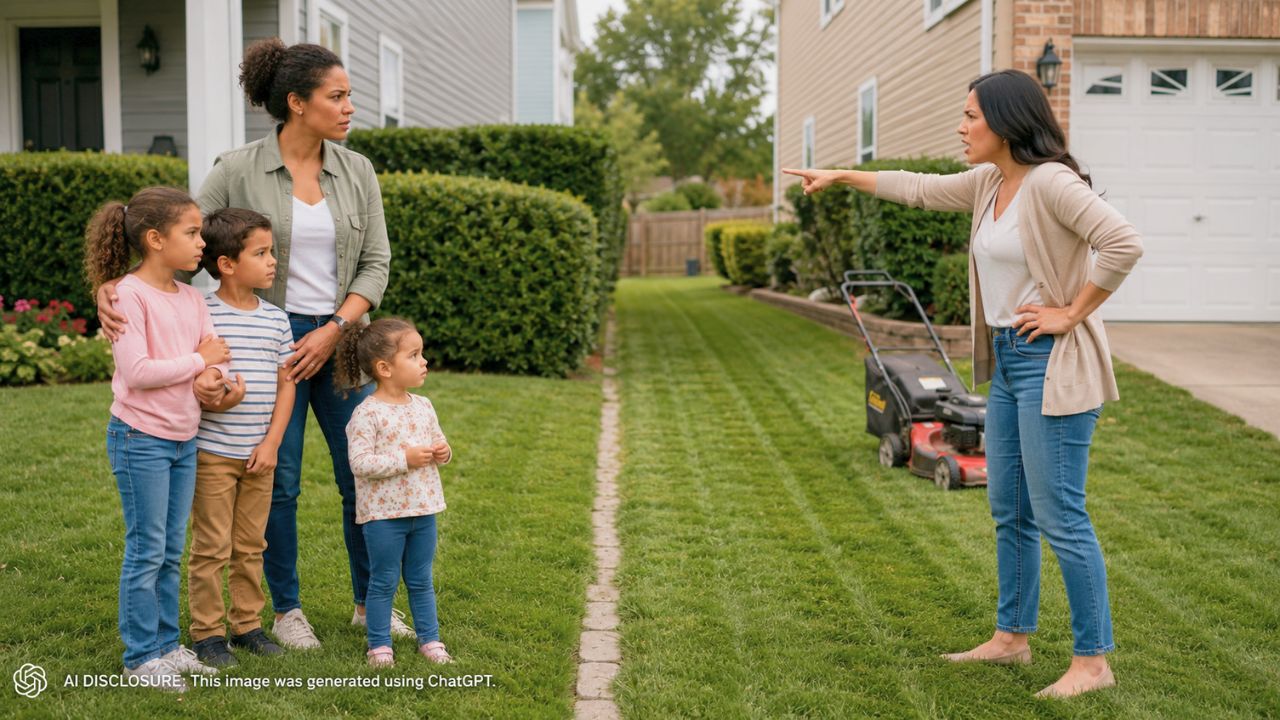
The family’s day-to-day friction isn’t subtle. The homeowner says the neighbor “regularly tries to chase them off ‘her land,’” not by coming over to talk, but by planting herself on her front porch and yelling at the children.
That choice—yelling at kids instead of speaking with the adult next door—became its own flashpoint. The homeowner says they “got into a big row with her” because “she has no right to yell at my kids, she can come talk to me.”
Even before the new information came out, that porch yelling framed the whole relationship: not a one-time complaint about noise or a ball rolling into the wrong yard, but a repeated claim that a certain patch of grass is off-limits.
Then came the detail that changed everything: mowing as a long game
The real gut punch came from another neighbor—the kind of neighborhood intelligence you don’t get at closing. According to what the homeowner was told, the grumpy neighbor had her “landscaper son mow that lawn regularly” years ago, during the period when the house was derelict.
The implication was blunt: because it was neglected and unmanaged, she treated it as an opportunity. Mow it, maintain it, act like it’s yours, and eventually claim it. The homeowner’s wording suggests the neighbor didn’t just blur the line—she “managed to assume property rights” to “a large portion” of what “should be my lawn.”
It’s the kind of story that makes any new owner’s stomach drop. You buy a home thinking you’re getting the lot shown on a map or in a listing photo. Then a neighbor’s routine—something as ordinary as mowing—turns out to be part of a years-long claim that reshaped what you can actually use.
Why it’s not just about grass: play space, safety, and resale anxiety
On paper, losing yard width is a property-line headache. In real life, it’s constant friction. With three kids, that missing lawn is play space that should be part of daily family life—running, riding bikes, setting up a small goal or sprinkler—things families do without feeling like someone is watching from a porch.
And even when nothing “happens,” the stress piles up. A neighbor who regularly threatens or chases kids off creates a safety worry that’s hard to ignore, especially if the adults aren’t always in the yard. It changes how a family uses the outside of their own home.
Then there’s the long-term fear homeowners don’t like to say out loud: what does this do to the property later? A “skinny” lot compared to others on the street can affect how the home feels to the next buyer, how a future fence might be placed, and whether the outdoor space matches what people expect when they see the house from the curb.
People zeroed in on proof: what’s owned versus what’s been “treated like owned”
The homeowner didn’t include a play-by-play of responses, but the question they asked—“Has anyone ever been in this situation before or have any knowledge of a similar situation”—is the kind that typically pulls homeowners toward the same first step: figure out what the land records and property boundaries actually say, not what a neighbor has been asserting.
The tension here is that the neighbor’s behavior has two layers. One is social: she’s acting like the space is hers and policing it by yelling at children. The other is practical: the claim was allegedly built through routine maintenance when the property was derelict, which is exactly the sort of detail that makes people think about surveys, deeds, and how long something has been going on.
In other words, the lawnmower wasn’t just lawn care. It was a statement. And once you hear that, it’s hard to un-hear it every time the grass gets cut.
The homeowner wants the land back—but the real fight is about what happens next
Once the homeowner learned the backstory, the anger shifted from “stop yelling at my kids” to “that should be my land.” They say they’re “even more pissed” now and would “love to find some way to claim that land back.”
That desire is understandable, but it also hints at how tricky the next steps can get. If a neighbor truly believes she has rights to the strip, she may escalate the moment someone challenges it—especially if her default approach is already to threaten children from a porch.
And if the homeowner starts acting like the area is theirs—by using it, maintaining it, or changing it—there’s a good chance it will turn the quiet, simmering porch-yelling into a daily confrontation. The homeowner is left balancing two needs that don’t always cooperate: protecting their kids from being harassed, and pushing back on a land claim that may have been “set” years before they ever got the keys.
For now, the story sits in that uncomfortable place so many homeowners recognize: the house is yours, the mortgage is yours, the stress is yours—and yet the boundary line outside feels like it belongs to whoever is willing to be loudest about it.
Like Fix It Homestead’s content? Be sure to follow us.