Rural Landowner Watches the Neighbor’s Contractors Send a Bulldozer 400 Feet Onto Her Land After Promising to Stay Off — Then It Buries Her Natural Spring Under a Flattened Dirt Pad
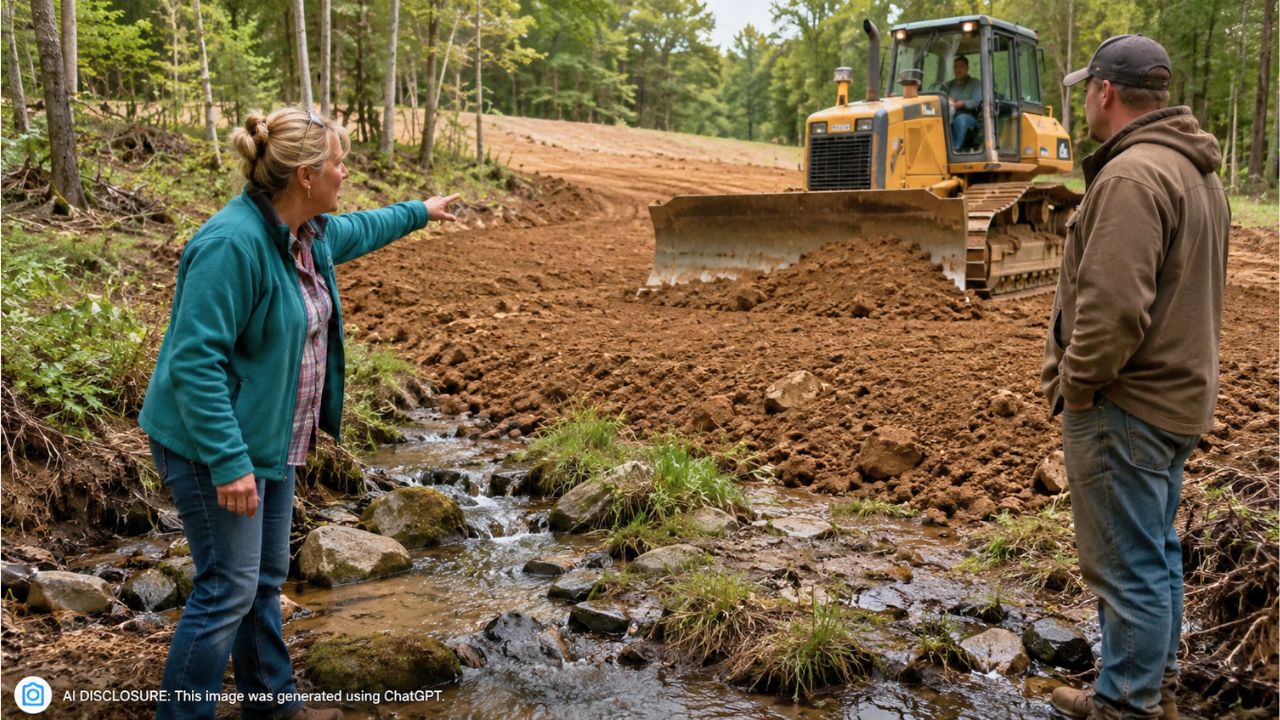
Photo credit: AI-generated image created using ChatGPT. Illustrative only.
On a rural stretch of Idaho land, one landowner thought she’d already done the hard part: catching a problem early, talking to the neighbor, and setting a clear boundary before heavy equipment turned her hillside into a mess. Then she walked down to the property and realized the contractors hadn’t just crossed a line—they’d kept going.
In an update shared in the original post, she describes finding a bulldozer route that ran hundreds of feet onto her land, plus a newly flattened pad of dirt that appears to have buried a natural spring. For anyone who’s lived on acreage long enough, that detail lands like a punch: springs aren’t just “nice to have.” They can be water sources, drainage relief, and part of what makes the land work.
The first sign was a bulldozer where it didn’t belong
The backstory starts with a neighbor trying to get access for repair work—re-engineering and fixing a failing retaining wall. Contractors brought in equipment, and the landowner noticed a bulldozer coming through her property without permission.
When she spoke to the neighbor, the neighbor said she “meant to ask permission and forgot.” The landowner drew a hard line: she would only allow the bulldozer to come down the hill, but it could not go back up the same way. The concern wasn’t petty. Anyone with a steep driveway or soft ground knows what tracked equipment can do to soil, roots, and erosion patterns in one pass.
Then the trees started dropping
Even with that limited allowance, the landowner says the contractors cut down several trees—without her consent and after she explicitly told the neighbor that no trees on her side were to be cut.
What made it feel especially blatant was where the trees fell. She describes most of them as being 20 to 50 feet across the property line on her side. She also says the work activity was happening 30 feet and beyond over her line near a portion of her 20-acre parcel that runs alongside the neighbor’s shop.
The landowner’s frustration wasn’t only about the trees themselves. It was also about what the cutting implied: either no one knew where the property line really was, or they knew and didn’t care. She notes she believes no survey was done and says she knows her boundaries because her parcel lines are known.
A face-to-face talk, an apology, and a promise
After the initial damage, she and her wife met with the neighbor’s husband. According to her account, he said he was unaware of what was happening and suggested his wife was the one working directly with the contractors.
In that meeting, the landowner told him she was unhappy and did not want the bulldozer coming back out through her property. He agreed. He also floated what he framed as an “offering”: having someone cut the downed trees into rounds and give them to the landowner.
It’s the kind of moment rural neighbors recognize—an attempt to settle things with sweat equity and firewood, not paperwork. Sometimes that works. Sometimes it only works until the next machine shows up.
Four days of silence, then the contractors came back anyway
After four days with no updates, the neighbor’s husband texted on Thursday to say they had checked all available exits for the bulldozer and were told the only way out was the way it came in—through her property. He apologized and said that moving forward, they would stay off her land.
He also offered a fix for the “entry point” off the road: putting a dump truck of dirt over the spot where they left the road on her property. On paper, that might sound like help. On the ground, dumping dirt can be its own kind of damage, especially on a slope where water has a mind of its own.
Still, the landowner thought she understood what “the way they came in” meant. The next morning, she found out she’d been imagining a much smaller trespass than what apparently happened.
The route wasn’t just a shortcut—it carved into the land
On August 10, the landowner and her wife went back down to check the area. What they found was not the bulldozer exiting the same path down the hill.
Instead, she says there is an old road or trail that runs more than 400 feet up into her property before turning and running down along her property line. The contractors appear to have taken that road deep onto her land, then turned, and then bulldozed a flat spot that covered her natural spring.
From there, she believes the equipment traveled down her property line and possibly onto a different neighbor’s property. That detail adds a new layer of stress: now it’s not only her boundary at issue, but potentially another household being pulled into the same mess.
She also points out there were posted signs. She says two “No Trespassing” signs have been up at the entrance to that road for more than three years, making it hard to frame what happened as an innocent misunderstanding.
People pushed documentation, surveys, and professionals—not more talks
The landowner’s next steps were practical and immediate: take pictures, consider filing a police report (even if she suspects it won’t lead to much), and contact an arborist and an attorney on Monday.
That’s where many property and tree disputes head quickly, because the damage is physical, expensive, and easy to argue about later if you don’t lock down evidence now. Trees can’t be uncut, and once a spring is buried under fill, “fixing it” might mean excavation, drainage work, or permanent changes to how water moves across the hillside.
In these kinds of disputes, the most common outside advice tends to be consistent: document everything while it’s fresh, confirm the boundary with a survey if there’s any chance it will be challenged, and get third-party estimates from someone qualified to value tree loss and land restoration. It’s not about escalating for sport—it’s about preventing a future argument from turning into a “he said, she said” with no hard proof.
The landowner also said she planned to speak with the other neighbor whose property may have been crossed before contacting the neighbor she believes is responsible. That’s the careful move on a rural road where people see each other for years: figure out who else is affected, and don’t let anyone else get blindsided.
What’s left now is the part every landowner dreads: walking the damage line by line, trying to estimate what it will take to restore the land, and deciding how to enforce boundaries when a “promise to stay off” already didn’t hold. A bulldozer path can be smoothed over with dirt, but the memory of where it went—and what it flattened—doesn’t disappear nearly as easily.
Like Fix It Homestead’s content? Be sure to follow us.