Pennsylvania Lakefront Owner Heads to Court Over a Neighbor’s Dock Crossing the Three-Hundred-Foot Waterfront Line — Then the Permit Office Says Enforcing Property Lines “Is Not My Job”
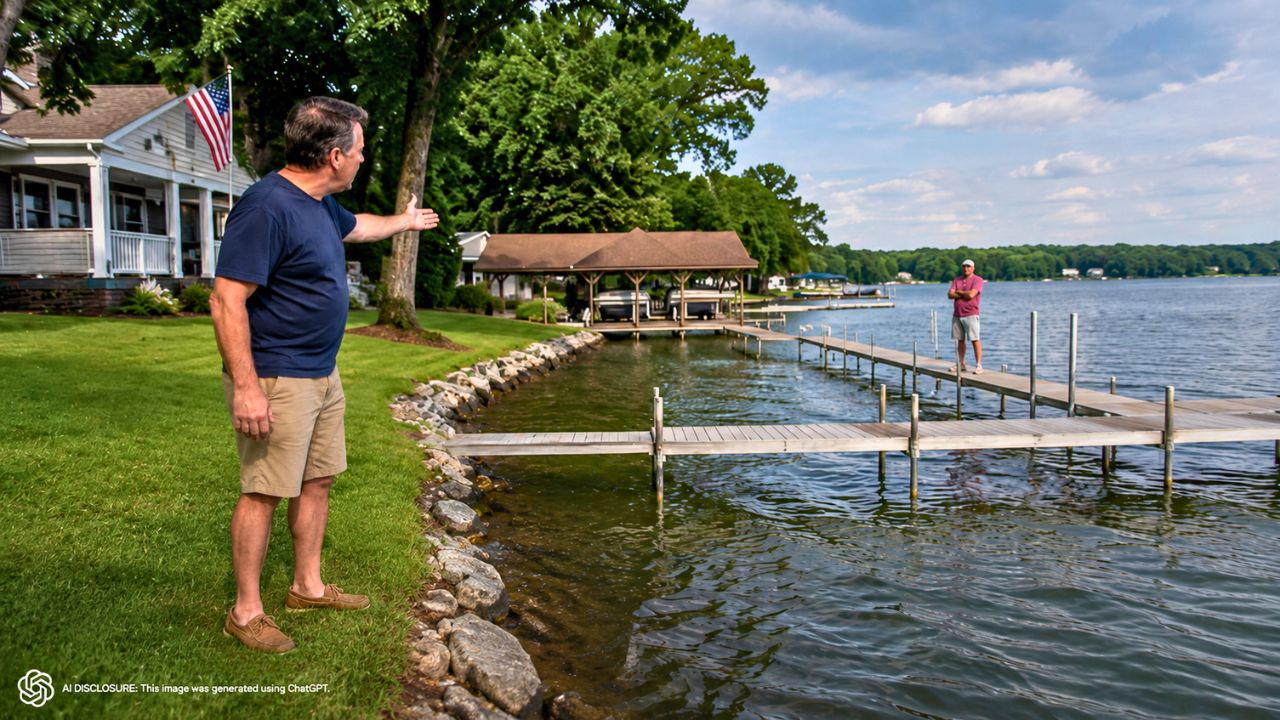
Photo credit: AI-generated image created using ChatGPT. Illustrative only.
On some lakes, the water is the easy part. It’s the invisible lines—who can build where, who can tie up where, who gets to pass without a fight—that turn a quiet shoreline into a courtroom calendar.
That’s where one Pennsylvania lakefront owner says they’ve landed after noticing a neighbor’s dock crossing what they believe is their waterfront boundary. In the original post, the homeowner laid out a familiar lake-country headache: the state owns the water, a third party owns the land, and their deed says they have 300 feet of lake access. Now, they’re prepping for a court date and looking for any practical suggestions that might keep them from getting steamrolled.
Where the paperwork gets weird: water, land, and “access”
The homeowner described a setup that’s common around older lakes and regulated shorelines: the water itself is owned by the state, while the land along the shoreline is owned by a separate third party. On top of that, they say their deed spells out 300 feet of waterfront property with access to the lake.
That wording matters because “waterfront” and “access” can feel straightforward until someone drops lumber, pilings, and hardware into the mix. A dock isn’t just a weekend convenience. It’s a physical structure that dictates boat traffic, swim space, and where families can safely step into the water without feeling like they’re trespassing.
According to the homeowner, the neighbor’s dock doesn’t just feel close—it’s over the line.
The moment it stops being neighborly: a dock that “crosses” your frontage
Dock disputes tend to start small. A corner of a platform looks angled wrong. A set of posts doesn’t line up with what you’ve always assumed was the divide. People try to ignore it because lake neighbors see each other constantly, and nobody wants to turn a summer view into a cold war.
But this owner says the neighbor’s dock permit is “improperly drawn,” which pushed the issue out of the realm of polite conversation and into paperwork. When you believe the permit diagram itself is wrong, the argument isn’t just about a dock—it’s about which documents the state accepts and what happens when those documents don’t match what a deed claims.
And once a dock is built and being used, the pressure ramps up fast. If you wait too long to object, you worry you’ll be told you accepted it. If you object immediately, you risk lighting the fuse with the people who live ten yards away.
Then the permit office shrugs: “not his job”
One line from the homeowner’s summary explains why this escalated: the permit person told them it was not his job to enforce property lines. To a homeowner staring at a structure they believe is encroaching, that’s the kind of answer that makes your stomach drop.
In real life, homeowners often assume a permit is a sort of blessing stamp—if the county or state signs off, surely someone checked whether it was allowed to be there. But the post suggests a more fragmented reality: an office may issue or process a dock permit without taking responsibility for where private boundaries fall.
That leaves the homeowner in a familiar bind. If the permitting side won’t referee the line, the burden shifts back onto the property owners to fight it out with surveys, deeds, and enforcement actions—exactly the stuff most people never wanted to learn in the first place.
Escalation by inches: enforcement, court, and the nuisance argument
The homeowner said they’re headed toward “105 enforcement with depa,” describing an enforcement path involving environmental oversight. They also said a court date is coming up and asked for “trial tips,” specifically noting they have to show the dock is a nuisance to them.
That word—nuisance—is where these disputes often get gritty. It’s not enough to say, “I don’t like it.” They’re preparing to argue the dock interferes with their use and enjoyment of what their deed says they have: 300 feet of waterfront access.
To make the point tangible, the homeowner mentioned they can place their own dock right at the property line. They also plan to put out two wake buoys. Even without extra detail, you can feel the chess match forming: if the neighbor’s dock crowds the line, a competing dock and buoys could turn the contested water into a narrow channel of frustration.
It’s the kind of escalation that can make everyone’s summer worse. But it also signals something important: the owner is thinking about physical markers and practical use, not just legal theory. On the water, what you can actually do—launch, swim, tie up, keep wakes down—often becomes the evidence people remember.
What other homeowners zero in on: proof, lines, and paper trails
The post itself reads like someone trying to build a checklist before walking into court: deed language, permit drawings, the state’s ownership of the water, third-party ownership of the land, and the need to frame the dock as a nuisance.
Even without a full comment thread included, the pattern in these shoreline fights is predictable. People fixate on documentation because conversations become “he said, she said” the moment a neighbor insists their permit makes it legal. In disputes over a few feet of water frontage, a clean paper trail is often the only thing that doesn’t get emotional.
Homeowners in similar battles usually want to know: What does the deed actually grant—frontage, an easement, or a right-of-way? Does the permit drawing match any recognized boundary? And if the permit office won’t enforce property lines, who will—an enforcement unit, a judge, or a separate civil process?
That’s why the homeowner’s focus on the permit being drawn wrong—and the official response that enforcing lines isn’t part of the job—hits so hard. It’s not just a neighbor problem. It’s a systems problem where the homeowner feels bounced between agencies while the dock stays put.
Living next to the dispute while waiting for a ruling
There’s a particular stress to waterfront disputes: you can’t avoid the subject. Every glance out the window and every walk down to the lake reminds you the argument is still sitting there, bolted together, casting shade where you think it shouldn’t.
Meanwhile, the homeowner is trying to plan moves that protect their access—placing a dock at the line, adding wake buoys—while also preparing to walk into court and make the case that the neighbor’s structure has crossed into nuisance territory. That’s a tough needle to thread. Anything that looks retaliatory can inflame the neighbor relationship, but doing nothing can feel like surrender.
For now, the dock remains the daily reminder that “water owned by the state” doesn’t mean the shoreline is a free-for-all. It means one homeowner is stuck proving, foot by foot, that the space they thought came with their deed is still theirs to use.
Like Fix It Homestead’s content? Be sure to follow us.