New Construction Next Door Pours a Foundation on Vacant Fire-Damaged Land — Then the Builder’s Erosion Barriers Turn Up Fifteen to Twenty Feet Onto the Neighbor’s Side Before Anyone Asks
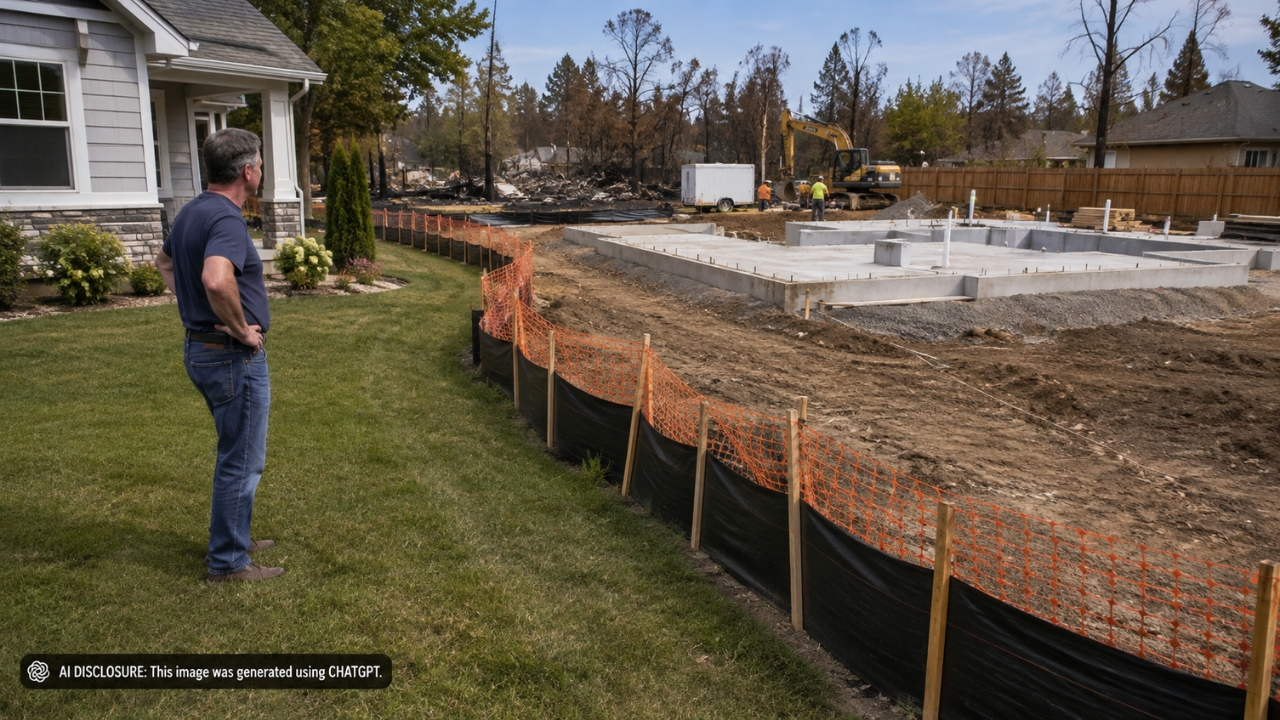
Photo credit: AI-generated image created using ChatGPT. Illustrative only.
It’s one thing to come home to a neighbor’s construction noise. It’s another to come home and realize the “property line” the crew is working off of seems to drift onto your lawn by a car length.
That’s what one homeowner described in the original post—returning from being out of town to find a foundation already poured next door on land that had been vacant since a house fire, plus erosion-control barriers snaking along the boundary… except in several spots they were set roughly 15 to 20 feet onto the homeowner’s side.
Coming back from a trip to a surprise foundation
The neighboring property had been sitting empty for over a year after the previous home burned. No new framing slowly appearing over months, no obvious day-by-day build to mentally track—just a long stretch of “vacant lot” that suddenly wasn’t vacant anymore.
While the homeowner was away, work moved fast. A new foundation was already in place, and the builder had installed erosion barriers along what they apparently believed was the edge of the construction site.
But the barrier line didn’t match what the homeowner understood as the true boundary. In places, the controls ran well onto the homeowner’s property, close enough to leave a bad taste even if the actual house ends up meeting required setbacks.
The erosion barriers were the red flag—because they were on the wrong side
The homeowner emphasized that, so far, there wasn’t a structure built over the line. The foundation itself appeared to be on the neighbor’s side. What changed the mood was the “extras”—the temporary stuff crews often treat casually.
Erosion barriers can mean stakes driven into the ground, fabric trenched in, soil disturbed, and equipment walking the line over and over. Even if it’s “temporary,” it’s also a signal: this is where the crew thinks the work zone ends.
And once a construction team gets comfortable using a strip of your land—whether it’s for runoff control, staging, or just turning a skid steer around—it can quietly become normalized. The homeowner’s concern wasn’t only the immediate lawn damage. It was preventing the next step: forms set a little too close, grading that changes drainage, or a fence line that “accidentally” shifts because nobody challenged the assumption early.
The pins were there, but nobody bothered to check them
What made it more frustrating was that the homeowner believed the iron pins marking the boundary were easy to locate. In other words, the clues weren’t buried in mystery. They were already in the ground.
Still, the homeowner hadn’t had a formal survey done, and that missing piece created a familiar homeowner trap: you can be right, but without paperwork you’re stuck trying to stop heavy equipment with a firm voice and a hunch.
The homeowner’s instinct was that the neighbor should have surveyed before any work began—or at minimum located those existing markers. But that didn’t help with the immediate question: what’s the best move now, while everything is still fixable?
Talking to the owner before it turned into a feud
Instead of letting the frustration simmer, the homeowner caught the property owner during a visit to check the build progress and brought up the boundary concerns directly.
The owner confirmed something that explains a lot: there had been no survey done before construction started. She also told the homeowner the plans don’t include building any closer than what’s already laid out, suggesting the actual house footprint should still comply with setbacks.
Just as important, the homeowner described the conversation as amicable. The owner even asked to be kept updated on any survey work the homeowner schedules—one of those small, practical gestures that can keep a neighbor dispute from turning personal.
The homeowner’s next step was already in motion: get a survey scheduled, then try to catch the contractor and make sure the crew knows where the line actually is.
What neighbors zeroed in on: proof, photos, and keeping it calm
Even without seeing every reply, the shape of the public reaction to stories like this is consistent: don’t wait until framing starts to get serious about boundaries.
People tend to focus on documentation first—because the “temporary” stuff is often what creates the first measurable damage. Erosion barrier placement, torn turf, ruts from machinery, and disturbed grading can all become a headache later if the homeowner needs repairs or reimbursement.
And there’s a second, quieter reason people push for clarity: once a neighbor’s build is far along, everyone gets defensive. Contractors are under schedule pressure, the owner has money tied up in crews and materials, and nobody wants to hear that something has to be pulled out and redone. Catching it early is the only time “Hey, that’s not the line” has a chance to stay a normal conversation.
The real risk isn’t just the lawn—it’s everything that follows the line
The homeowner’s worry wasn’t limited to a few feet of fabric fence. Property line confusion can ripple into all the unglamorous parts of a build: where runoff goes after grading, where downspouts discharge, how close a driveway apron gets, and whether landscaping ends up planted and watered on the wrong side for years.
When the neighbor’s lot had been vacant after the fire, there wasn’t much to argue about—just two properties sitting still. Construction changes that instantly. The minute forms go in and crews begin shaping the land, the stakes become physical.
Even if the home itself lands legally inside setbacks, a 15- to 20-foot encroachment by “temporary” barriers is a sign the crew may keep drifting—especially if they’re relying on eyeballing, old assumptions, or a rough plan view without a staked line.
For now, the homeowner is trying to handle it the way most people wish these disputes went: talk early, keep it civil, and bring in a surveyor to turn a gut feeling into a clear map. The tension is still there, though, because the build is moving forward—and every day the crew keeps working off the wrong mental boundary is another chance for someone to tear up a little more lawn before they’re finally told where the property actually begins.
Like Fix It Homestead’s content? Be sure to follow us.