Homeowner Working From Home Overhears a Crew Already in the Yard — Then Finds the Neighbor Sent Them to Butcher a Tree Without Ever Asking Permission
Photo credit: AI-generated image created using ChatGPT. Illustrative only.
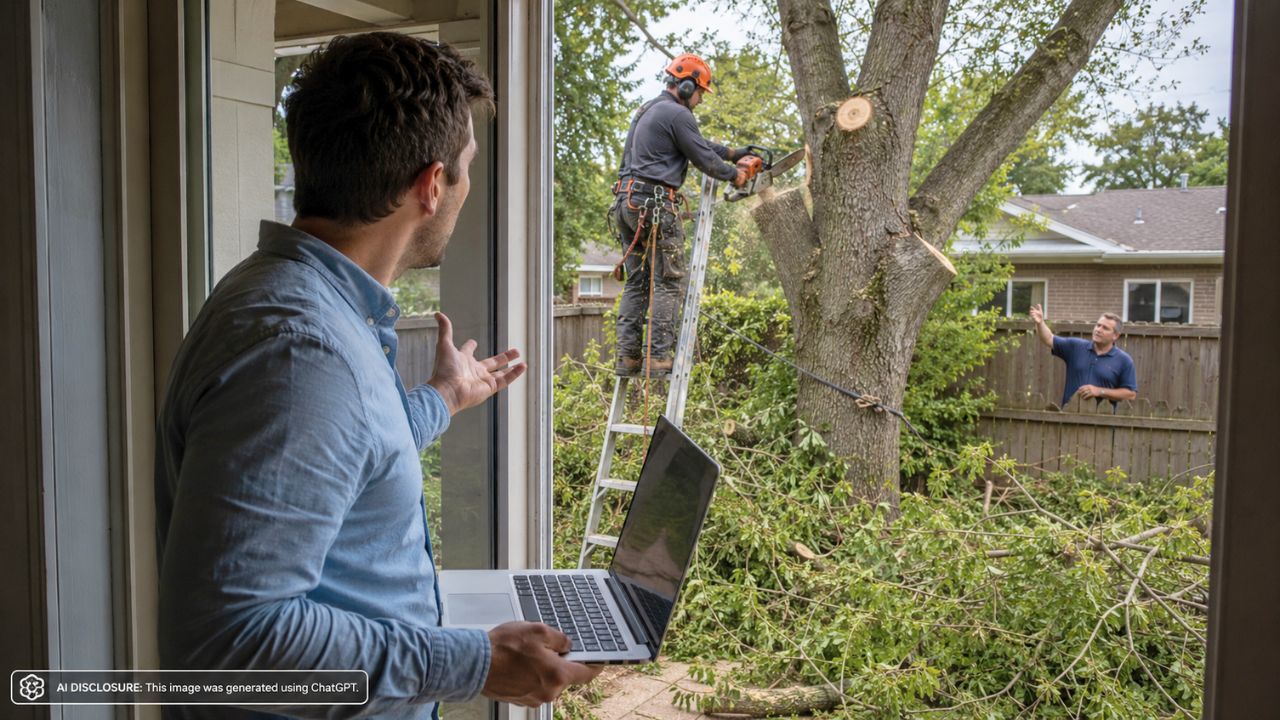
It started as background noise: voices outside, the thud of branches, the kind of yard commotion you assume is on someone else’s property. But this homeowner was working from home, and the sounds weren’t coming from the street or the neighbor’s side. They were coming from inside their own yard.
By the time they stepped out to see what was going on, a crew was already in the tree—on the homeowner’s side—cutting away. The workers said they were there to “trim the tree,” sent by the neighbor. The homeowner’s account, shared in the original post, makes it clear they weren’t just annoyed by surprise yard work. They felt like they were watching their tree get wrecked in real time.
The “trim” turned into a haircut they never agreed to
The homeowner said they know the basic rule: a neighbor can usually cut branches that overhang the property line. The issue here was how the work actually happened—workers entering the yard without notice, climbing the tree from the homeowner’s side, and continuing to cut after being told to stop.
And this wasn’t a careful shaping job. The homeowner described it as “butchered,” saying the crew took off close to half the tree’s height. They didn’t have a “before” photo, but they did have photos showing how aggressive the cuts were and how dramatically the canopy was reduced.
There’s a particular kind of helplessness in catching something mid-action. It’s not like noticing a missing fence board after the fact, where you can at least start documenting immediately. In this case, the homeowner walked into an active worksite they never approved, with someone already up in the branches.
Then the crew got rude—and wouldn’t leave
The homeowner confronted the workers and told them they wanted the crew off the property and to stop until the neighbor could be consulted. The neighbor, according to the post, wasn’t home while this was going on—adding to the frustration. It’s one thing to have a tense conversation with the person who ordered the work. It’s another to be stuck arguing with workers who insist they’re authorized.
The crew pushed back, arguing they weren’t affecting the homeowner’s property—despite the detail that a worker was “legitimately climbing the tree” from inside the homeowner’s yard. That’s where the dispute stopped being about pruning techniques and became about trespass and control.
The homeowner said they only started feeling like “the bad guy” once the work crossed into what looked like serious damage and the landscaper’s attitude turned dismissive. It wasn’t framed as a petty neighbor gripe. It read like a homeowner trying to stop a mistake before it became permanent.
The real fear: did they just shorten the tree’s life?
Plenty of people can live with a bad haircut on a shrub. Trees are different. The homeowner’s worry wasn’t just aesthetics—it was whether this kind of heavy cutting could impact the tree’s health and stability.
They asked the crew if they could provide an arborist report stating the trimming wouldn’t affect the tree. The answer they got: no report, and they didn’t “need” one. That response matters because it draws a line between professional tree care and someone doing the minimum to clear a view, open a yard, or address overhang complaints.
The homeowner also pointed out an odd detail: that tree provided shade to the neighbor’s rear patio, so the motivation didn’t even make obvious sense from a comfort standpoint. But motives don’t always have to be logical. Sometimes it’s about leaves in gutters, fear of branches in storms, or a long-running annoyance that finally turns into action when someone hires a crew.
Now the homeowner is left with a tree that might recover—or might decline slowly over seasons. That’s the maddening part. If it dies next year, was it drought, disease, or the cuts? When you don’t control the work, you also don’t control the paper trail.
Property lines are one thing—access is another
In plain homeowner terms, the question becomes: even if a neighbor can cut back overhanging limbs, do they get to send workers onto your land to do it? The post makes clear the homeowner didn’t consent to yard access, and they didn’t get a heads-up that strangers would be in the yard with ladders and saws.
That access piece is where a lot of normal “neighbor trimming” stories go off the rails. A reasonable neighbor trims from their side, stays on their side, and takes what they’re legally allowed to take. A less reasonable one treats the property line like a suggestion and acts first, explains later.
The homeowner is in the Town of Islip, Suffolk County, New York, and asked what options exist besides suing. You can hear the hesitation: they’re angry, but they also know legal fights with neighbors can poison day-to-day life for years, especially when the view from the kitchen window includes the person you’re fighting with.
People zeroed in on documentation and an arborist, fast
Even without a full comment thread included in the source material, the instincts around these disputes tend to be consistent, and the homeowner’s own questions point in that direction. Once a tree has been heavily cut, the immediate value is in documenting what’s left and getting a professional opinion on the damage.
The homeowner already tried to ask for an arborist report from the crew and was brushed off. That’s usually a sign you’ll need your own expert if you want a credible assessment of whether the pruning crossed the line into harm. In tree disputes, the difference between “ugly but okay” and “improper cuts that may kill it” is the difference between annoyance and real financial liability.
Another practical thread that comes up in these stories is proof: photos from multiple angles, a timeline of what happened, and any record of the neighbor ordering the work. If the crew had a work order, someone signed something. If they were hired through a landscaping company, there may be an invoice, a scope of work, or at least a text message that shows intent.
When a tree gets “butchered,” the fight doesn’t end when the saw stops
The worst part about this kind of yard conflict is that it keeps unfolding after everyone goes home. The homeowner now has to look at that tree every day and wonder what comes next—sprouting, dieback, disease, storm risk, or a slow decline that’s hard to pin on one cause.
And there’s another layer: once a neighbor has sent workers into your yard once, it changes how safe your property feels. It’s not just about landscaping anymore. It’s about boundaries, assumptions, and whether you need cameras or stronger fences just to feel like your yard is yours.
The homeowner wasn’t asking for drama. They were asking for basic respect: don’t enter the yard without permission, don’t take a chainsaw to a shared-edge tree without clarity, and don’t act like the person who owns the land is being unreasonable for objecting. Now they’re left weighing what it takes to protect the tree—and how far they’re willing to go to make sure it doesn’t happen again.
Like Fix It Homestead’s content? Be sure to follow us.