Homeowner Finds a Neighbor Planted Trees on the Surveyed Property Line — Then He Moves the Marker Stake and Wants Mesh Netting Further In
Photo credit: AI-generated image created using ChatGPT. Illustrative only.
The homeowner thought they had the property line handled years ago: hire a surveyor, get stakes placed, and eventually put in a fence when time and budget allowed. But one day, that slow-burn plan turned into an immediate boundary fight—because the neighbor showed up with landscapers and started planting a row of “tall giants” right where the line was supposed to be.
In the original post, the homeowner explains they bought the house four years ago and had stakes professionally placed to mark their property for a future fence. They’d been busy with other renovations, so the fence never happened. Then the neighbor planted trees along the edge—without asking permission for workers to step onto the homeowner’s land—and the details got messy fast.
The stakes were there for a reason
This wasn’t a casual “I think the line is about here” kind of situation. The homeowner says they had a professional surveyor come out and place stakes specifically for building a fence later. Those stakes were meant to be the physical reminder: this is where my property ends, and yours begins.
Anyone who’s owned a home long enough knows why people do this. Property lines are easy to argue about in theory and surprisingly hard to see in real life—especially once landscaping, grading, and retaining walls start visually “suggesting” boundaries that aren’t official at all.
Because the fence project was delayed, the stakes became the only on-the-ground reference the homeowner had. And that’s exactly what made the next part feel so deliberate.
The neighbor planted first, asked later
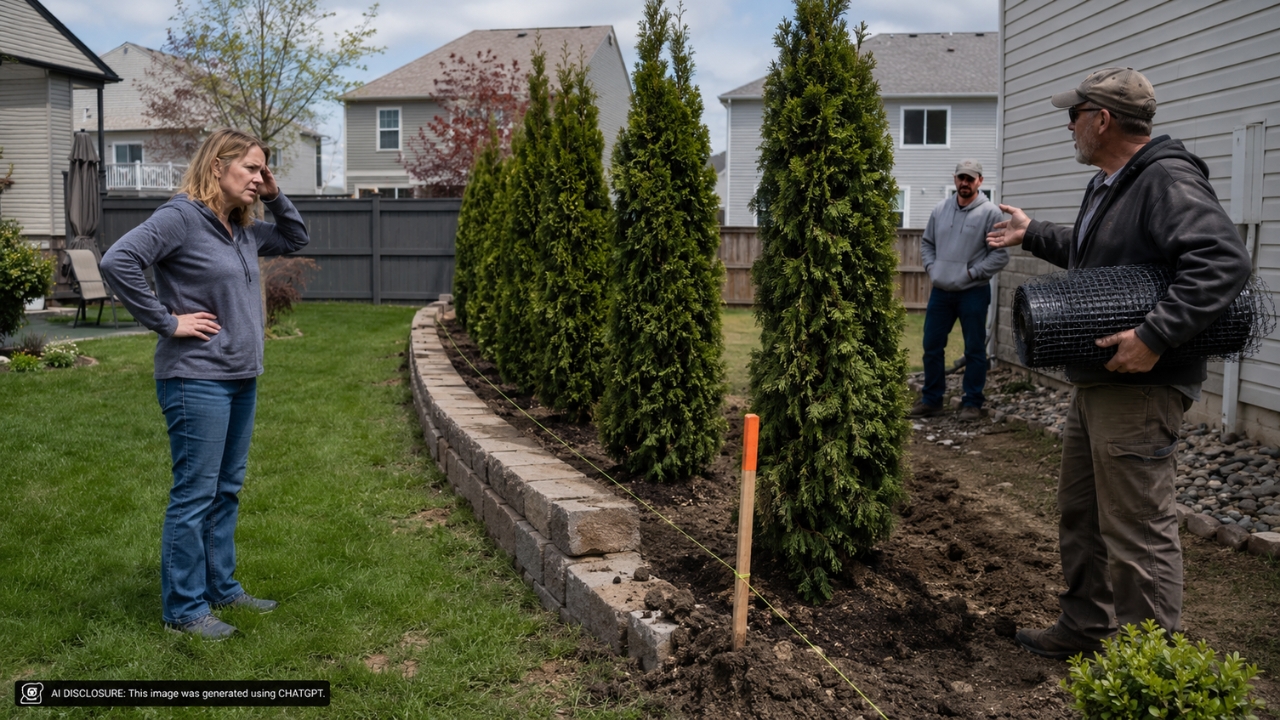
According to the homeowner, the neighbor decided “yesterday” to plant a line of tall trees and didn’t ask permission to access the homeowner’s property for the work. The landscapers went ahead and did the planting anyway.
The neighbor already had a retaining wall, and the homeowner says the trees were planted on the other side of that wall—on the homeowner’s side. That retaining wall matters, because walls and hardscaping have a way of becoming “the border” in people’s minds, even when they’re not built exactly on a surveyed line.
In other words: the neighbor may have looked at the wall and treated it like the boundary, then designed the planting around that assumption. But assumptions don’t hold up well once tree roots, shade, and maintenance responsibilities start creeping across a line.
Then the marker stake “moved”
The homeowner’s biggest red flag wasn’t just the trees. It was the stake.
They say it was “very evident” their stake had been moved—conveniently relocated to the other side of the newly planted trees. That’s the kind of detail that changes the tone instantly. A disagreement about where the line is can be an honest mistake. Moving a physical marker makes it feel like someone is trying to rewrite the map after the fact.
And it created a new problem: because the stake was moved, the homeowner can’t say with total certainty whether the trees are on their property line or the neighbor’s. That uncertainty is exactly what makes these fights drag on. Trees aren’t like a trash bin you can roll back to the right spot. Once they’re in, they’re in—especially if they’re planted as a “privacy line” meant to stay for decades.
An apology, then another request
When confronted, the neighbor apologized for the misunderstanding and told the homeowner he believed the land belonged to the town, not the homeowner. That explanation may or may not make sense depending on how the lots are laid out, but it’s a familiar refrain in boundary disputes: “I thought it was public” tends to come out when someone realizes they didn’t have permission.
The homeowner says they were “nice enough” not to demand the trees be removed right away. That’s a big choice, because once you allow plantings to remain—even temporarily—it can start to feel normalized. And the longer trees sit in the ground, the harder it becomes socially (and practically) to insist they be moved.
Then came the follow-up: the very next day, the neighbor asked if he could add a mesh netting fence further into what would be the homeowner’s property. So instead of backing away from the line until everything was verified, the neighbor wanted to push something else even deeper into the same space.
At that point, the homeowner’s question wasn’t about being neighborly anymore. It was about whether they were wrong to insist the neighbor pay for a surveyor to come back and redo the stakes.
Why trees and netting can turn into a long-term headache
In a typical neighborhood, a row of tall evergreens isn’t just decoration. It becomes a permanent feature that affects both properties—shade patterns, leaf and needle drop, root spread, and who gets stuck trimming branches on the “wrong” side.
Add mesh netting to the mix and it gets even more sensitive. Netting may sound temporary, but temporary solutions have a habit of becoming permanent once they’re installed and everyone gets used to them. If the netting goes up inside the homeowner’s boundary, it becomes another physical “truth on the ground” that can confuse future owners, contractors, or even the homeowner themselves when the original markers are gone.
And there’s a practical, everyday element to this too: access. If the neighbor’s trees are right on or over the line, who enters whose yard to water, prune, treat pests, or replace dead trees later? Those routine tasks can turn into years of awkward conversations—or worse, unannounced visits that feel like trespassing.
Readers pushed proof and paperwork before anything else
The post landed in a space where people tend to prioritize documentation and boundaries, and the underlying theme is straightforward: don’t negotiate against yourself when the line is literally in question.
When a stake has been moved, the natural next step is to get the boundary re-established by a professional and to stop any additional installations until that happens. It’s not about punishing the neighbor. It’s about getting back to a shared set of facts.
The homeowner’s instinct—to have the surveyor come back and redo the stakes, and to have the neighbor cover that cost—follows the same logic. If the neighbor’s project triggered the dispute and the marker was disturbed, restoring the original reference point is the cleanest way to reset everything.
It also draws a clear line (no pun intended) for what happens next: once the stakes are verified, either the trees and netting are fine where they are, or they’re not. But at least the decision is based on the surveyed boundary instead of a shifted marker and a retaining wall that may be misleading.
The homeowner is now stuck in that uncomfortable middle space many people recognize: trying to stay civil while realizing the only way to protect the property is to slow everything down and insist on verification. A fence can wait. A row of tall trees and new netting on disputed ground is the kind of “small landscaping project” that can define the neighbor relationship for years.
Like Fix It Homestead’s content? Be sure to follow us.