Rural Landowner Finds a Neighbor’s Pond Overflow Flowing Onto the Property — Then Realizes the Runoff Has Been There Since Move-In
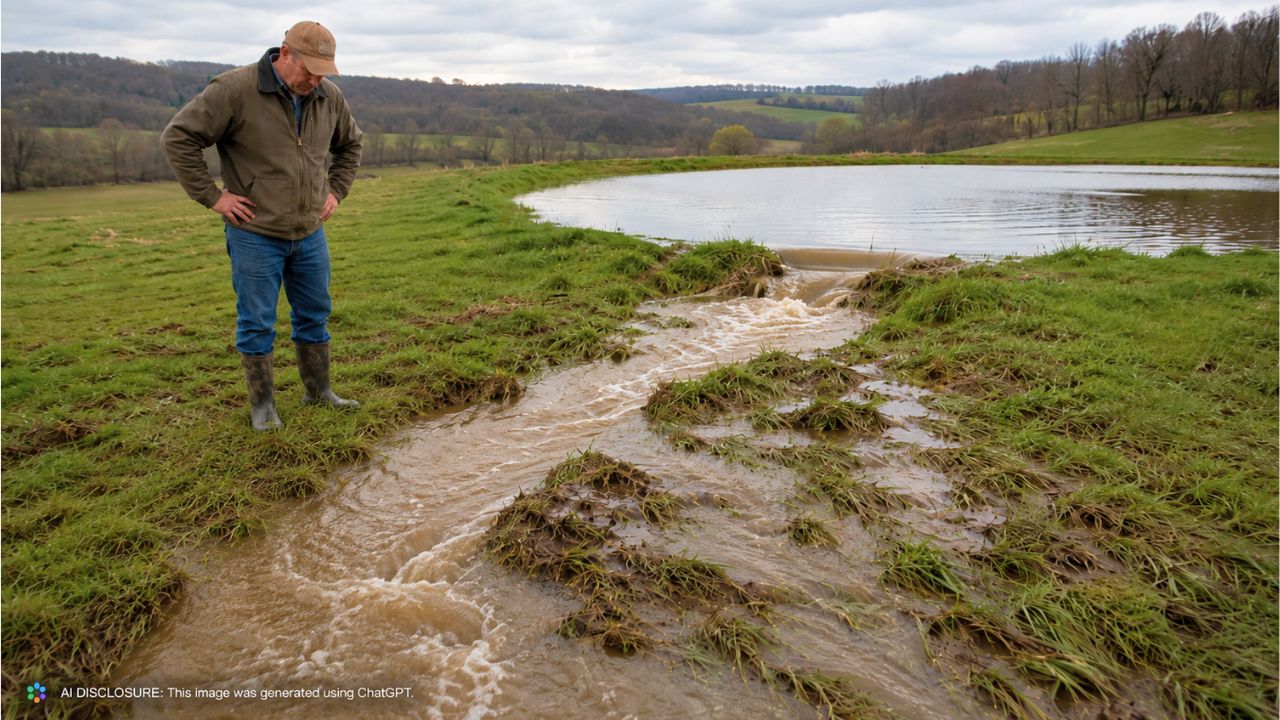
Photo credit: AI-generated image created using ChatGPT. Illustrative only.
Out in the country, water has a way of finding the lowest point—and sometimes that lowest point is your backyard. One rural homeowner said they’d been living just outside town for a little over a year when they finally connected the dots: the soggy, swampy patch on their land wasn’t just a “high water table” problem. It was being fed by the neighbor’s pond overflow.
In the original post, the homeowner described noticing that the property to the south has a very large pond sitting right on the line, separated by a tall dirt mound wide enough to drive a car along. And inside that mound—on both ends of the pond—are two pipes, one that looks like cast iron and another metal, both sending overflow toward the homeowner’s side.
The first year, it just felt like “rural wet ground”
The homeowner didn’t say the overflow was obvious from day one. If anything, it sounds like it blended into the normal frustrations of living on low land: a high water table, low spots that fill up after even a small rain, and the kind of soft ground you expect when you buy in the country.
That’s part of what makes this kind of discovery so aggravating. When you’re new to a property, it’s hard to tell what’s “just how the land is” and what’s being artificially created by drainage, grading, or someone else’s structure. A year can go by quickly when the seasons are changing and you’re focused on move-in fixes.
Then something clicks. A puddle doesn’t recede the way it should. One area stays muddy long after everything else dries. And once you start looking, you realize the water has a path—and that path starts somewhere you don’t control.
The detail that changed everything: pipes in the dividing berm
What the homeowner described wasn’t vague runoff across an open field. It was hardware: two overflow pipes set into the dirt mound dividing the properties, positioned on both ends of the pond, aimed in a way that sends water onto the homeowner’s land.
That’s a different kind of problem than “my neighbor’s land is higher than mine.” It suggests intentional design—either the pond was built with overflow relief, or it was modified to protect the pond owner’s side from washouts by giving water a dedicated exit.
The result, according to the homeowner, is massive flooding and the creation of a swampy area on their property about half the size of the neighbor’s pond, with standing water a couple feet deep at the deepest point. In rural living, that’s not just an eyesore. That’s lost use of land, a potential breeding ground for mosquitoes, and a long-term headache if it creeps toward driveways, outbuildings, or the home’s foundation.
When “overflow” turns into a permanent wetland next door
A pond’s overflow is supposed to be the safety valve—something that kicks in when water rises. But when a pond sits right at a property line, overflow doesn’t just disappear. It becomes someone else’s drainage problem.
And that’s where the homeowner’s frustration comes through: they’re already dealing with a naturally high water table, so any extra water is amplified. If low spots flood after a small rain, then a directed overflow isn’t just a once-a-year event. It can be the thing that keeps the soil saturated all season, even when the rest of the yard tries to recover.
It also changes how you think about every improvement. Want to plant trees? Put in a shed? Improve a driveway? Those projects depend on stable ground. Standing water that’s “a couple feet deep at the deepest” can undermine posts, turn grading projects into a constant fight, and make mowing and access miserable.
For many rural homeowners, the biggest sting is realizing the problem may not be new at all. If the overflow has been flowing that direction since before they bought the place, it’s possible the swampy zone isn’t a sudden defect—it’s a feature that was quietly there at move-in, hiding in plain sight.
The question nobody likes asking: is this even allowed?
The homeowner’s core question was simple: “Is this legal? What should I do about this?” That’s the moment the issue stops being about wet boots and starts being about property rights.
In the country, neighbors often handle drainage informally—ditches, berms, culverts, and “that’s how it’s always been.” But the moment there are pipes that appear to be directing water, it feels less like natural drainage and more like one landowner choosing where excess water goes.
Even without getting deep into legal specifics, the practical reality is that water disputes can escalate fast. If you confront the neighbor too early and it turns hostile, you can lose the chance for a calm fix. If you ignore it, the wet area can expand, and you may end up repairing damage without ever addressing the source.
The homeowner didn’t mention any prior conversations with the neighbors or any previous agreements tied to the pond or the dirt mound. That lack of history can make it feel like you’re walking into a story that started before you got there.
What other homeowners pushed: document first, then pick your next step
While the post itself was a straight question, the way these rural drainage threads usually go is predictable: people home in on proof. When the claim is “they’re directing their overflow onto me,” the next move is often to gather clear photos and videos showing where the pipes exit, where the water travels, and what it does during heavy rain or high pond levels.
That documentation matters for more than internet validation. If you end up needing a surveyor, a drainage contractor, or a conversation that involves local officials, the ability to show the path of water—especially from visible pipes—can keep the discussion grounded in facts instead of vibes.
There’s also a practical reason to slow down. If you start moving dirt on your side to block flow, you could accidentally worsen flooding elsewhere, or create erosion that damages your own land. And if those pipes are part of an established overflow design, tampering could trigger bigger issues: washouts in the berm, blowouts at the outlet, or sudden rerouting that sends water somewhere even more destructive.
The homeowner’s post doesn’t say what they did next, but the tension is clear: they’ve discovered a physical setup that seems to benefit the pond owner by exporting water—and now they have to decide whether to treat it like a neighbor-to-neighbor fix, a drainage engineering problem, or something that requires formal intervention.
The hard part isn’t the mud—it’s what it might mean long-term
A swampy section of land can become normal frighteningly fast. You stop walking there. You stop planning around it. You accept it as “that corner.” But when you realize it’s being fed by an overflow system, it changes your relationship with your own property.
If the wet area is truly half the size of the neighbor’s pond, this isn’t a minor nuisance. It’s a chunk of land effectively taken out of use, with all the side effects rural homeowners know too well: pests, smell, ruts, and the constant uncertainty of whether the next storm will push the waterline further.
And the most unsettling part is the timing. The homeowner said they noticed it recently—after more than a year in the home—which raises the possibility that the runoff has been part of the landscape since move-in. That kind of discovery doesn’t just make you mad at the neighbor. It makes you replay the purchase, the walk-throughs, and every rainy week you chalked up to “country living.”
For now, the pipes are still there, the ground is still flooding, and the homeowner is left holding the two questions that make rural property disputes so draining: who’s responsible, and how do you stop the water without starting a war next door?
Like Fix It Homestead’s content? Be sure to follow us.