Homeowner Finds a Power Company Cut Down the Entire Line of Privacy Trees Separating Two Yards — Then Realizes the Neighbor Who Authorized It Can Now Watch Them Swim With Their Kids
Photo credit: AI-generated image created using ChatGPT. Illustrative only.
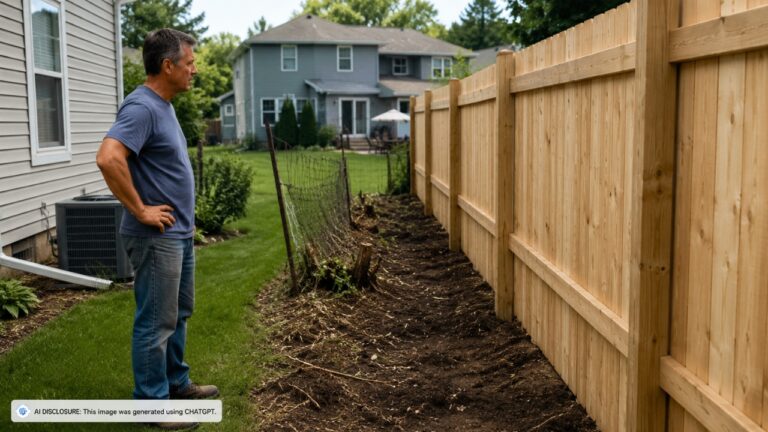
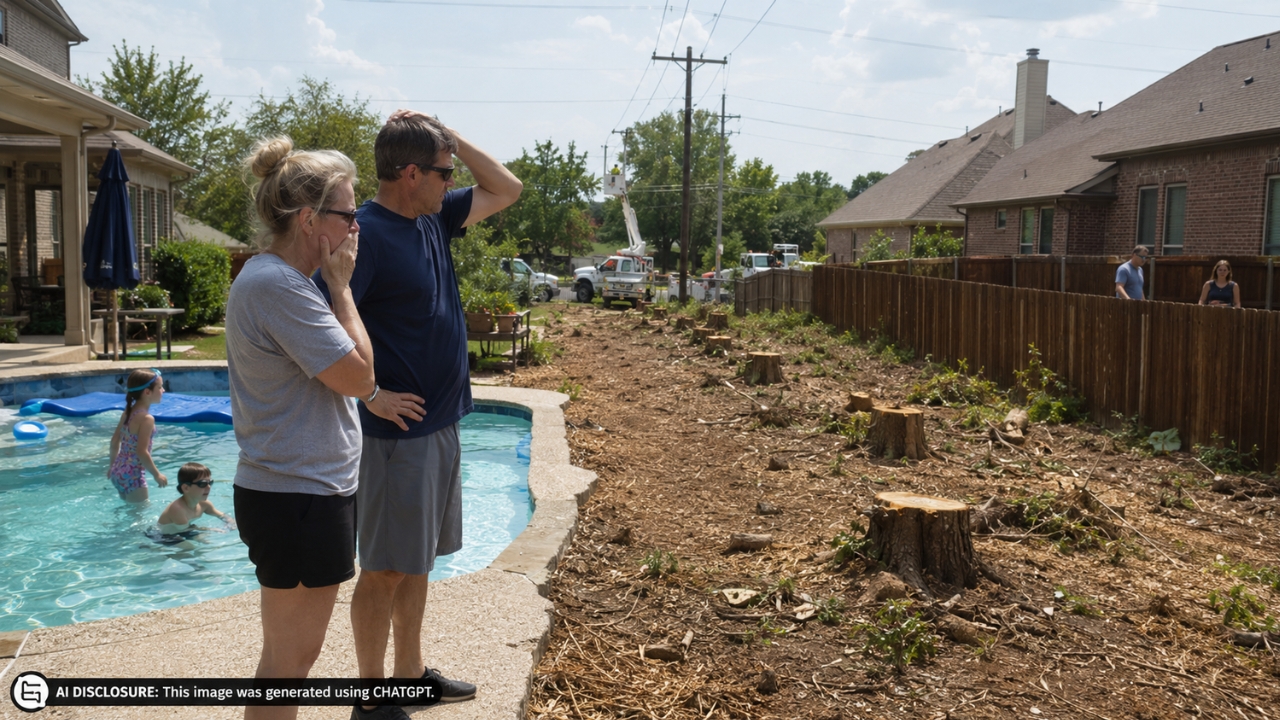
They came home to a stripped property line where a living wall used to be. Not a messy trim job. Not a few branches. The entire line of privacy trees—years of growth in oaks, crepe myrtles, and other mature plantings—had been taken down, leaving a clean sightline straight into the backyard.
In the original post, a Dallas-area homeowner said the trees were fully on their property, backed up by a survey. The part that made it feel instantly personal wasn’t just the loss of landscaping—it was the sudden reality that the neighbor who’d been complaining for years could now see directly into their pool area while they swim with their kids.
It wasn’t “tree trimming,” it was a clear-cut
The homeowner described the trees as a long-established border between two yards, ranging from about 6 to 40 years old. It wasn’t a line of scraggly saplings; it was the kind of mature screening that takes decades to replace, especially in Texas heat where establishing new trees can be a project all by itself.
And that’s what hit so hard. Utility crews do trim around lines, and many homeowners have seen the classic “V” or “side shave” where branches get removed to keep clearance. But the homeowner says this crew didn’t just top the trees or remove problem limbs. They took down almost every single tree separating the properties.
For a family backyard, that changes everything overnight. Shade is gone. Wind patterns change. Noise carries. And the feeling of being tucked away in your own space can disappear in a single afternoon.
A neighbor’s text, not a request
The homeowner said they weren’t home when it happened. Instead of a knock at the door or a conversation ahead of time, the neighbor texted the homeowner’s husband saying it was going to happen—without asking permission.
That detail mattered because this wasn’t the first time the neighbor had made the trees an issue. The homeowner wrote that the neighbor had repeatedly complained the trees were “bothering him,” even claiming they scratched his friends’ and mother’s cars. At one point, a trimming job was arranged for overhanging branches on the neighbor’s driveway, and the homeowner says they agreed to pay for cleanup of their own fallen limbs and debris.
So this wasn’t a mystery feud that came out of nowhere. It was a long-running annoyance that finally escalated into something irreversible: the removal of trees the homeowner says were entirely on their land.
The privacy hit landed harder than the landscaping loss
If you’ve ever relied on a tree line for backyard privacy, you know it’s not just decoration. It’s a fence without the fence vibes. It blocks sightlines, softens sound, and creates that “this is our space” feeling—especially around patios, play areas, and pools.
The homeowner didn’t mince words about the new reality: now they can’t go swimming without the neighbor being able to watch them, their spouse, and their kids. That’s the kind of detail that turns a property dispute into a daily quality-of-life problem. It’s not only about replacement cost or aesthetics; it’s about comfort and feeling safe in your own yard.
And unlike a damaged fence panel, you can’t run to the hardware store and fix it in a weekend. Even fast-growing privacy trees take years to become a screen, and in the meantime, your backyard routines change. Curtains stay drawn. Kids get shuffled inside. The pool that used to be a perk starts to feel exposed.
Then came the bigger question: did the utility even have the right?
After the shock of the clear-cut, the homeowner raised another concern: they’re not sure the power and internet line in that area was ever permitted, because it doesn’t show on their survey the way other lines do. They noted that utilities at the front of the house and by the road had been handled before, but this particular run wasn’t something they recognized as documented.
That’s where these stories get complicated fast. If a utility has a recorded easement, it may have rights to access and vegetation management within that corridor—sometimes very broad rights. But if the homeowner’s paperwork doesn’t show it, it raises questions they weren’t expecting to have to ask: What exactly is recorded on the title? Where is the easement boundary, if one exists? Who authorized what work, and under what authority?
The homeowner said they had not yet contacted the power company and only learned what happened that day. They were trying to figure out basic next steps—who to call first, what to ask, and how to even begin untangling whether this was utility policy, neighbor overreach, or both.
People zeroed in on documentation before confrontation
Even from the homeowner’s own details, you can see why the advice quickly turns practical. They already have a survey. They have a timeline (they weren’t home; the neighbor texted). They have a history of prior complaints and prior trimming arrangements that acknowledged the trees were on the homeowner’s side.
The general tone of the responses they received, based on the homeowner’s update thanking everyone for “ideas and advice,” was to treat it like a real property damage event, not a handshake misunderstanding. In these moments, the boring stuff becomes the lifeline: photos of what’s left, any “before” pictures that show the tree line, copies of texts, and a record of exactly when the crew arrived and what they did.
Because once the trees are gone, the story becomes paperwork. Where were the trunks relative to the boundary? Who gave the OK? Was there an easement? Was the work consistent with what utilities typically do for line clearance, or did it go beyond what was necessary?
Now the yard is exposed, and the fix won’t be fast
The homeowner’s frustration wasn’t only about what was cut—it was about what can’t be un-cut. Mature trees don’t come back quickly, and replacing a mixed line of established oaks and crepe myrtles isn’t the same as planting a few shrubs along a fence. Even if you replant immediately, there’s a long stretch where the yard feels open and watched.
And it leaves the homeowner juggling two tracks at once: the emotional reality of living without privacy, and the logistical problem of figuring out who is responsible for what happened. If the neighbor truly “authorized” the work on trees that weren’t his, that’s one kind of dispute. If a utility acted outside an easement—or without one—that’s another.
For now, the homeowner is left staring at a blank property line where a natural barrier used to be. The pool is still there. The kids still want to swim. But the backyard no longer feels like a backyard, and the next phone call—whether to the utility, an arborist, or someone who can interpret surveys and easements—suddenly matters a lot more than it did yesterday.
Like Fix It Homestead’s content? Be sure to follow us.