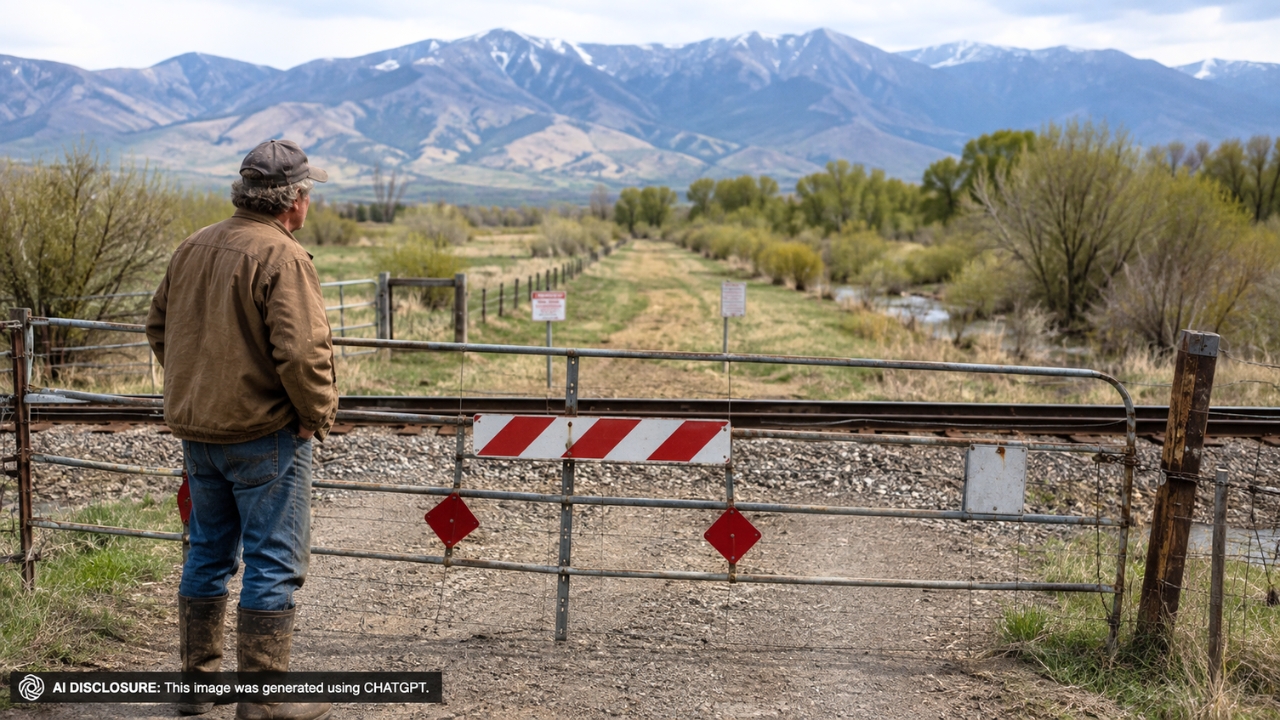
Rancher Finds His Only Crossing Fenced Off After Forty Years — Then He Is Arrested for Trespassing on the Way to His Own Five-Acre Parcel
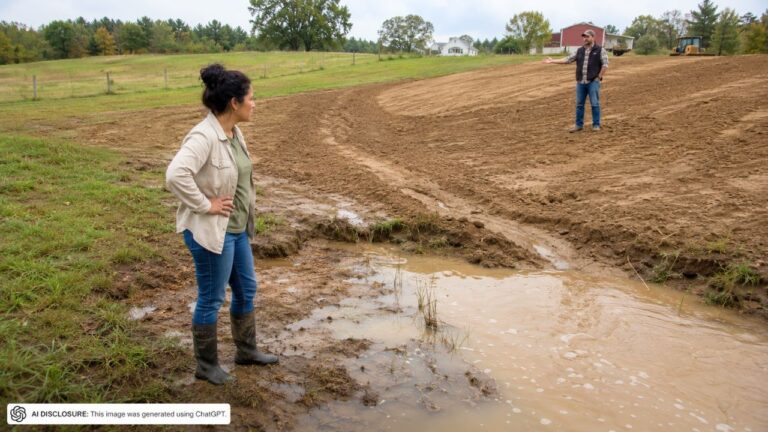
Photo credit: AI-generated image created using ChatGPT. Illustrative only.
For decades, Sam Nelson’s routine was simple: cross the railroad tracks, check on the pasture, keep the weeds down, and let his family use their little slice of Montana the way rural families do. Then one day the familiar crossing point near Rocky Creek was barricaded and plastered with “no trespassing” signs, turning a five-and-a-half-acre parcel into something he could see—but not legally reach.
The details, including how a long-used crossing turned into an arrest and a court fight, are laid out in the source post. Nelson says his family has used the same access route since 1982 to reach land tucked between Interstate 90 near the Bear Canyon exit and the railroad tracks just outside Bozeman.
A land parcel that sounds small—until you lose it
Nelson’s property is described as a narrow, hard-to-reach piece of ground bisected by Rocky Creek. It’s been used for hunting, running cattle, floating the creek, and as a kind of wildlife refuge—exactly the sort of place that becomes part of a family’s calendar and identity over time.
And it wasn’t just sentimental. Nelson says he spent thousands improving it: managing weeds, putting out fires, and even building a road to make travel easier. He and his daughters built their homes on the far side of the tracks specifically to be close to the parcel.
That’s the part that makes the access issue sting. Land that you can’t access isn’t just inconvenient—it can become a bill you pay every year for something you’re not allowed to use. Nelson put it bluntly: if he can’t get there, the land becomes “worthless,” and worse, a negative because he still pays taxes on it.
The only crossing turned into a “no trespassing” trap
According to the report, the only way to reach Nelson’s land is to cross tracks owned by Montana Rail Link. For years, that crossing happened as a matter of course—until the railroad blocked the historic crossing point about five years before the article, fencing it off and posting warning signs.
If you’ve ever dealt with rural access—shared driveways, prescriptive roads, gates that “have always been open”—you know how quickly life can turn when a long-standing path becomes a legal boundary. The driveway doesn’t move, but the permission does.
In Nelson’s case, that change meant he could no longer legally do the basic tasks that keep rural land from turning into a mess: controlling weeds, maintaining the road, monitoring fire risk, and generally keeping an eye on what’s happening. After his access was cut off and time passed, he said the parcel became overgrown with weeds.
When a handshake turns into a contract with a 30-day guillotine
The timeline gets sharper around 2015. Nelson proposed building a new road through his property that would cut across railroad-owned land. He says railroad employees came out and documented approval for the new road.
Then came the paperwork. When Nelson asked for a lease agreement to use the railroad land, Montana Rail Link offered a contract that, as described in the report, allowed the railroad to remove the road and access point with just 30 days’ notice.
That’s not the kind of “permission” a landowner can safely build around. Nelson refused to sign, saying he wouldn’t have spent years of time, money, and effort if the railroad could yank the access at will. After he declined the contract, he says the railroad installed a fence along the northern boundary of their land, effectively cutting off his way in.
This is the part rural property folks instantly recognize: the moment something gets formal, it can get smaller. What used to be a lived-in pattern becomes a narrow, written allowance—one that can vanish with a letter and a deadline.
He kept pulling down barriers—then the trespass arrest came
Nelson says he repeatedly removed fences, signs, and barricades from 2017 onward. His reasoning was practical and legal at the same time: in Montana, he believed he needed uninterrupted use for five years or more to secure what’s called a prescriptive easement.
A prescriptive easement is the legal version of “we’ve always used it.” The article even gives a simple example: if kids have used a private shortcut to school for decades, openly and continuously, that route can become protected if someone tries to shut it down.
But trying to keep “continuous use” while a railroad posts “no trespassing” is like trying to keep a shared driveway open by driving on it after someone chains the gate. Every trip is suddenly a gamble.
In 2021, Nelson was arrested and charged with criminal trespassing for using the crossing to reach his own land. The charges were ultimately dropped because of the pending civil case, but the sheriff warned him not to return. Since then, Nelson hasn’t been back in two years.
The court fight hinges on a familiar word: easement
In November 2021, Nelson sued Montana Rail Link and Burlington Northern. He’s seeking a summary judgment, with a hearing scheduled in Gallatin County District Court before Judge Rienne McElyea, asking the court to recognize the crossing as a prescriptive easement based on decades of use.
The railroad’s response, as reported, is that a prescriptive easement can’t be obtained over a federally granted right-of-way because it would interfere with railroad operations. Nelson’s attorney, Alanah Griffith, said she doubted that argument would hold up, noting there have been Montana cases where people won prescriptive easements over railroad land.
The railroad, she said, is arguing it should get government-like exemptions because of its role as an “integral” national byway. And if the railroad wins on that theory, Griffith warned, it could be used to persuade other courts that prescriptive easements can be denied across railroad property more broadly.
Meanwhile, on the ground, Nelson is stuck in the most aggravating kind of limbo: owning land that’s close enough to matter, improved enough to miss, and locked up enough to become a problem.
What people latched onto: proof, history, and the messy reality of “use”
In support of Nelson’s claim, neighbors and family members wrote letters describing the long history of using the same access point. The Burkhart family, who owned the property before Nelson, wrote that their family used that crossing for decades as well—helpful because it stretches the “always been that way” timeline beyond just one owner.
They also highlighted something that tends to get overlooked until it’s gone: informal caretaking. In their letter, Bob and Gloria Burkhart praised Nelson for keeping weeds under control and for quickly spotting and putting out multiple fires started by train sparks—fires that could have gone unnoticed and spread.
Other letters from Nelson’s daughters and granddaughters described growing up with horseback rides, fishing, and campfires on the land. That’s the human side of an easement fight: it’s not only about a strip of gravel over tracks; it’s about whether a family’s daily access can be erased with a fence line.
Nelson said if he wins, the first thing he’d do is go back in, fix the road, and clear the overgrown brush. Until then, the parcel sits behind a barrier—owned, taxed, and effectively sidelined—while the question of access gets argued in court instead of solved on the ground.
Like Fix It Homestead’s content? Be sure to follow us.