Homeowners Find a 1960s Sewer Easement Now Claims Thirty Feet of Their Backyards — Then the District Demolishes a Pool Before the Lawsuit Is Heard
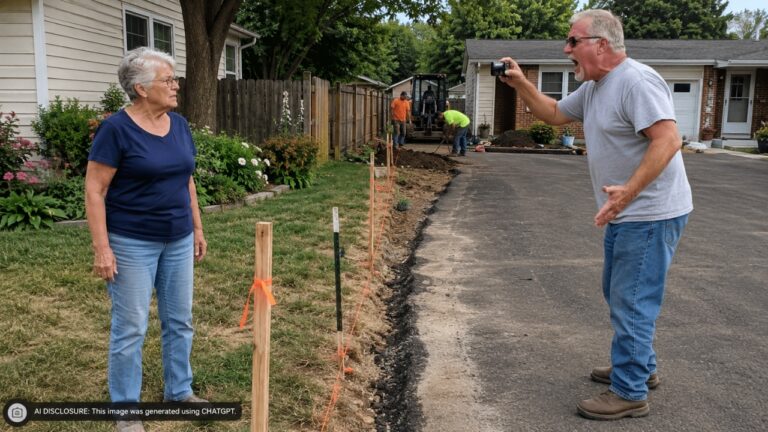
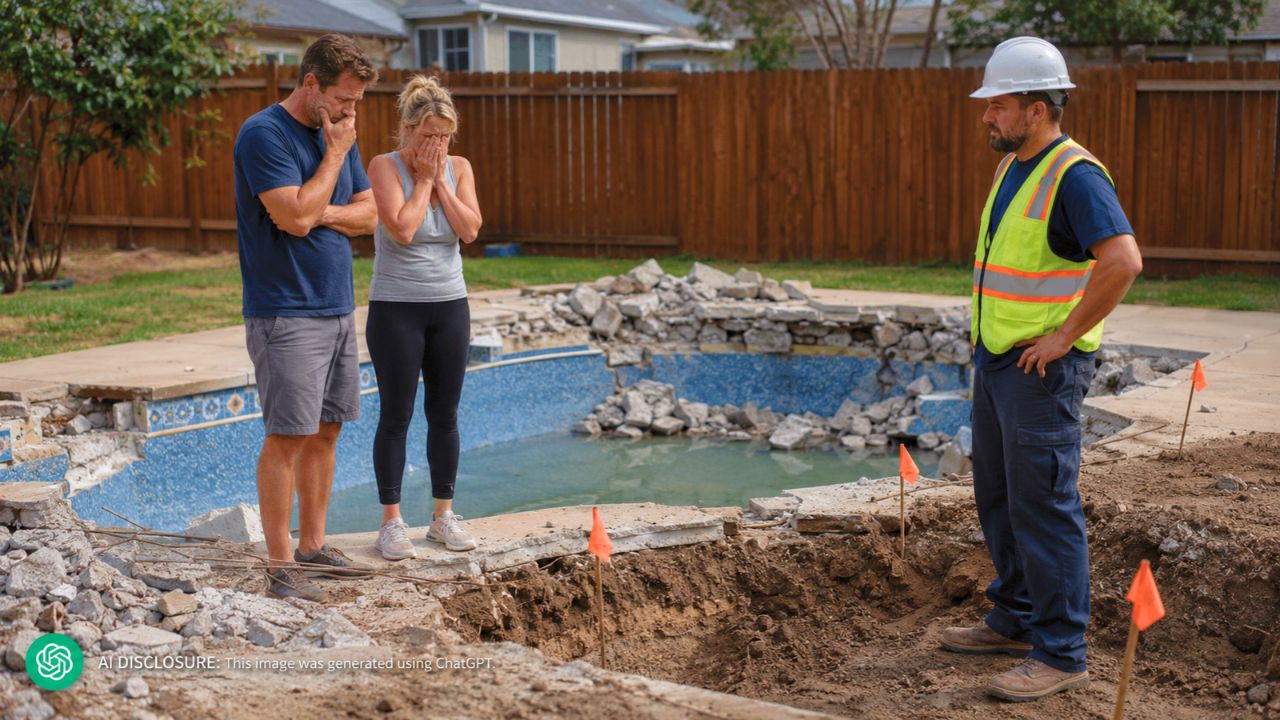
Photo credit: AI-generated image created using ChatGPT. Illustrative only.
You know that calm, boring strip of backyard you assume is yours forever—the part with the pool, the shed, the little patch you finally got to grow right? On one Huntington Beach cul-de-sac, homeowners say that “forever” ended the moment a decades-old sewer easement got pulled back out of the filing cabinet and turned into a demolition plan.
On Rhone Lane, 29 homes are now dealing with the Orange County Sanitation District’s move to enforce a sewer easement dating back to the 1960s—an action that the district says requires reclaiming roughly 30 feet of yard from each property. The details are laid out in the source post, and it reads like a homeowner nightmare: pools, sheds, and even part of a house potentially in the path, with construction already underway in at least one spot.
Thirty feet doesn’t sound like much—until it’s your pool
The district says the easement covers a regional wastewater pipeline that moves between 10 and 25 million gallons of wastewater a day. Their position is simple: they need better access for maintenance and safety, and that access can’t be negotiated down to “we’ll let you in if something breaks.”
Homeowners hear “easement” and often think “right of entry,” not “we’re taking a chunk of the yard you’ve been maintaining and paying taxes on.” But that’s where this street’s reality got sharp. OC San’s plan, as described, involves clearing the encroachments and then installing an 8-foot cinder block wall with gate access once the yards are opened up.
And on this block, “encroachments” isn’t just a fence line. It’s swimming pools. It’s sheds. It’s the stuff families save for, build permits for, and plan summers around.
Demolition starts, neighbors say they didn’t get a real choice
Residents told ABC7 they got notice about the project in December 2023. But the way it played out on the ground is what has people feeling blindsided—especially because demolition has already begun on the street while not everyone has agreed to terms.
Ted Beresford’s yard is the visual that sticks. He says he lost his swimming pool, and his backyard is now rubble. He also said he believed his pool wasn’t even in the easement area and that “the measurements clearly show that,” adding, “It never should have happened.”
The twist is that Beresford bought the home in November 2024, and he says the previous owner had already signed a settlement agreement with OC San ahead of demolition. Beresford says he was told his pool wouldn’t be touched—then it was. That’s the kind of detail that makes every homeowner think about the fine print they didn’t know to demand before closing.
The lawsuit line: some signed, others refused
Not everyone on Rhone Lane is taking a settlement and moving on. Only 13 homeowners have signed settlements with the district, according to OC San. The rest are refusing and have filed a lawsuit.
Philip Rizzo, who has lived on the street for more than 20 years, said his title showed three easements—one for utility poles and two for sanitation—but he believed that meant access in an emergency, not a permanent cut into his yard. He said it took until 2023 to get a lawyer to pull the easement document, describing it as 14 pages long.
Rizzo also said his above-ground pool was built to accommodate his son, who uses a wheelchair. Now he’s being told that pool—and roughly half his backyard—has to go. It’s the kind of detail that turns an infrastructure project into something personal and immediate, because it’s not just “land” in the abstract. It’s accessibility and daily life.
Dean and Debora West, also part of the lawsuit, said they’ve lived in their home since 2011 and have an in-ground pool. Debora West described the shock of being told the pool would be taken: “We never ever thought that the easement meant that they would give them our pool and our land, or we would have never bought this home.”
OC San’s answer: waiting for a failure would be irresponsible
Homeowners keep circling the same question: why enforce it now, after decades? They point to a 2022 evaluation of the pipe that they say showed no signs of damage. If the pipeline looked fine, why show up with demolition crews?
OC San’s communications director Jennifer Cabral pushed back hard on the idea of waiting. “If we waited until the pipeline broke or until there’s some type of issue with the pipeline, that’s irresponsible on our part,” she said, adding that the district’s job is environmental and community protection beyond the 29 homes affected.
Cabral also said that when the district was doing maintenance, crews couldn’t access the easement area cleanly, had to navigate around obstacles, and that it put crews at risk. From the district’s perspective, these encroachments “continued to get worse over time,” and correcting them now is the only way to prevent bigger trouble later.
Construction is expected to last through the end of the calendar year. The district said it will cover demolition costs for the 13 homes that settled, at an estimated $2.8 million.
The part that would keep any homeowner up at night: permits, surveys, and who knew what
There’s a question hanging over everything: how did permitted work happen on top of a long-recorded easement? ABC7 said they asked the City of Huntington Beach why permits were issued to homes on the street if the easement has been there since the 1960s, and a city spokesperson said they were investigating.
That detail matters because it’s the practical pressure point. A lot of people assume permits equal safety, finality, and approval. Homeowners on this street are learning that a permit doesn’t necessarily protect you from an older recorded right—especially when the enforcing agency is saying the access needs have changed.
It also explains why neighbors are now obsessing over paperwork: recorded easement maps, measurements, title documents, and what exactly was disclosed when each house changed hands. If you’re in Beresford’s shoes—buying after a settlement was signed—your entire understanding of “what you own” can shift after closing, fast.
The reaction you’d expect: document everything and don’t assume “easement” is harmless
Even without a comment thread attached, the homeowner playbook practically writes itself here. When a government district shows up with survey stakes and demo equipment, people stop relying on memory and start relying on documents.
On Rhone Lane, that’s already happening in real time: neighbors who refused to sign are pushing the dispute into court, while others are operating under agreements already signed. That split alone can change the mood of a street—because demolition at one house doesn’t feel isolated when your own pool might be next.
And if you’re watching from another neighborhood with a utility easement in your backyard, this is the story that makes you pull out your title paperwork and squint at the plat map. Not because the pipe is failing today, but because enforcement doesn’t always arrive on the same timeline as construction did.
A hearing in the case against OC San is scheduled for May 1. Until then, Rhone Lane is stuck in that miserable in-between: some yards already torn up, others bracing, and everyone staring at the same backyard line—trying to figure out whether it was ever really theirs.
Like Fix It Homestead’s content? Be sure to follow us.