Homeowners Find Their Neighbor Claiming 3,000 Square Feet of Their Yard by Adverse Possession — Then Their Surveyor Is Turned Away by a Security Detail
Photo credit: AI-generated image created using ChatGPT. Illustrative only.
Most property-line fights start small: a fence that’s “always been there,” a tree line everyone treats like the border, a strip of lawn one neighbor quietly mows because it’s easier than arguing. But in Montgomery County, a dispute between Gov. Josh Shapiro and his neighbors escalated into dueling lawsuits, allegations of harassment and trespassing, and one detail that would make any homeowner’s stomach drop—when the neighbors tried to bring in a surveyor, they say he was turned away by a security detail.
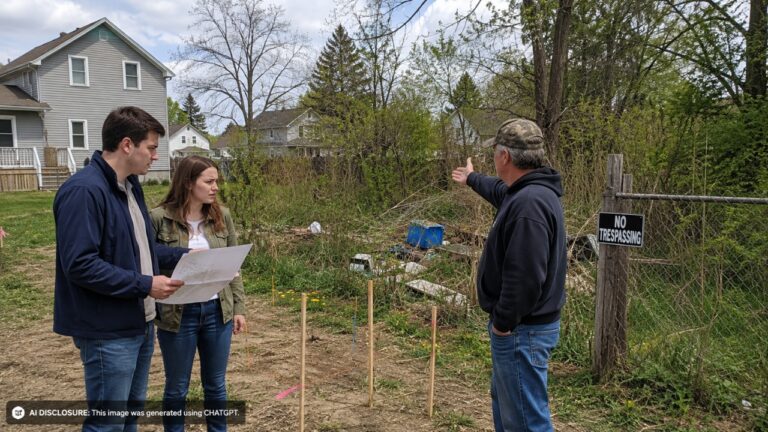
The reporting, laid out in the original post, describes a roughly 3,000-square-foot slice along the boundary between Shapiro’s home and the home of Jeremy and Simone Mock. It’s the kind of square footage that’s big enough to matter—big enough for landscaping, a fence line, a dog run, a garden, or just the feeling that you can breathe on your own property.
It started with a fence and a “we thought it was ours” boundary
Shapiro and his wife, Lori, say that when they bought their house in 2003, there was already a fence, and a tree line just beyond it that seemed to separate their property from what would later become the Mocks’ side. That’s familiar terrain for homeowners: you buy the place, you inherit the “normal,” and you assume the physical markers match the deed.
Then this summer, the Shapiros say they discovered the parcel they’d always treated as theirs wasn’t actually inside the boundaries described in their deed. That’s the nightmare moment—when you realize the house came with a long-running assumption that may not be legally true.
Instead of staying a quiet neighbor-to-neighbor fix, the timing collided with something bigger: Shapiro was making extensive security upgrades to his private residence after an arson attack at the state-owned governor’s mansion in Harrisburg. Spotlight PA reported those upgrades—paid for with taxpayer dollars—cost nearly $1.1 million and included landscaping and replacing an old fence with a new one.
The negotiation phase: buy it, lease it, then “alternative actions”
According to the Mocks’ federal lawsuit, the Shapiros approached them in July and said they wanted to purchase the disputed strip. Anyone who has lived through a boundary issue knows that moment can go two ways: it can be the start of a clean solution, or it can be the start of the end of neighborly peace.
The Mocks say the two households couldn’t agree on a price, and then started talking about a lease instead. That’s another real-world move—when nobody wants to permanently give up land, but one side wants control for a specific purpose, like a fence, grading, or privacy landscaping.
But negotiations broke down. The Mocks allege that a lawyer for the Shapiros contacted them and warned the Shapiros would take “alternative actions.” In property disputes, that phrase lands like a door slam. It’s when the problem stops being awkward and starts being expensive.
Adverse possession gets pulled out—and the yard turns into a battleground
The Shapiros’ countersuit, filed in Montgomery County’s Court of Common Pleas, says they own the disputed parcel “as a matter of law by adverse possession.” In Pennsylvania, the source notes, adverse possession requires proving exclusive occupation and use for 21 years.
The Mocks allege that after the adverse possession claim surfaced, the Shapiros began planting trees and other plants in the disputed area and flew a drone over the Mock property. That’s the kind of escalation homeowners recognize immediately: improvements and surveillance can feel less like “maintenance” and more like staking a flag.
The Shapiros, for their part, claim they maintained the land for nearly 25 years and say the Mocks didn’t use or maintain it after moving into their home in 2017, nor objected to the Shapiros using it. That “you never complained until now” argument shows up in almost every long-running property-line feud—because time and routine are powerful, even when paperwork says otherwise.
When security shows up, it stops feeling like a normal neighbor dispute
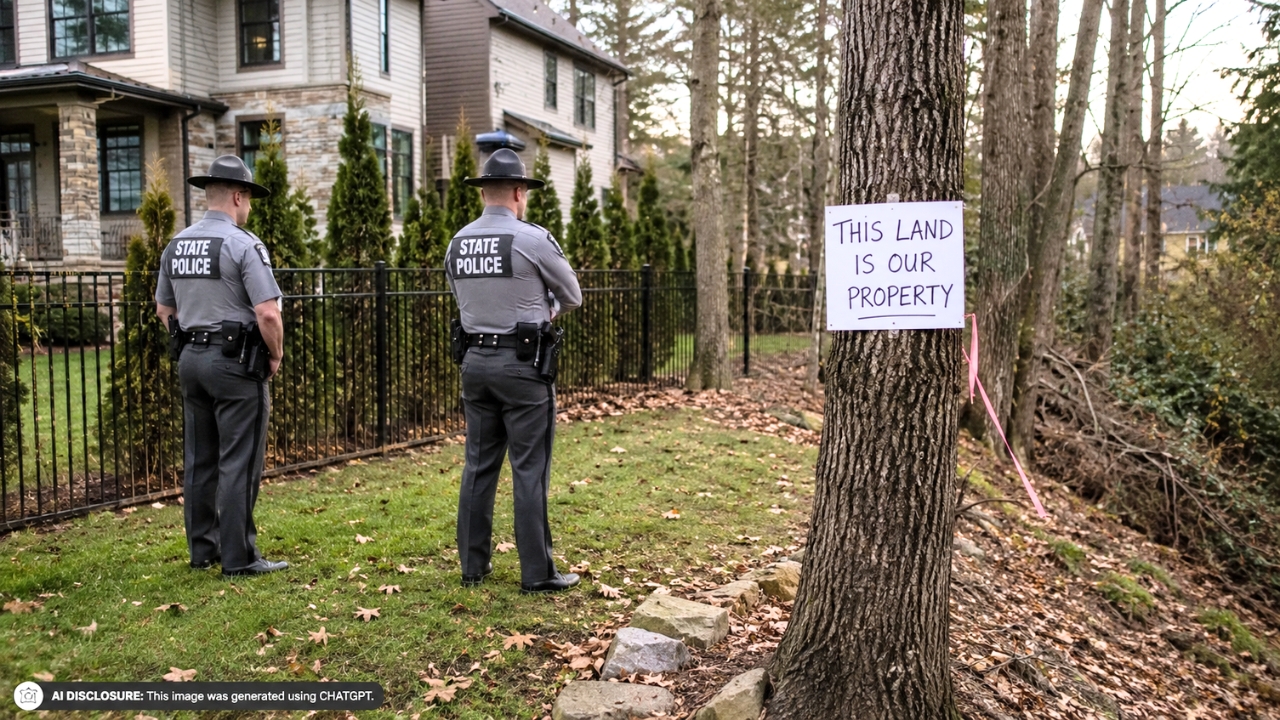
Here’s where this story leaves the usual “two homeowners yelling over the hedges” lane. The Mocks allege Gov. Shapiro “personally directed the State Police to patrol the Mock property,” and their lawsuit includes a picture of two troopers standing at the alleged disputed site. They also claim that when they tried to use the area, troopers insisted the land was “disputed” and told them to immediately leave what the Mocks say is their property.
That’s the kind of detail that would make any homeowner start documenting everything—because once law enforcement is physically present, the day-to-day act of walking your own yard can suddenly feel like you’re about to be accused of something.
In Shapiro’s version, after negotiations fell apart, they scrapped plans for a new fence and their attorney informed the Mocks they were taking control of the parcel through adverse possession. But either way, the disputed strip wasn’t just theoretical anymore. It was being treated as controlled space.
The surveyor moment: “Denied access” and a sign on a tree
If you’ve ever tried to end a property-line argument, you know the usual next step: hire a surveyor, get stakes in the ground, and work from something concrete. That’s why one allegation in Shapiro’s lawsuit jumps out: the Shapiros claim the Mocks hired a surveyor who showed up unannounced and was ultimately denied access by the governor’s security detail.
In homeowner terms, that’s a devastating stall. Surveys aren’t just paper; they’re how fences get built, how contractors know where to dig, and how you keep a dispute from turning into irreversible changes. If a surveyor can’t access the area in question, the “fix it” part of the problem gets trapped behind people with authority telling you no.
After that, the Shapiros allege, the Mocks posted a “provocative sign” on a tree in the disputed area claiming it as their own. And the Shapiros say the Mocks contacted local police to try to have the Shapiros charged with criminal trespass. At that point, the strip of yard isn’t yard anymore—it’s a trigger for the next call, the next complaint, the next legal filing.
How people reacted: paperwork, cameras, and the fear of “improvements” becoming evidence
Even without a comment section attached to the court filings, you can predict the practical homeowner reactions this kind of story tends to spark. People get fixated on proof: deeds, prior surveys, dated photos of the fence line, old real estate listings, Google Street View captures, lawn care invoices, landscaping receipts, and anything else that can show who treated the land as theirs and for how long.
The other immediate reaction is anxiety about changes on the ground. Planting trees, moving a fence, or doing landscaping in a disputed area can feel like theft to one side and “maintenance” to the other—but either way, it changes the physical reality. And once the land is physically altered, it gets harder to rewind without someone paying to remove plantings, redo grading, or repair damaged turf and root systems.
This case also highlights a modern twist that homeowners increasingly run into: drones and surveillance. The Mocks allege a drone was flown over their property. Even when it’s legal, it can pour gasoline on an already-hot boundary dispute because it turns a yard fight into a privacy fight.
The Mocks are seeking damages and an injunction to stop the Shapiros from using the property. The Shapiros are also seeking an injunction and a declaration that the parcel belongs to them, plus attorneys’ fees and other relief the court deems fair. Meanwhile, the strip of land sits there—3,000 square feet of grass and trees—acting like a magnet for every fear homeowners have about boundaries, control, and what happens when the person on the other side has more leverage than you do.
Like Fix It Homestead’s content? Be sure to follow us.