Landowner Plans a Septic System on His Own Lot — Then the Neighbor Claims the Strip by Adverse Possession, Citing Decades of Easter Egg Hunts
Photo credit: AI-generated image created using ChatGPT. Illustrative only.
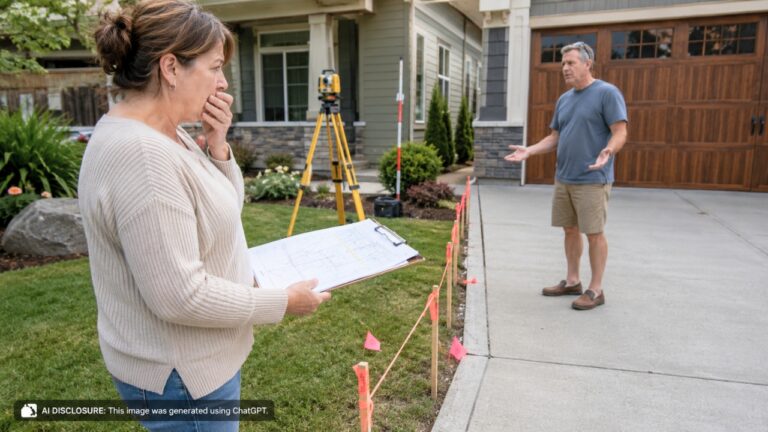
It started the way a lot of neighbor property feuds start: a homeowner gets ready to do something normal and expensive—site work, engineering, a septic install—and suddenly the neighbor is standing on the edge of the driveway saying, “That part is mine.”
In Scituate, Massachusetts, that standoff turned into a Land Court fight over a skinny, triangular patch of frontage land. And the neighbor’s proof wasn’t a new fence or a fresh survey stake—it was decades of family routines, landscaping, and Easter egg hunts around one old tree, laid out in the source post.
The lot looked simple—until the septic plan hit the “wrong” triangle
The case, EMRG LLC v. Monteiro-Maraj, centered on two adjacent residential properties on Ann Vinal Road. The eastern parcel belonged to EMRG LLC, with the home occupied by two different EMRG principals over time—previously Robert Day and later Michael Comerford.
Next door, Alcinda Maria Monteiro-Maraj’s family had been on their parcel since her grandfather bought it in the 1960s. Monteiro-Maraj immigrated to the U.S. in 1975 and lived there with extended family, eventually taking title in 2020.
Then came 2021. EMRG hired an engineering company to install a septic system in a triangular area between EMRG’s driveway entrance and the boundary line shared with Monteiro-Maraj’s property. That triangle sat on EMRG’s deeded land—but it didn’t feel that way to the neighbor who’d been treating parts of it like her yard for years.
One “Old Tree” turned into the whole argument
The disputed triangle had a little bit of everything people casually do in the fuzzy edges between properties: grass, landscaping, informal use, and assumptions that harden into “everyone knows this is ours.” Monteiro-Maraj and her family said they’d used the area for decades—mowing, tending it, and holding gatherings.
The judge heard claims about recreational setups too: riding motorcycles, a dunk tank, an above-ground pool, inflatable play devices, and party tents. In the way these cases often go, the courtroom became a map-reading exercise—what happened where, and how often, and whether it left a permanent mark.
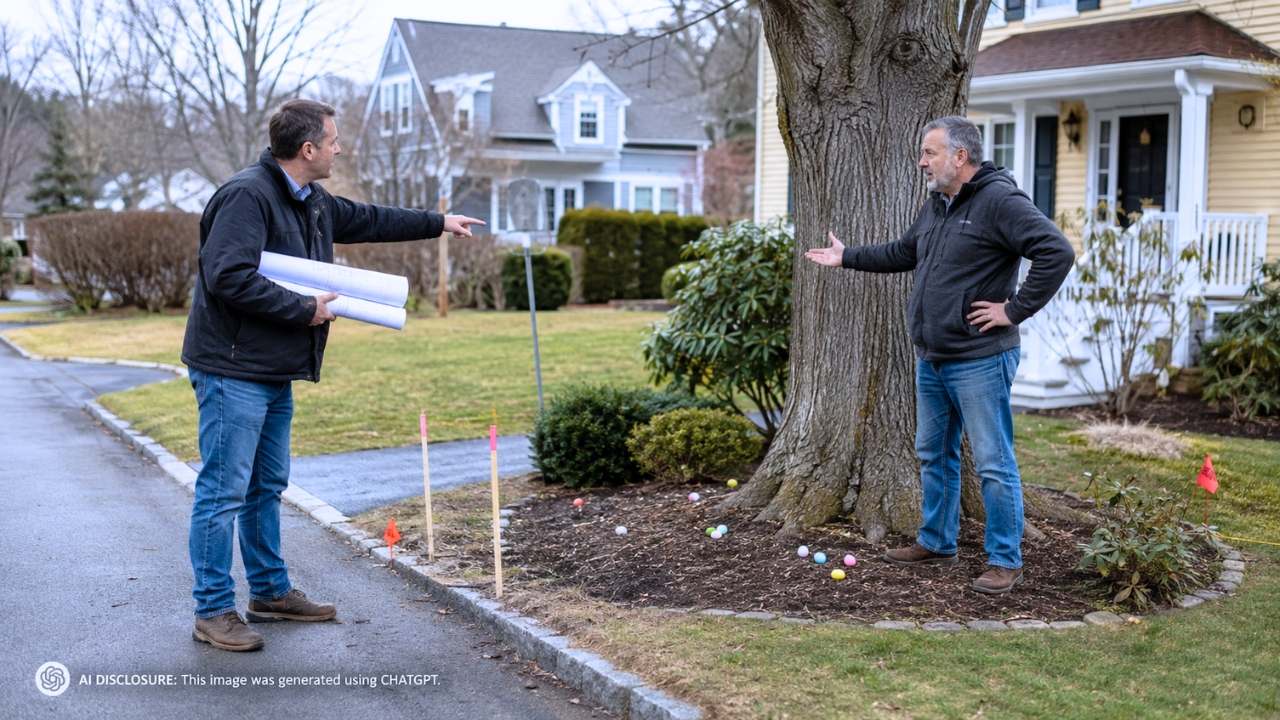
Inside that triangle was a mulched, landscaped patch around a deciduous tree. The parties called it the “Old Tree Area.” That small, specific spot ended up carrying almost all the weight of the case.
The lawsuit wasn’t about feelings—but feelings drove it
After Monteiro-Maraj objected to the septic work, EMRG sued in April 2022. They asked the Land Court to require her to “try title” to the disputed area and also brought a claim for trespass. Monteiro-Maraj countered with adverse possession—basically, that long-term use had ripened into ownership.
Massachusetts doesn’t hand out land just because someone’s been nearby a long time. Judge Gordon H. Piper noted that to win, Monteiro-Maraj had to prove “adverse, actual, exclusive, continuous, open, and notorious use” of the disputed area for at least 20 years.
This is where home-life details start acting like receipts. Monteiro-Maraj introduced extensive evidence aimed at showing the triangle wasn’t some ignored roadside sliver—it was treated like part of the family’s property, to the point that she believed it was hers. She was also a professional landscaper, and the care she put into the area fed into that belief.
Most of the “we used it” claims didn’t stick
The judge didn’t buy the whole sweep of activity as proof of ownership. He found that much of what was described either didn’t happen in the disputed triangle at all, or happened in a way that was “sporadic, and without permanence or impact.”
That’s a key detail homeowners miss when they hear the phrase “adverse possession” and imagine any casual use counts. The court wasn’t looking for fun memories—it was looking for use that looks like ownership, year after year, in a way that would put the true owner on notice.
But the Old Tree Area was different. It wasn’t just a spot where someone once planted something. It was “a cultivated, landscaped piece of land” used for its aesthetics and, crucially, as the recurring stage for seasonal Easter egg hunts “over the course of many years.”
Judge Piper found that combination—long-term landscaped presence plus repeated, visible family use—was enough to satisfy “actual possession” for that narrow strip around the tree. Not the whole triangle. Just that “narrow ambit of the Old Tree Area.”
Exclusive use mattered more than the size of the claim
The court also focused hard on whether the use was exclusive. According to Piper’s findings, Monteiro-Maraj and her family treated the Old Tree Area as theirs for more than 20 years, and the only people allowed to use it were immediate family or invitees coming for the Easter egg hunts.
Just as important: there was “no evidence” that either EMRG occupant—Day in the past or Comerford more recently—ever tried to use that specific landscaped area, remove the landscaping, or stop guests from playing there during those hunts.
The final judgment landed like a compromise with sharp edges. EMRG kept rights to the majority of the triangle. Monteiro-Maraj won title by adverse possession only to the area “under and around the Old Tree,” abutting her property.
EMRG’s attorney, Marc D. Kornitsky, framed it as a win for his client: Monteiro-Maraj claimed about 3,700 square feet, but prevailed on about 300 square feet—described as roughly a 10-by-3 sliver. Kornitsky also said if she’d won bigger, EMRG could have lost more than half the frontage along Ann Vinal Road and, along with it, the area planned for the septic system.
The reaction everyone has: “Document everything—especially from above”
Homeowners reading this tend to split into two camps: people who feel a little sick imagining their septic plan derailed by a surprise boundary fight, and people who immediately think of all the informal “yard” areas they’ve been caring for that aren’t actually theirs on paper.
One practical thread running through Kornitsky’s comments is how modern documentation can flip a case. He described impeaching witness testimony using Google Earth images and aerial photography surveys—like when someone claimed an above-ground pool was in the disputed area, but the aerial view showed the grass outline where it really sat.
On the other side, Monteiro-Maraj’s lawyer, Denise A. Chicoine, pointed to the kind of proof that feels almost too ordinary to matter—photos of Easter egg hunts over the years, plus witnesses who could identify the people in those photos and place the activity in the Old Tree Area. Chicoine called that “a good example of an ‘open and obvious’ use.”
The emotional part didn’t disappear just because a judge measured it down to a strip. Chicoine said the ruling advanced her client’s goals but was also disappointing—while also acknowledging her client got the portion she was most attached to.
In the end, the land didn’t change much physically. It’s still a triangle by a driveway with an old tree on it. But the meaning of that space changed permanently: one side got a court-confirmed sliver tied to decades of family tradition, and the other avoided losing the frontage and septic area they say they needed. And now both neighbors get to live with the kind of property line that feels less like a boundary and more like a scar.
Like Fix It Homestead’s content? Be sure to follow us.