North Carolina Homeowner Puts Up a Fence After Getting Her Own Survey — Then Five Months Later the Neighbor Threatens Her Over an Old Dock Stake and a Survey She Has Yet to Produce
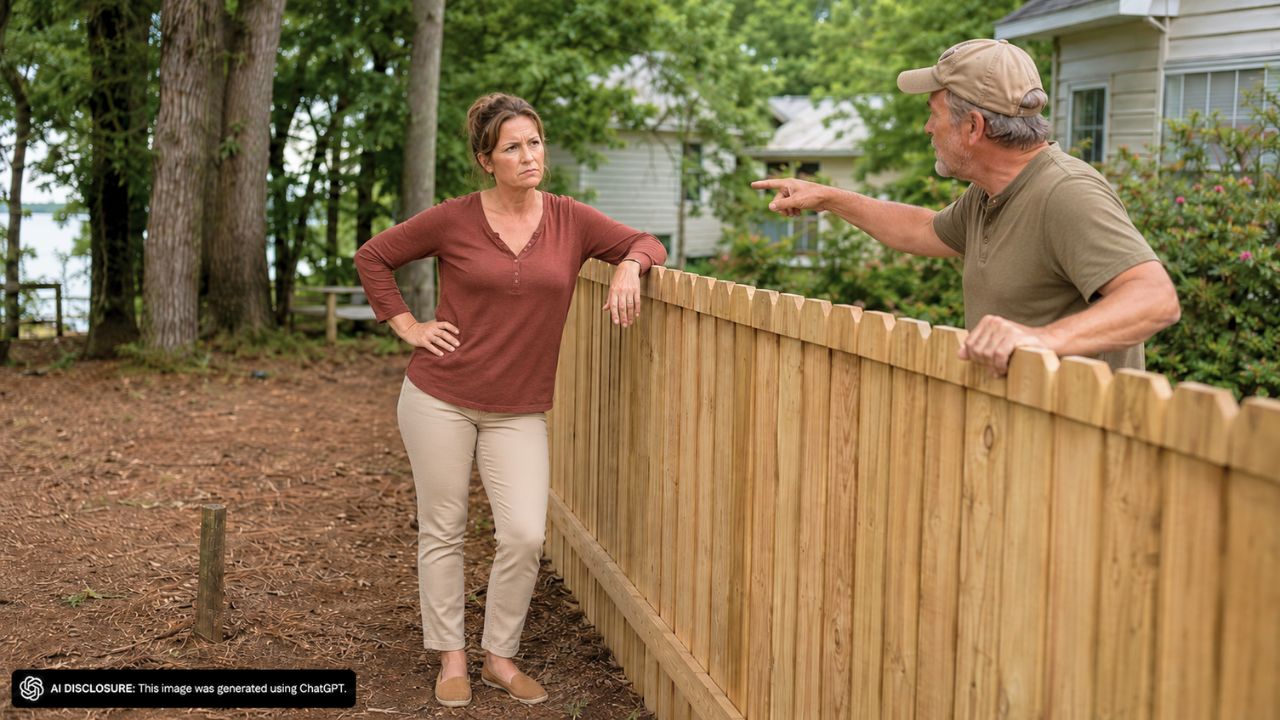
Photo credit: AI-generated image created using ChatGPT. Illustrative only.
Five months after buying her North Carolina home, a new homeowner thought she’d already handled the stressful part: she paid for a survey, then put up a fence so her dog could run free. The fence went up with the confidence that the line was right—until a neighbor came calling with a very different story and a not-so-subtle threat.
In the original post, the homeowner described how her neighbor claimed the fence was encroaching “anywhere from 1-5 feet” over the property line. The neighbor pointed to an old dock area, an older fence location from a prior owner, and a metal stake in the ground—details that would make anyone second-guess their own paperwork, especially when the neighbor has lived there for decades.
A fence, a fresh survey, and then the late-arriving complaint
The homeowner bought the house in June 2023 and did what many people wish they’d done before building anything permanent: she got a survey first. With that in hand, she installed a fence. Nothing fancy in the telling—just a normal, practical move to create a safe space for a dog and some peace in a new place.
Then, five months later, the neighbor challenged it. Not with documents right away, but with references to long-ago landmarks: an “old dock” where a previous owner once had a fence, plus a metal stake that the neighbor implied was the real boundary marker. If that stake was correct, the homeowner estimated her fence could be 3–4 feet on the neighbor’s side.
The neighbor said she would share her own survey. The homeowner suspected it might be much older than the one she recently paid for, but the bigger issue was the timing: the threatening tone showed up before the proof did.
When “we’ll be good neighbors” meets “property damage” talk
Property line disagreements can start as awkward and quickly turn ugly, and this one did not stay polite. The homeowner said the neighbor’s granddaughter escalated things by threatening “property damage” if the homeowner moved the fence back—despite the homeowner trying to de-escalate and stating she wanted to be good neighbors.
That detail changes the temperature. It’s one thing to argue over a few feet of yard when everyone is calm and comparing paperwork. It’s another when someone in the mix starts implying retaliation. For a new homeowner trying to settle in, that kind of talk doesn’t just raise legal questions—it raises safety and peace-of-mind questions.
Her immediate instinct was to do the normal, responsible thing: go back to the professional. She reached out to her surveyor and asked him to come resurvey the property line, and she asked the neighbor to be present so everyone could see the same thing at the same time.
The “eureka” moment: the measurement wasn’t from the foundation
Just when it looked like this might be headed straight into a standoff between two competing surveys, the homeowner had a realization that will sound painfully familiar to anyone who has ever measured for a project in their yard.
She went back and studied her survey again and realized she had been measuring 10.8 feet from her deck—not from her foundation. That detail mattered. Once she went outside and re-measured, she found she actually had “two more feet after my fence,” meaning the fence wasn’t where she initially feared it might be based on the dock-stake story.
And then came the twist that made the whole dispute feel less like an honest misunderstanding and more like a power play: she noticed the neighbors had built “a fancy new shed right on our property line.” The fence wasn’t the only new structure in the neighborhood. It was just the one getting questioned.
The shed becomes the new pressure point
After the re-measure, the homeowner did what plenty of people do when they feel boxed in: she went to the county. She stopped by County Zoning to ask what the rules were around that new shed.
What she learned only added to the tension. According to her update, the shed did not have permits and “may have built it on an area of land where they’re not allowed.” She didn’t describe the exact restriction or setback issue, but the implication was clear: the neighbor’s side might have its own exposure if officials started asking questions.
That’s the part of fence fights people don’t talk about at first. One structure gets challenged, and suddenly everyone’s looking at everything—sheds, setbacks, old stakes, who mows what, what’s been “that way for 20 years,” and what the county actually recognizes on paper.
The homeowner also mentioned she planned to install a new camera aimed toward the neighbors, framing it with a bit of holiday-season sarcasm: “it’s thanksgiving and I’m feeling generous.” Underneath that humor was the reality that she now felt the need to document what happens around her fence and yard.
How homeowners reacted: proof first, threats never
The post itself reads like a homeowner working through the same checklist many experienced property owners repeat: rely on your survey, document everything, and don’t get pushed into expensive changes based on someone else’s memories of where a dock used to be.
Even without a long comment section included in the source material, the direction of the discussion is easy to predict because the core problem is so common: someone makes a strong claim but hasn’t produced the paperwork yet. The homeowner ultimately landed on a firm boundary of her own—if the neighbor believes there’s an encroachment, the neighbor can pay for her own survey and bring evidence.
Her final update reflected that shift. She decided not to pay for her surveyor to come back immediately. In her words, the neighbor can pay for a survey, and “if I’m wrong, then and only then will I move my fence back.” Her reasoning was simple: “You shouldn’t threaten people without any proof.”
A quiet yard is the goal, but now it’s a paperwork war
This wasn’t a homeowner trying to pick a fight. The original goal was small and normal: a fence, a dog, and the ability to enjoy a new home without constant neighbor drama. But once the neighbor brought up an old stake and started talking about encroachment by several feet—then let a family member toss around “property damage”—the dispute stopped being about landscaping and started being about control.
Now, instead of just enjoying the yard, the homeowner is tracking measurements, watching the neighbor’s new shed, checking with zoning, and planning cameras. The fence is still there, but the feeling of safety that should come with it is what’s really being tested.
And in the meantime, the simplest question still hangs in the air: if the neighbor has a survey that proves the fence is over the line, why hasn’t she produced it yet?
Like Fix It Homestead’s content? Be sure to follow us.