Hunters Step Across the Corner Where Public and Private Land Meet Using a Ladder — Then the Ranch Owner Sues, Claiming a $9 Million Loss
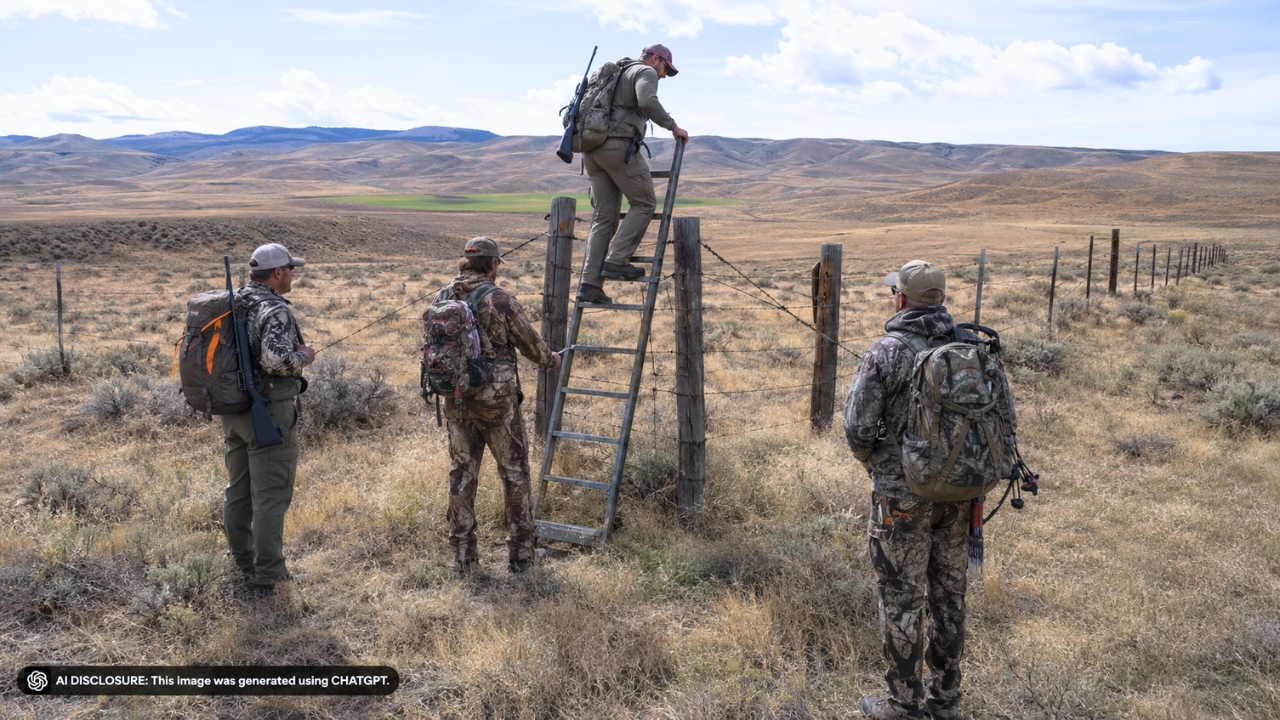
Photo credit: AI-generated image created using ChatGPT. Illustrative only.
Imagine looking out across your fence line and realizing strangers just “entered” the landlocked public ground next to you without ever opening a gate. No tire tracks. No cut fence. Just four hunters and a metal ladder at the exact spot where two public parcels touch two private parcels at a single point—one square corner.
That’s the real-world property-line headache at the center of a long-running Wyoming fight that just took a major turn. In the source post, Montana Free Press reports the U.S. Supreme Court declined to hear landowner Fred Eshelman’s appeal after he tried—and failed—to stick criminal and civil trespass claims on four Missouri hunters who used a specially built ladder to “corner cross” into public land during a 2021 trip.
Four corners, one ladder, and a very expensive argument
Corner crossing sounds like a technicality until you picture it on the ground. In a lot of the West, federal land and private land are laid out like a checkerboard—alternating square-mile sections that meet at corners. At those corner points, you can stand on one public square and see another public square diagonally touching it… but the two private squares also touch that same point.
The hunters’ move was simple and, depending on who you ask, either clever or infuriating: they used a ladder to step from one public corner to the other without physically touching the private land in between. Eshelman, a pharmaceutical executive who owns the private sections involved, pursued trespassing claims anyway and later argued the dispute had enormous reach across “roughly 300 million acres” of checkerboard land.
He also claimed a $9 million loss in the civil side of this fight—an eye-popping number that helps explain why this didn’t stay a neighborly disagreement about where boots can land.
How this ends up in court instead of being handled at the fence
Most property disputes start with a conversation at a gate or a note taped to a post. But checkerboard country doesn’t always give you that kind of clear “front door.” The access point is a mathematical dot, not a driveway.
In this case, none of Eshelman’s criminal or civil trespassing charges “stuck,” according to the report. That’s a big deal for landowners who see the corner as part of their control over access, and just as big for public-land hunters who see corner-locked acres as public land that’s effectively trapped.
The 10th Circuit Court of Appeals weighed in earlier this year. A three-judge panel said the lower court “was correct to hold that the Hunters could corner-cross as long as they did not physically touch” Eshelman’s land. That detail—physically touch—has become the line in the sand for a lot of folks following along.
The Supreme Court’s “no” leaves two different realities out West
The U.S. Supreme Court declining to take the case didn’t create one clean rule for everyone. It left the 10th Circuit’s approach standing in the states under that court: Wyoming, Colorado, Utah, Oklahoma, Kansas, and New Mexico. In those places, the decision keeps corner crossing legal under the conditions described by the court.
Elsewhere, it’s murkier. Montana Free Press notes that in states outside the 10th Circuit—including Montana—corner crossing remains in a legal gray area. That’s not an abstract warning, either. Montana alone has more than 900,000 acres of “corner-locked” land, meaning there’s a lot of ground where a single step can turn into a major dispute depending on who wants to push it.
Wyoming has even more corner-locked acreage than any other state, based on an analysis by OnX, the navigation-app company many hunters use to track land ownership and boundaries. That matters because the more corner-locked land you have, the more often these awkward “invisible doorway” corners show up.
For rural landowners, the fear isn’t just trespass—it’s control
If you’ve ever owned rural property, you know the stress isn’t always about damage. It’s about access. Who can show up, when, and whether you’ll even know they’re there. A ladder at a corner can feel like a workaround today and a steady stream tomorrow.
Landowners also worry about the practical stuff that comes after: gates left open, livestock spooked, fences blamed for things they didn’t do, and the nagging question of liability when somebody gets hurt near your boundary. Even when a person insists they never stepped on private ground, the worry is that you’ll still be the first call when something goes sideways.
On the other side, public-land hunters see corner crossing as a way to reach land that’s public on paper but boxed in by private ownership patterns. If those public sections can’t be legally accessed, they might as well not exist for regular people. That’s why this one ladder became such a big symbol.
The courts pointed at an 1885 law meant to stop “blocking off” public land
One reason this case drew so much attention is what the judges leaned on. The 10th Circuit judges referenced the Unlawful Inclosures Act, a federal law Congress passed in 1885 to bar landowners from obstructing access to public land.
That’s an old statute, but the problem is old, too: private ownership patterns and fencing decisions that can functionally wall off public acreage. The judges’ framing suggests the law isn’t just about literal fencing—it’s also about the effect of keeping people out of land the public is supposed to be able to reach.
Still, the ruling’s practical “do not touch private land” condition leaves plenty of room for real-life arguments at the corner. On uneven ground, with snow, mud, wind, and a loaded pack, the difference between “didn’t touch” and “might have touched” is the kind of thing that can turn into photos, GPS tracks, and a courtroom timeline.
How people are reacting: proof, paperwork, and watching the corners
When stories like this make the rounds, the most common reactions aren’t philosophical—they’re practical. Hunters talk about mapping apps, pinning exact corner coordinates, and documenting their approach so they can show they never crossed onto private soil. Landowners talk about watching those corners like they’d watch a shared driveway that keeps getting used as a turnaround.
The quiet subtext is that both sides are thinking like homeowners who’ve been burned before: if it’s not written down, if it’s not documented, you’re the one eating the time and legal costs. That’s how a property-line dispute becomes a lifestyle—cameras, boundary checks, and constant suspicion whenever someone parks on a county road nearby.
And the bigger tension doesn’t go away with the Supreme Court stepping aside. It just moves back to the ground level, where a single metal ladder at a single corner can trigger the same question every season: is this a clean step between public parcels, or is it trespass with better equipment?
The Supreme Court’s refusal to take the appeal locks in a win for corner crossing in the 10th Circuit, but it doesn’t magically smooth out the hard feelings that come with checkerboard ownership. Out in the wide-open places, property lines may be invisible—but they’re rarely imaginary, and they can still cost a fortune to fight over.
Like Fix It Homestead’s content? Be sure to follow us.
- Man Says He Found Out the Fence He Paid For Wasn’t Actually on His Property
- Woman Says Her Neighbor Started Taking Mulch From Her Delivery Pile Before She Could Even Spread It
- I made Joanna Gaines’s Friendsgiving casserole and here is what I would keep
- What Caliber Works Best for Groundhogs, Armadillos, and Other Digging Pests?