Homeowner Wakes to Find the Neighbor Pruned Holes Into a Privacy Hedge of Mature Spruces — Then Discovers It Was to Open Up a View of His New Shed
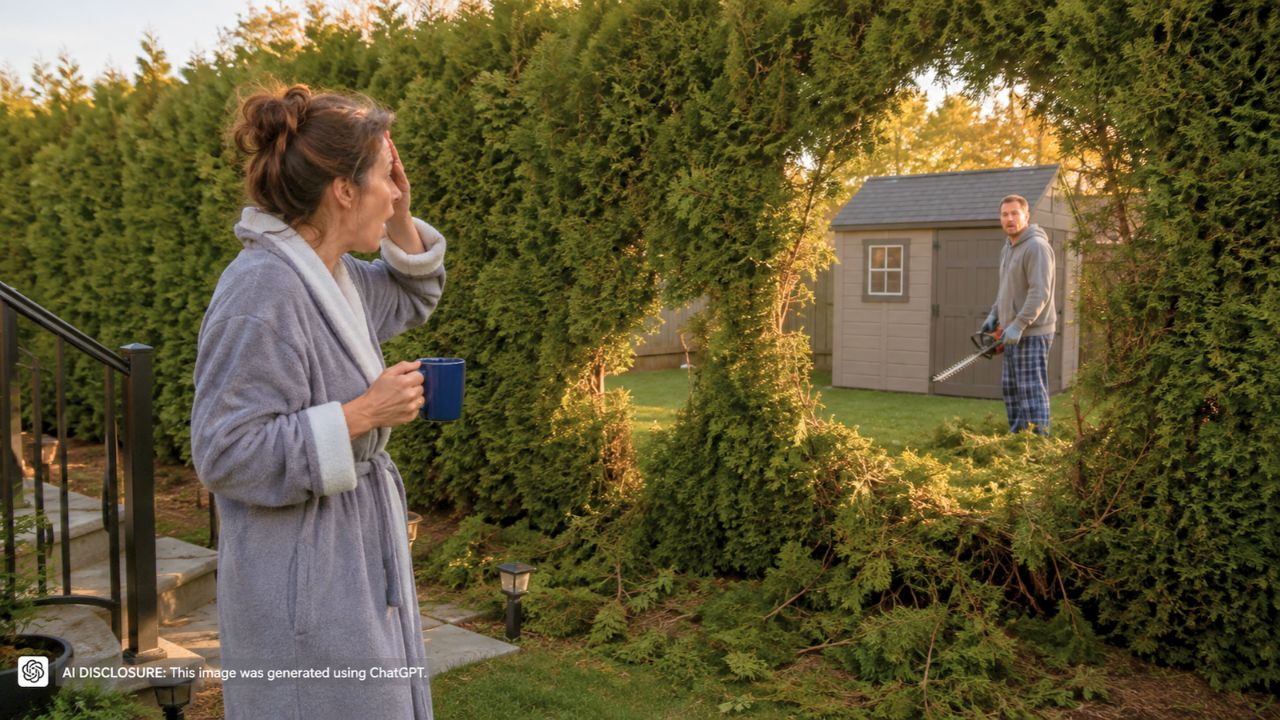
Photo credit: AI-generated image created using ChatGPT. Illustrative only.
It’s one thing to lose a little privacy when leaves drop in winter. It’s another to wake up and find someone has carved “windows” right through your living green wall—without asking, without warning, and apparently with a very specific goal in mind.
That’s what one homeowner says happened after a neighbor came onto their property and cut deep holes into a mature hedge of spruce-like evergreens. In the source post, the homeowner explains the hedge used to block the view between the properties. Now, thanks to aggressive pruning, they say they’re stuck looking straight at the neighbor’s newly built shed.
The morning the “privacy wall” suddenly had windows
The homeowner describes having a “beautiful mature hedge” of what they believe are Norway spruces, grown tight together like a natural fence. The kind of planting people choose specifically so they don’t have to stare at the neighbor’s stuff—sheds, clutter, whatever life looks like on the other side.
Then one day they noticed something was off: holes cut into the hedge. Not light trimming, not a neat edge along the property line—actual openings that changed what the hedge was doing in the first place.
The emotional whiplash is easy to picture. One day you have a green barrier; the next day there are gaps big enough that your eye goes straight through. And when you realize those gaps point right at a brand-new outbuilding next door, it stops feeling like “tree maintenance” and starts feeling personal.
Before saying a word, they paid for a survey
Instead of marching over and starting a shouting match, the homeowner says they spent money to get the property surveyed first. That detail matters, because so many neighbor disputes spiral when nobody can prove where the line actually is.
In their mind, the survey was step one: confirm ownership and boundaries before accusing anyone of trespassing or damage. Only after getting it surveyed did they consider approaching the neighbor about what happened.
And the timing stung. The homeowner says the pruning left them “stuck looking at this new shed” instead of the trees. In other words, the hedge didn’t just lose some branches—it lost its purpose.
The pruning wasn’t just ugly—it may have permanently changed the trees
Evergreen hedges can be unforgiving. The homeowner points out a problem many people don’t understand until they ruin a row of privacy trees: “pines are dead in the middle, the only green is on the ends.”
They say they regularly trim on their own side, but in a way that keeps the hedge functional—taking “a few feet off” so the limbs can naturally rise and still look full. What the neighbor allegedly did was different: cutting back “6–8 feet,” which can expose bare interior branches that may never fill back in.
That’s the part that turns this from an annoying weekend fix into a long-term property issue. A hedge with holes isn’t just less pretty—it’s less valuable as screening, less pleasant to live with, and harder to “repair” quickly without replacing trees entirely.
Now every “fix” comes with a cost
After the cuts, the homeowner is left staring at options that all feel like losing. They admit they’re tempted to cut the trees down and start over, which is a brutal thought when you’re talking about mature evergreens that took years to establish.
A fence seems like an obvious answer until you picture where it would go. The homeowner says putting a fence up would make them “lose about 20 feet” of their property unless they put it on the far side of the trees. Even then, the trade-off isn’t great: instead of looking at a green hedge, they’d be staring at a fence.
This is the practical side of neighbor property damage that doesn’t show up in casual conversations. It’s not just “a few branches.” It changes how you use your yard, what you see out your windows, and what your outdoor space feels like every day.
What people focused on: permission, property lines, and documentation
The homeowner’s big question is simple: what can they do legally, if anything? They feel backed into a corner because the hedge was part of the property’s livability—and now it’s been altered in a way they didn’t choose.
In disputes like this, people tend to zoom in on two key facts: whether the neighbor crossed onto the homeowner’s property, and whether the pruning went beyond what’s typically allowed from the neighbor’s side of a boundary. The homeowner’s choice to get a survey first reflects that same reality: the conversation goes very differently when you can point to a line that’s been verified.
There’s also an unspoken second layer: proving what the hedge looked like before. When a hedge is cut, it’s immediate, but the consequences stretch over years—gaps that don’t fill back in, brown interiors that stay brown, reshaping that can’t be undone. That’s why so many homeowners in similar disputes start gathering records fast: photos, dates, and any professional opinions about whether the trees can recover.
The neighborly “I would have helped” that makes it worse
One of the most telling parts of the homeowner’s account is how avoidable they believe this was. They say if the neighbor had asked, they would have helped trim the neighbor’s side and explained how these trees respond to pruning.
That line lands because it’s not about refusing cooperation—it’s about being denied the chance to cooperate. A five-minute conversation could have prevented holes in a decades-long privacy screen.
Instead, the homeowner is now weighing drastic options: living with the view of the shed, putting up a fence that changes the feel of the yard, or cutting down mature trees and starting over. And all of it stems from a decision someone else made with a saw, in a space that wasn’t theirs.
For homeowners, this is the nightmare version of “shared boundary” living: the thing you invested in for peace and privacy becomes the exact reason you’re now documenting property lines, pricing out replacements, and wondering how to fix a green wall that can’t simply grow back overnight.
Like Fix It Homestead’s content? Be sure to follow us.