New Owners of a Fourteen-Acre Kentucky Parcel Lock a Gate Across the Access Road — Then a Family Sues Because the Deed Reserved Their Cemetery
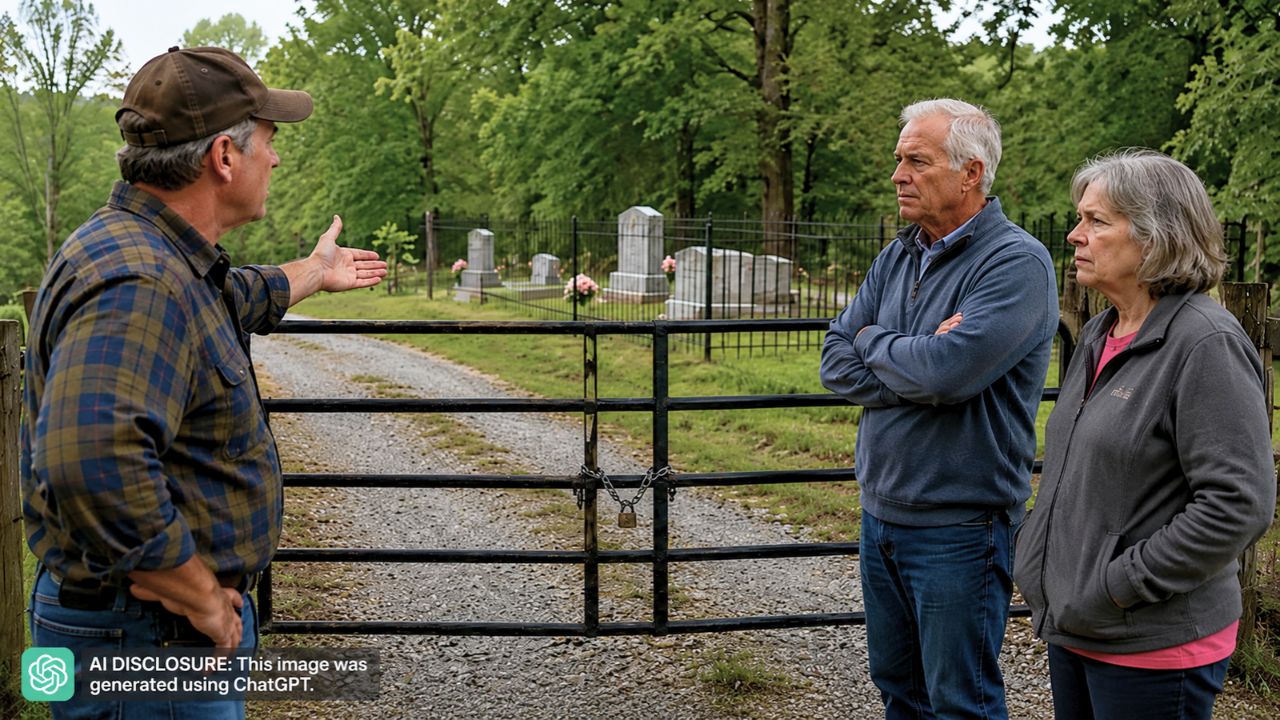
Photo credit: AI-generated image created using ChatGPT. Illustrative only.
Buying rural land is supposed to be the simple dream: a gate, a gravel road, some elbow room, and nobody telling you what to do. In Jackson County, Kentucky, that dream turned into a hard lesson about what you can’t “unbuy” when the land comes with a century-old family cemetery inside the fence line.
After Dana, Alyssia, and Kimberly Maddox bought a 14-acre tract in March 2023, they locked a gate across the access road leading to a small graveyard on the property. The family connected to those graves sued, and the courts ultimately sided with the cemetery family, saying access and burials could continue. The full appellate decision is laid out in the discussion.
A gate across a gravel road changed everything
The cemetery wasn’t a rumor or a half-forgotten corner with one weathered marker. The Brumagen, Abrams, Hayes Cemetery had burials dating back to at least 1912, and it was fenced off with a gravel road leading to it. Some living family members even had double headstones already set—markers placed for future burials beside spouses.
That’s the kind of detail that matters on rural land: it’s not just history, it’s ongoing use. People don’t put down stones for the future unless the family expects to keep coming back.
Not long after the purchase, the Maddoxes put up a locked gate across the access road and wouldn’t give the Brumagen family a key. A posted sign required visitors to request access 48 hours in advance. In the real world, that doesn’t just slow down Sunday flower visits—it complicates mowing days, repair days, and anything tied to funerals and burial equipment.
The deed wasn’t silent, and the survey drew a map
This wasn’t a handshake agreement or a “grandpa said we could.” The deed the Maddoxes received said the land transfer was “subject to that Cemetery, and the access road thereto.” A survey attached to the deed showed the fenced cemetery and the gravel road leading to it.
If you’ve ever bought property with a shared driveway, an old farm lane, or a utility easement, you already know what “subject to” feels like. You might own the dirt, but you don’t own the ability to block it off like it’s a private patio.
The Maddoxes argued they owned the cemetery and the surrounding property outright, and that any older ownership interest had been wiped out—pointing to a tax foreclosure years earlier and saying current family members had no deed, no written easement, no burial plot paperwork, and no document that entitled them to keep using it.
But the Brumagen family’s view was more basic: this place has been a family burial ground for generations, and you can’t buy the pasture around it and then treat the cemetery like a shed you can lock up.
Then the access fight turned physical
Once a gate goes up, the argument rarely stays theoretical. After a judge ordered the Maddoxes to provide a gate key, the Brumagens alleged that more obstacles showed up around the cemetery entrance: posts, logs, and rebar that made it hard to get in with the kind of gear people actually use to maintain a rural cemetery.
A small family graveyard doesn’t maintain itself. Someone has to bring a riding mower. Someone has to haul tools. And if there’s a burial, you’re talking about a hearse and equipment that doesn’t squeeze through a narrow, booby-trapped opening.
The Maddoxes, on the other hand, accused Bernie Brumagen of damaging their property by removing some of the barriers. That’s the ugly middle of rural property disputes: one side thinks they’re clearing access that was promised, the other thinks they’re tearing up private improvements.
Even if nobody intends it to, that kind of back-and-forth can escalate fast—because “access” isn’t an abstract right when there’s a locked gate between a family and their dead.
The real flashpoint: not just visiting, but future burials
Lots of landowners can wrap their head around allowing visits. It’s the future use that changes the temperature. The Maddoxes argued that even if prior owners had allowed burials in the past, that didn’t mean new owners had to allow it forever.
The Brumagens said the cemetery had been visibly and continuously used for generations, and Kentucky law protected more than just the right to stand at a headstone. During the litigation, the trial court issued emergency orders permitting additional family burials over the Maddoxes’ objections—an indicator that the court believed the right being fought over wasn’t merely sentimental, but legally real and time-sensitive.
That’s where a normal “neighbor easement” story turns into something heavier. Once burials are involved, the stakes aren’t just access for maintenance; it’s whether the cemetery remains a living family place or becomes a fenced relic controlled by whoever owns the surrounding acreage.
The courts drew a hard line around the cemetery rights
In April 2025, the Jackson Circuit Court granted summary judgment to the Brumagen family. The order permanently prohibited the Maddoxes from interfering with cemetery visitors and said the Brumagens, their heirs, and successors could continue burials, visitation, family gatherings, maintenance, and other activities consistent with cemetery use.
The order also barred the Maddoxes from erecting impediments along the cemetery boundary or access road. In other words: no more “technically you can enter, if you can fit a mower between the posts” solutions.
On appeal, the Kentucky Court of Appeals affirmed. The court leaned heavily on Kentucky common law traditions around old family cemeteries, explaining that when someone buys land knowing an established family cemetery is on it, ownership of the surrounding tract doesn’t grant unrestricted control over the cemetery.
The appeals court rejected the idea that future burial rights could exist only through a written easement or something like adverse possession. Under Kentucky common law, establishing a family burial ground can create an easement-like right for appropriate family members, including a continuing right of interment.
The deed language and survey didn’t hurt, either. The deed’s “subject to” reference to the cemetery and access road, paired with the recorded survey showing both, put the Maddoxes on notice that their purchase came with strings attached.
There was a dissenting judge who didn’t agree that the “subject to” language should be read as a perpetual right to future burials. But the majority opinion controlled, and the judgment for the Brumagen family stood.
How homeowners reacted: paperwork, surveys, and “don’t block the lane”
In homeowner circles, this kind of story tends to split people into two camps fast: the “my land is my land” camp and the “you can’t lock people out of their family cemetery” camp. But the practical crowd usually homes in on the same thing the court did—documentation and notice.
The detail that sticks is the survey attached to the deed, showing the fenced cemetery and the gravel access road. That’s the kind of paper that makes a gate lock feel less like a property-rights move and more like an unforced error.
And then there’s the mechanical reality: if access is supposed to exist, it has to function for real-world use. A cemetery isn’t maintained by walking in single file. Once obstacles start appearing—posts, logs, rebar—it stops looking like “security” and starts looking like interference.
The Maddoxes bought a quiet 14 acres. What they got instead was a reminder that rural land often comes with invisible neighbors: old rights, old paths, and family places that don’t go away just because the deed changed hands. A gate can mark a boundary, but in Kentucky, it can’t erase a cemetery that’s been there for generations.
Like Fix It Homestead’s content? Be sure to follow us.