Homeowner Holds Record Title to the Disputed Strip — Then a Judge Rules She Trespassed on Her Own Land and an Appeals Court Reverses
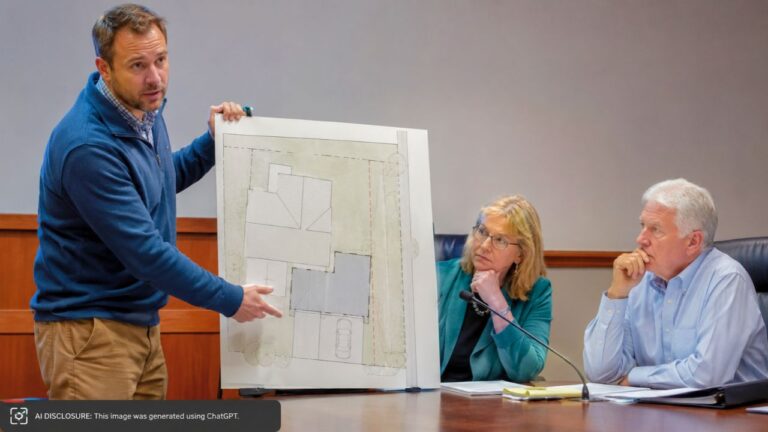
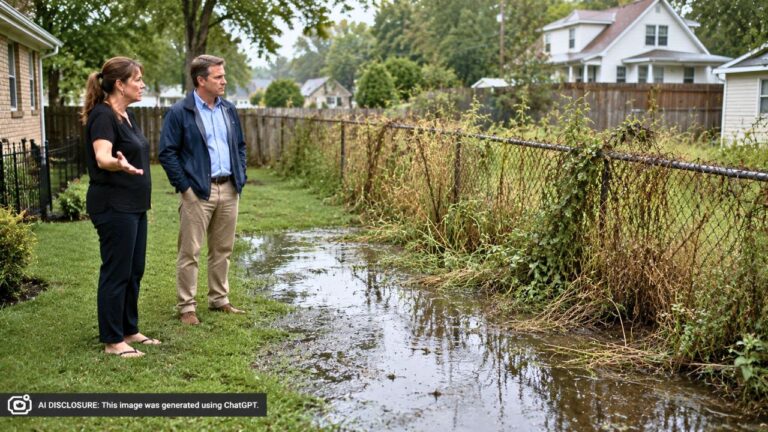
Photo credit: AI-generated image created using ChatGPT. Illustrative only.
Imagine moving into a new place, planning something simple like a fence for your dog, and finding out your neighbor’s “stuff” isn’t just close to the line — it’s over it. Not a flower bed, not a few inches. A shed and a whole compost enclosure sitting on your side.
That’s what happened to Lorraine Esposito in Branford, Connecticut, and it spiraled into a courtroom fight where a trial judge effectively treated her like the intruder on her own property — until an appellate court stepped in and reversed much of it. The details come from the discussion of Esposito v. Rabin.
It started with a fence plan and a boundary survey
Esposito bought her home at 71 Midwood Road in August 2021. Like a lot of homeowners, she wasn’t looking for drama — she wanted to put up a fence for her dog, Keno, and ordered a boundary survey first.
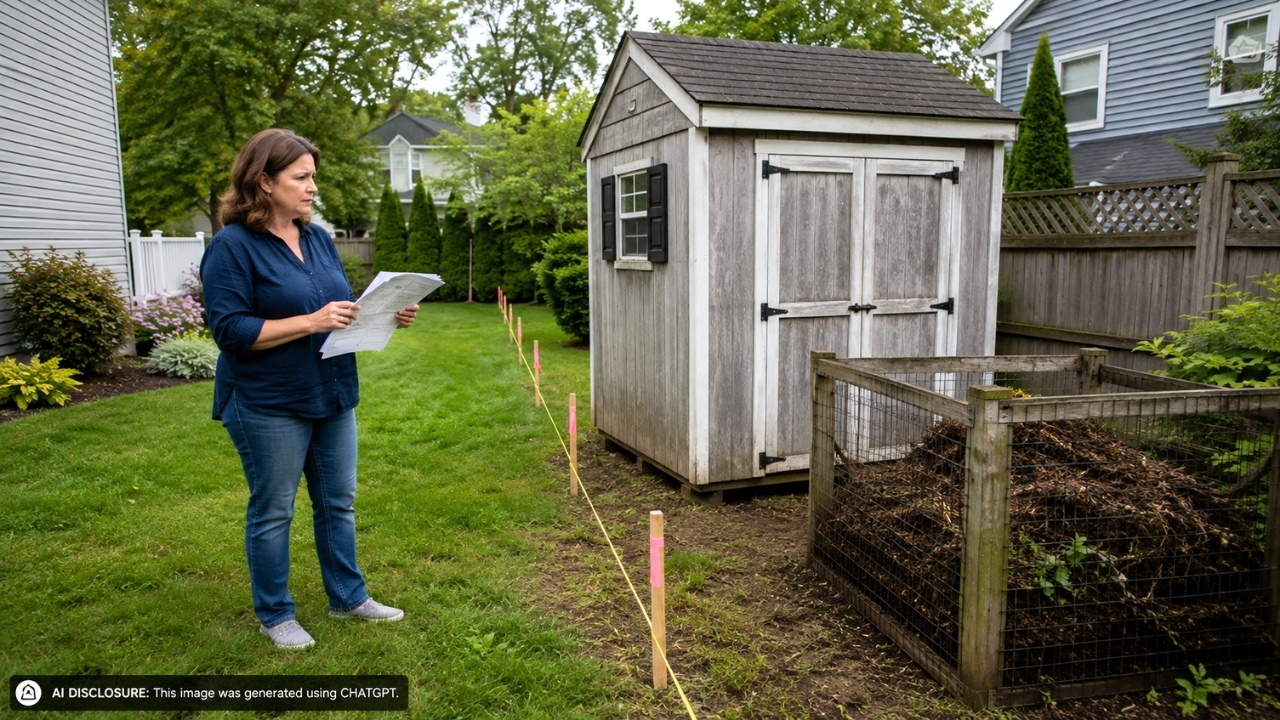
The survey didn’t just raise a question; it dropped a brick on the table. About 80% of the neighbors’ shed and 100% of their fenced compost corral were shown to be on Esposito’s property. Along with that came other claimed encroachments: a drainpipe, a buried wire, debris, and yard waste.
Instead of coming out swinging, Esposito initially told the neighbors they could “borrow” the strip temporarily, but she reserved the right to revoke that permission and require everything to be removed. That’s the kind of neighborly move many people make, thinking it will keep things calm while everyone figures out a longer-term fix.
The “borrowed” strip turned into a purchase offer — then a legal threat
Neighbor Daniel Rabin offered to buy the strip. Esposito said no. Then she found more debris and yard waste on her property and decided she was done waiting and ready to move forward with her fence.
When she told the Rabins they needed to relocate the shed, compost area, and anything else over the boundary, she didn’t get a “Okay, give us a timeline.” She got a lawyer letter. The Rabins’ attorney claimed the neighbors already owned the disputed property through adverse possession — basically, that they’d used it openly and continuously for long enough that it became theirs.
The claimed area itself seemed to shift. At first, their lawyer sent a map showing a triangular area Esposito estimated at about 2,500 square feet. Later, the Rabins identified a different claimed area measuring 1,202 square feet.
When proof got messy, the property line fight got mean
Esposito revoked permission for any use of her land, installed temporary fencing along the surveyed boundary, and filed suit in May 2023. She wasn’t just asking for a judge to scold the neighbors — she asked for damages, an injunction to remove encroachments, and a judgment confirming her title.
The Rabins counterclaimed. Daniel testified that his family had been using the disputed area since 1985, with a long list of uses and structures: play equipment, a stone wall, garden items, dog-related features, sheds, compost corral, an underground dog fence, and drainage pipe.
But once the case got into specifics, the timeline and the lines on paper didn’t sit neatly. Esposito produced 2008 aerial photos she said showed no shed or compost corral, and a 2013 property card didn’t list a shed. Daniel said a shed was there and pointed to a 2011 photo that he claimed showed it through bushes.
Even the neighbor’s survey work raised questions. According to the source material, the Rabins’ surveyor did not return to the property to establish the new boundary; instead, the line was drawn based on Daniel’s directions. That kind of detail matters, because these disputes live and die on what can be proven — not what “everyone has always known.”
The trial court’s ruling: nobody wins, but the homeowner loses anyway
The trial judge found the Rabins had not adversely possessed the entire disputed area for the required 15 years. Still, the judge concluded several individual encroachments — including the shed, compost corral, drainpipe, underground dog fence, and stone wall — had existed openly long enough to qualify for adverse possession.
Then came the head-scratcher. The trial court refused to quiet title in Esposito’s favor because of the neighbors’ supposed rights in those encroachments. But it also refused to quiet title in the Rabins’ favor because they didn’t provide an adequate legal description of what they claimed to own.
And it didn’t stop there. The judge ruled that Esposito trespassed by putting up fencing that interfered with access to the shed and other encroachments. She was ordered to remove fencing that blocked access.
The neighbors also won a nuisance claim tied to Esposito’s security cameras and motion-activated noisemakers. Esposito said the cameras were to document what was happening near the disputed strip, and the noisemakers — which made dog-barking and gunshot sounds — were used to deter coyotes, deer, foxes, and raccoons around her dog. The trial court barred her from pointing cameras toward the Rabins’ property and from using the noisemakers.
The appeals court: you can’t trespass on land you still own
The Connecticut Appellate Court dismantled most of that result. First, it said the trial court couldn’t just leave ownership unresolved. Esposito had record title, and the Rabins failed to establish a legally defined parcel they supposedly acquired by adverse possession.
The appeals court emphasized that adverse possession requires clear and convincing proof of the actual property claimed. If you can’t define it, you can’t take it.
So the appellate court ordered the lower court to quiet title to the disputed property in Esposito’s favor. That flipped the trespass logic too: if Esposito is the record owner, she can’t be a trespasser on her own property. The orders requiring her to remove her temporary fence or avoid interfering with the neighbors’ structures were reversed.
The court also held that the Rabins had trespassed on Esposito’s land. A key point in the source material: even after surveys commissioned years earlier showed they didn’t own the strip, they continued using it and maintaining the encroachments as if they did. The case was sent back for a hearing on what damages Esposito should receive and what injunctive relief should be imposed — meaning the question of what physically happens to that shed, compost corral, and other features is still very much on the table.
Reactions homeowners tend to have: “Survey first, document everything”
This is the kind of dispute that makes homeowners pick sides fast, mostly based on their own worst fear: buying a house and inheriting a boundary mess no one disclosed clearly. The practical-minded reaction is usually the same: get a real survey before you build, plant, or pour anything — and keep it in writing when you give “temporary permission,” because friendly accommodations can turn into claimed rights.
The other big homeowner takeaway people latch onto is documentation. Photos, old listings, aerial imagery, property cards, dated communications — they’re not just “nice to have” when a fence line turns into a lawsuit. In this case, the fight over whether a shed was present in 2008 versus 2011 wasn’t trivia; it went directly to the timeline needed for adverse possession.
The camera-and-noisemaker side of the story also feels familiar to anyone who’s lived too close to a property line dispute. Once you’re documenting movement near a boundary, everything starts getting interpreted as aggression. The appellate court tossed the nuisance ruling here because it said the trial court didn’t actually analyze whether there was an unreasonable interference, and there was no evidence establishing the necessary harm.
Esposito has her title affirmed, but the lived reality is what makes these cases drag on: a shed doesn’t move itself, and a compost enclosure doesn’t politely vanish because a judgment says it should. Now the case heads back for decisions on damages and what injunctive relief will require — the unglamorous part where “who owns what” turns into “who has to do what, and how soon.”
Like Fix It Homestead’s content? Be sure to follow us.