Montana Landowner Sues Claiming the Neighbors Obstructed the Platted Sixty-Foot Kelsey Lane Easement — Then the Court Awards the Neighbors Their Attorney Fees Instead
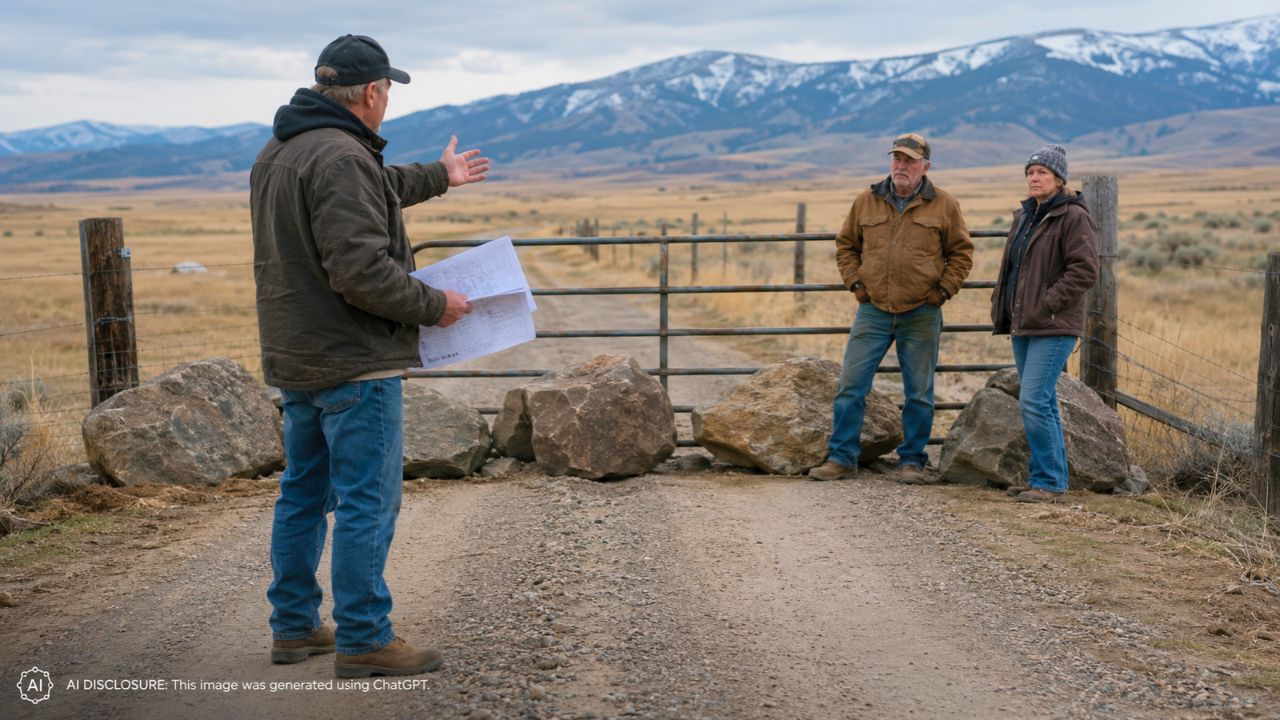
Photo credit: AI-generated image created using ChatGPT. Illustrative only.
It started the way a lot of shared-access fights start: somebody wants a fence, somebody else sees that fence as a future lock on the gate. In a Montana subdivision near Butte, that tension turned into a full-blown easement lawsuit—and the person who went to court to clear the way ended up watching the neighbors walk away with their access rights intact and a six-figure attorney-fee award.
The details are all laid out in the discussion of the Montana Supreme Court decision. The headline version is simple: a platted 60-foot private road easement existed on paper, a fence went up in the wrong place, and the legal fallout got expensive fast.
A road on paper, a loop on the ground, and a fence in the way
The properties were in Keck Acres subdivision, where a 1998 plat showed a “60’ Wide Unrestricted Private Road Easement for Ingress and Egress” called Kelsey Road/Kelsey Lane. Most of the route was paved, which is how these things often fade into the background—until you reach the part that isn’t. The southern loop, leading toward Lot 4, was left unimproved.
David Vicevich and Gillian Clark owned property containing much of that southern loop. Urban and Lucinda Kultgen owned Lot 4. And like a lot of rural-subdivision “roads,” this wasn’t a neat public street with curbs and clear edges—it was a recorded access corridor that people treated differently depending on whether they needed it that year.
Around 2018, Vicevich and Clark started discussing a fence along the boundary. The Kultgens pushed back, specifically resisting proposals that would eliminate or restrict the access they believed they had through that platted loop. That’s the key detail: this wasn’t just “where should the fence go,” it was “are you quietly taking away my way in.”
The moment it stopped being theoretical
By September 2019, the fence was built. And it wasn’t just close—it crossed the western leg of the easement and ran along the boundary in front of Lots 5 and 4. The record the Supreme Court worked from described it as completely blocking access from that side of the easement to Lot 4.
Anyone who’s lived through neighbor friction can recognize that shift. Once a fence goes up, it’s not a conversation anymore. It’s a physical “no,” visible every day, and it forces the other side to either live with it or escalate.
The Kultgens demanded removal in October 2020. But instead of pulling it back and sorting out the paperwork later, Vicevich went to court seeking a declaration that the southern loop easement had been abandoned.
“Nobody uses it” wasn’t enough to erase a recorded easement
The abandonment claim leaned on familiar arguments: the loop had never really been developed for vehicle traffic, it was overgrown in places, and vegetation and other objects had been allowed to remain in it. Vicevich also argued the Kultgens themselves acted as if the loop wasn’t needed.
The problem was Montana law doesn’t treat “infrequently used” as the same thing as “given up.” The Kultgens said they used the easement to reach Lot 4 and even for daily life stuff like walking their dogs. The record also included use by contractors, wood-delivery vehicles, garbage trucks, and other neighbors on portions of the loop.
More importantly, abandonment requires decisive conduct showing a clear intent to permanently surrender the right. An unpaved stretch of a platted road—especially in a place where people don’t pave everything—doesn’t automatically show that kind of intent. The Supreme Court rejected the abandonment theory.
The attempted “rewrite” that didn’t include the one neighbor who mattered
There was another twist that will feel familiar to anyone who’s watched a neighborhood try to “clean up” old documents. In 2021, several other property owners signed an agreement that supposedly replaced existing easements with a narrower 30-foot access route ending at Lot 5.
But the Kultgens never signed it. And that ended up being decisive. The Supreme Court said other landowners can create or modify rights among themselves—but they can’t take away or relocate the Kultgens’ existing property right without the Kultgens’ consent.
The recorded documents controlled the outcome. The Kultgens’ deed referred directly to the subdivision plat, and that plat expressly depicted the 60-foot easement. The court also noted that a later plat combining other lots expressly preserved existing easements rather than wiping them out.
The fence order got narrowed, but it still had to come down
Vicevich and Clark acknowledged the fence ran roughly an inch inside their own property line along the shared boundary. But that’s exactly where the easement sat, too. If you’re not used to easements, that’s the gut-punch: you can own the land and still not be allowed to block the corridor that runs across it.
The Supreme Court agreed the fence unreasonably interfered because it left no opening from the western leg of the easement to Lot 4. That meant removal of the fence, at least to the extent it blocked the easement access.
They did get one limited correction. The trial court’s original order required removal of “any obstructions” placed in the easement within five years of the lawsuit. The Supreme Court said that was too broad because the case hadn’t actually established what those other obstructions were. On remand, the judgment had to be rewritten to target the specific fence that was litigated.
But that narrow win didn’t change the real-world result: the easement survived, and the fence couldn’t stay where it blocked access to Lot 4.
The expensive surprise: losing meant paying the other side’s lawyers
The part that made this explode beyond a normal neighbor dispute was money—specifically, attorney fees. Recorded restrictive covenants prohibited fences and other obstructions on access easements and allowed the prevailing party in litigation to recover reasonable attorney fees.
The trial court awarded the Kultgens $106,209 in attorney fees after trimming their request by several thousand dollars. The Supreme Court upheld that entire award, finding it supported by billing records, testimony, and expert evidence about reasonableness.
And then it got worse for Vicevich and Clark: because the Kultgens remained the prevailing parties on the major issues, the Supreme Court also awarded additional attorney fees for the appeal, with the amount to be set by the trial court on remand. In other words, the meter kept running.
The reactions you hear every time: “Show me the plat” and “Don’t build first”
If you’ve spent time around property-line arguments, you can predict the practical reactions. People fixate on the documents—plats, deeds, and recorded covenants—because once a judge looks at a clean easement description, every informal “we’ve always done it this way” story gets a lot less powerful.
There’s also the classic warning that shows up any time someone fences near shared access: don’t build first and litigate later. A fence feels like a weekend project until it blocks someone’s recorded right-of-way, and then it becomes a court exhibit with consequences that can dwarf the cost of lumber and posts.
This case also highlights the risk of handshake neighborhood “updates.” Agreements can work when everyone signs, but they don’t magically erase the rights of the one property owner who refuses—especially when that right is recorded on a subdivision plat.
In the end, the subdivision still has the same 60-foot easement on the books, the fence that blocked access to Lot 4 has to be removed, and the legal bill landed heavily on the people who tried to treat that loop like it no longer mattered. The physical problem looked like a line of fence. The real problem was ignoring what the paperwork already promised the neighbor.
Like Fix It Homestead’s content? Be sure to follow us.